The short version
- Fire safety law does not cover your house. The Regulatory Reform (Fire Safety) Order 2005 excludes domestic premises, with limited exceptions for buildings of two or more dwellings.
- Electrical law does. Part P of the Building Regulations, and BS 7671, which gained a chapter on stationary secondary batteries in Amendment 4 (15 April 2026).
- PAS 63100:2024 is the UK fire-protection specification for home batteries — but it is not law, and not a direct MCS requirement.
- Cell failure is rare. What matters is whether the system is built and sited so one failed cell stays one failed cell.
Battery storage has gone from a curiosity to a normal line on a solar quote, and one question now comes up more than any other: is this thing going to set my house on fire? The honest answer has three parts. The risk is real but small; the rules governing it are less complete than most people assume; and the biggest single variable is the competence of whoever installs it.
The fire safety law you have read about probably does not apply to your house
Search fire safety duties in England and Wales and you land on the Regulatory Reform (Fire Safety) Order 2005, which requires a “suitable and sufficient assessment of the risks” (article 9) and adequate, periodically repeated fire safety training for employees (article 21). None of it reaches your home. Article 6 states that the Order “does not apply in relation to domestic premises, except to the extent mentioned in paragraph (1A) or article 31(10)”. A house occupied as a single private dwelling sits outside it: you have no legal duty to hold a fire risk assessment for your own home, battery or not.
That cuts both ways. If nobody is legally obliged to assess the fire risk of the battery on your garage wall, the quality of that judgement rests entirely on the installer’s design and on voluntary standards. It is an argument for asking harder questions, not fewer.
What does apply: Part P, BS 7671 and PAS 63100
A home battery is electrical work, and electrical work in a dwelling is regulated. Part P of the Building Regulations requires it to be safe, and Approved Document P sets out when work must be notified — self-certified by a competent person scheme member, or notified to building control before it starts.
BS 7671, the IET Wiring Regulations, is the standard the work is designed and tested against — not law, but the accepted route to showing compliance. The current version is BS 7671:2018+A4:2026, published 15 April 2026, and Amendment 4 added a new chapter on stationary secondary batteries. The previous version stays valid until 15 October 2026.
PAS 63100:2024 is written for this exact problem — Electrical installations. Protection against fire of battery energy storage systems for use in dwellings, published by BSI on 20 March 2024. It sets fire safety requirements for installing small-scale battery storage in homes, covering battery and fault management and where a system may be installed.
Its status matters. PAS 63100 is a publicly available specification, not legislation, and it is not a direct requirement of MCS’s battery standard — it reaches installers indirectly, through the IET Code of Practice, in “should” language rather than “shall”. A quote that says nothing about it breaks no rule. It also tells you very little. Ask.
What the lithium-ion risk actually is
The failure mode people worry about is thermal runaway: a cell fails, heats, drives exothermic reactions inside itself and generates more heat than it can shed. Once started it is hard to stop, it vents large volumes of toxic gas. A serious hazard, and why the standards exist.
The frequency gets left out. A review of domestic battery storage safety risks commissioned by the Office for Product Safety and Standards, published in 2020, put the internal failure rate for well-constructed 18650 cells at roughly one in ten million — which its worked example translated to a single cell failure in every 10,000 5kWh systems. It is explicit that this is not the same as one in 10,000 systems burning: a properly designed pack should contain a single cell failure without it propagating.
That is the whole engineering argument. The risk is not that a cell might fail; it is whether the pack, the battery management system and the installation are built so one failed cell stays one failed cell. That review predates both PAS 63100 and the BS 7671 amendment, so read it as scale rather than currency.
Where the battery goes is a design decision, not a convenience
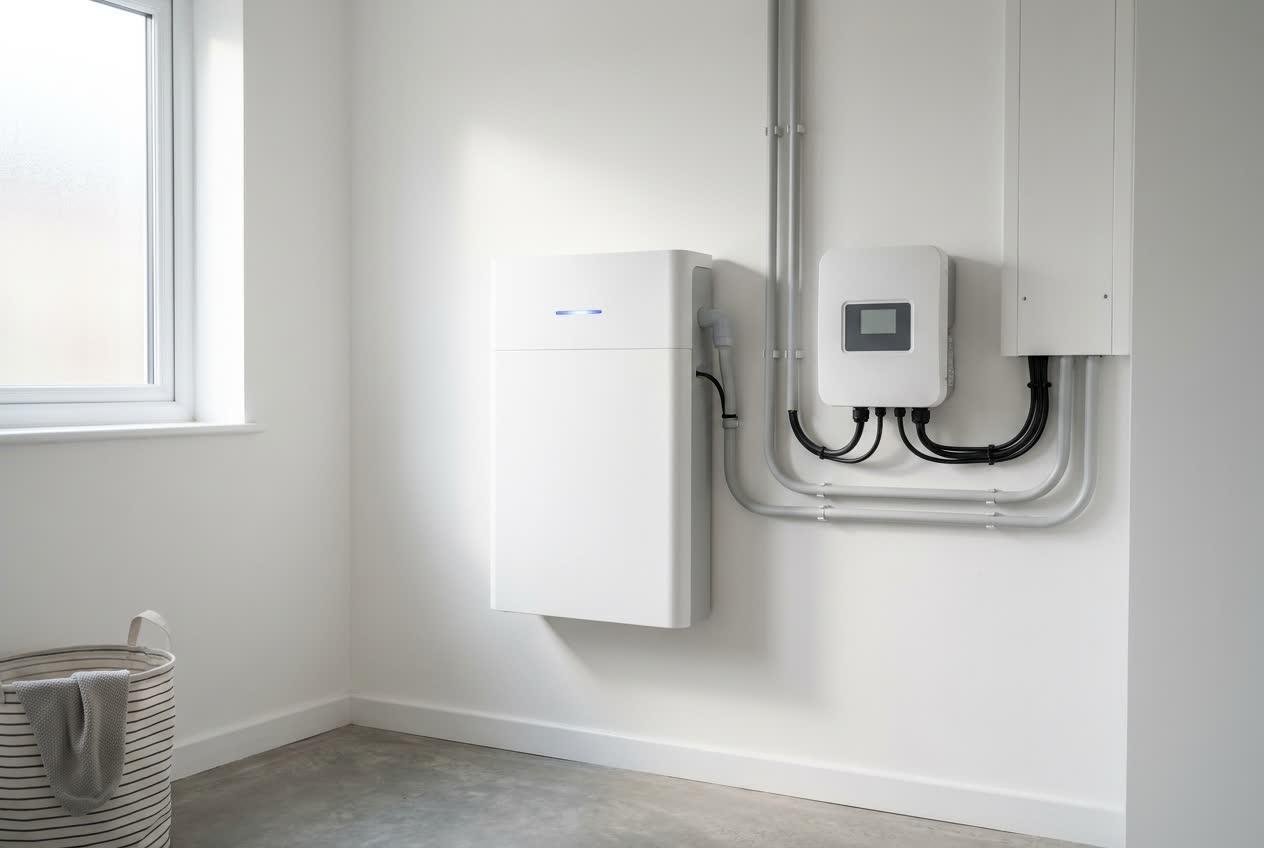
Siting is the part most likely to be settled by whatever is easy on the day, and it should not be. The questions are whether a fire could spread into the living space, whether it would block the way out, whether the unit stays in its temperature range year-round, and whether the fire service could reach it.
In practice that pushes towards a garage, an outbuilding or an external wall, and away from lofts, under-stair cupboards and anywhere on your route out. Ask what drove the choice: “shortest cable run” is an answer, but not a fire safety one. Ask about smoke detection near the battery too — it buys the only thing that matters in a thermal event, which is time.
If you live in a flat
The exclusion in article 6 is narrower than it looks. Where a building holds two or more sets of domestic premises, the Order does apply to the structure and external walls — cladding, balconies and windows included — and to flat entrance doors opening onto common parts, as the Fire Safety Act 2021 clarified after the Grenfell Tower Inquiry's first report. So a battery in a flat is not purely your own business: somebody holds a fire risk assessment for that building, and there will usually be lease terms too. Talk to them first.
Fire safety is a training question, not just a kit question
Everything above concerns the finished installation. During the install the risk is temporary but real, and it comes from the work: drilling and cutting, running cables through old fabric, working on live DC circuits from an array that cannot be switched off while the sun is on it. That is where fire safety becomes a training question rather than a specification. For a team working in an occupied home, the underpinning knowledge is specific:
- Fire safety awareness — how fires start and spread, and what to do in the first thirty seconds.
- Fire extinguisher awareness — which extinguisher suits which fire, and when not to fight one at all. A battery in thermal runaway is firmly in the get-out category.
- Fire warden and fire marshal — for work in buildings where other people are present.
- Electrical safety awareness — on a solar and battery job, the ignition source most likely to be created on the day.
- Risk assessment awareness — hazards, who could be harmed, proportionate controls, record, review. It ties the rest together, and it is the first thing dropped on a job running late.
These are awareness courses: underpinning knowledge, and dated certificates that can be checked. They do not replace the regulated electrical competence needed to design and certify the installation.
What to ask before you sign
- Where are you putting the battery, and why there? Listen for whether fire spread and escape routes come up unprompted.
- Does the design follow PAS 63100:2024? It is voluntary, so the answer may be no. You are testing whether they know what it is.
- Who notifies the work under Part P? A competent person scheme member self-certifying, or building control. There is no third option.
- What certification do I get at handover? An electrical installation certificate to BS 7671, at minimum. Ask for dated certificates rather than assurances, training records included.
- What happens if the battery faults? A specific answer about the battery management system, isolation and who to call — not reassurance.
Where ByEco stands
MCS and TrustMark certification is in progress for us, and until it is complete we say so plainly rather than let it be assumed. It matters here specifically: MCS publishes MIS 3012, the Battery Installation Standard, issued 1 January 2025 and mandatory for contractors certified to MCS:2025 — and we are not yet one of them.
The courses linked above are CPD-accredited online courses from Nexis CPD, an independent UK online CPD training provider and ByEco’s training partner. Regulated electrical competence is obtained separately, from approved awarding bodies, and always will be.
If you want a straight answer about siting, notification, or whether a battery is worth adding at all, ask us. We would rather talk you out of a bad installation than sell you one.
Sources
Every figure on this page was checked against primary sources on 1 September 2026. Grant rules and energy prices change — if you are reading this much later, verify before acting.
- Regulatory Reform (Fire Safety) Order 2005, article 6 — application to premises
- Regulatory Reform (Fire Safety) Order 2005, article 9 — risk assessment
- Regulatory Reform (Fire Safety) Order 2005, article 21 — training
- Fire Safety Act 2021
- GOV.UK — Approved Document P: electrical safety, dwellings
- BSI — PAS 63100:2024, protection against fire of battery energy storage systems for use in dwellings
- BSI — BS 7671:2018+A4:2026, the latest amendment to the wiring regulations
- IET — Amendment 4:2026 to BS 7671:2018
- GOV.UK — Domestic battery energy storage systems: a review of safety risks (OPSS, 2020)
- MCS — The Battery Installation Standard (MIS 3012)
Talk it through
Every home is different, and the honest answer to “is this worth it?” depends on your heat demand, your insulation and your tariff. Send us your postcode and we will give you a realistic figure rather than a hopeful one.