The short version
- A hybrid heat pump is a heat pump plus a boiler (usually gas) run by a single controller, either as two separate units or as one packaged unit.
- No Boiler Upgrade Scheme grant. GOV.UK: “You cannot get a grant for a hybrid heat pump system (for example a combination of gas boiler and air source heat pump).” A standalone heat pump can get £7,500.
- The controller switches on outdoor temperature or on price. In the government-funded Electrification of Heat trial, the heat pump supplied a median 40.4% of space heating in hybrids, and the boilers provided all the hot water.
- Keeping gas means keeping the gas standing charge: 29.68p a day under Ofgem’s October–December 2026 cap, about £108 a year at that rate.
- Installing a hybrid now can close the door on the grant later: Ofgem’s guidance excludes homes whose existing heating includes a heat pump providing space heating.
A heat pump with a gas boiler sounds like a neat compromise: low-carbon heat most of the time, with the boiler as back-up on the coldest days. Sometimes it is a sensible answer. But the grant rules, the standing charge and the trial data all point towards a standalone heat pump wherever one can be properly designed for the home.
What is a hybrid heat pump?
The Energy Saving Trust describes a hybrid as “a standard heat pump with another heat source, usually a gas, oil or LPG boiler”. It comes in two forms: bivalent systems, where a heat pump works alongside a separate boiler, and packaged systems, where the heat pump and boiler are a single unit.
What makes it a hybrid rather than two heating systems bolted together is the control. The MCS heat pump design standard says all the components “must be controlled by a single master controller” that can run them together or separately “depending on operating conditions and the selected control’s philosophy”. In the government trial described below, the separate-unit hybrids all used an outdoor air source heat pump, working as described in our guide to how an air source heat pump works.
A retrofit hybrid can keep your existing boiler or use a new one; in that trial, 139 of the separate-unit hybrids had a new boiler and 11 kept the old one.
Can you get a grant for a hybrid heat pump?
Not through the Boiler Upgrade Scheme, the £7,500 grant for air source heat pumps in England and Wales. GOV.UK is blunt: “You cannot get a grant for a hybrid heat pump system (for example a combination of gas boiler and air source heat pump).”
Ofgem’s installer guidance (version 5.1, the current version) spells out the detail:
- “Fossil fuel hybrids are not eligible.” That covers heat pumps installed alongside a separate fossil fuel boiler, including “retrofit hybrids”, and heat pumps with a built-in gas or oil boiler.
- A grant-funded system “must fully replace the property’s existing fossil fuel or electric heating system”. Back-up appliances are allowed only if “not fossil fuel based”, such as an immersion heater.
- A “hybrid-capable” heat pump installed on its own, with no fossil fuel appliance present, may be eligible.
The catch people miss. Ofgem’s guidance also says: “If the previous heating system includes a heat pump providing space heating, the property will not be eligible for BUS funding.” GOV.UK puts it as “You cannot get a grant to replace a low carbon heating system.” So under the current guidance, if you pay for a hybrid now and later decide to go fully electric, you should not expect the grant to help with that step.
Our Boiler Upgrade Scheme guide covers the full rules. Only an MCS-certified installer can apply for the grant on your behalf.
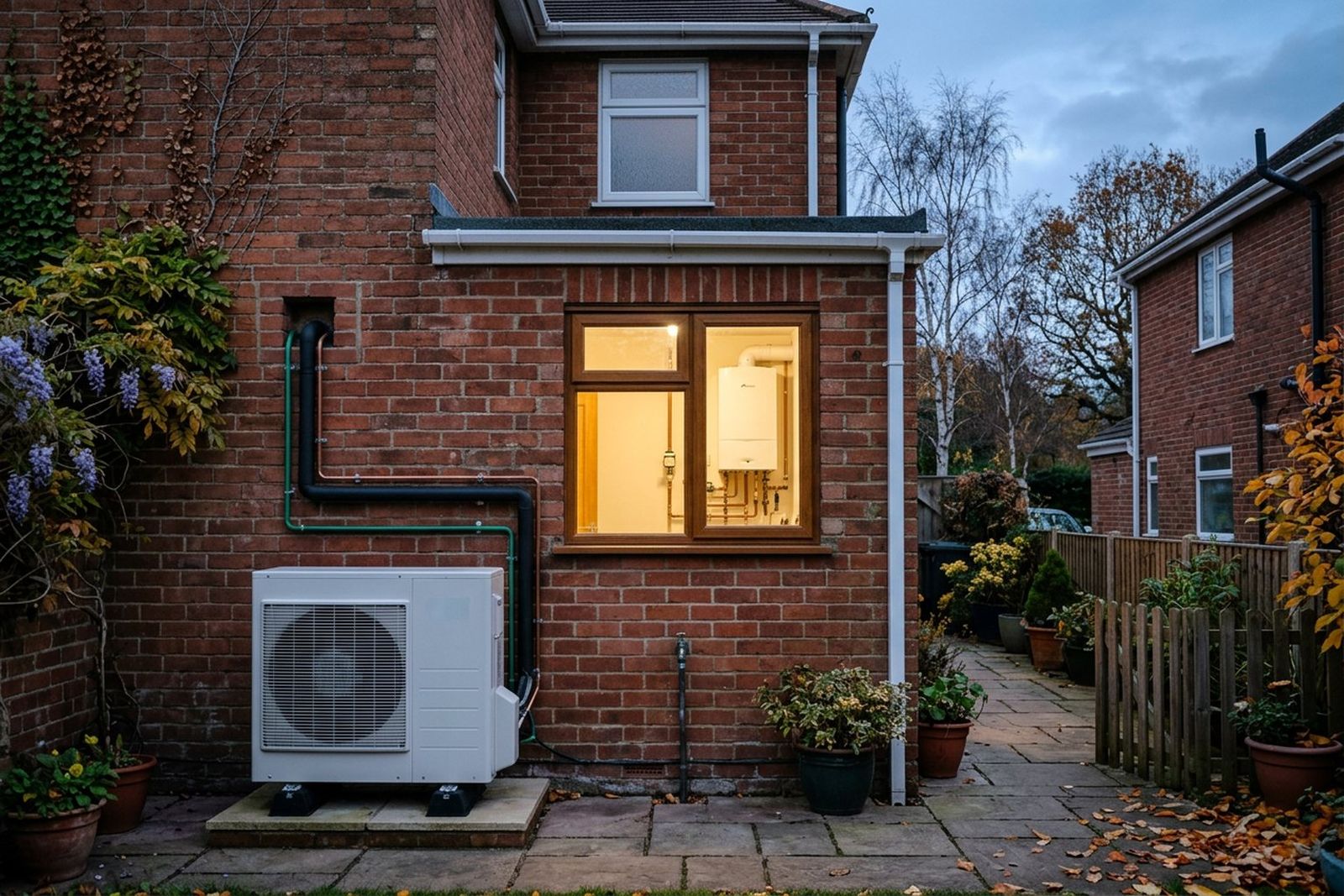
How a hybrid decides between heat pump and boiler
With two heat sources and one controller, a hybrid usually switches in one of two ways.
Switching on outdoor temperature
The installer sets a bivalence point, an outdoor temperature below which the boiler is brought in. As one example, Vaillant’s sensoCOMFORT control manual describes a heating bivalence point below which “the system control enables the back-up boiler to operate in parallel with the heat pump” (factory setting −5°C), and a separate “alternative point” below which it “switches the heat pump off and the back-up boiler meets the heat demand” (off by default). These are factory settings, not recommendations.
Switching on price
Other hybrids compare running costs. The same manual describes a tariff-based mode in which the control “uses the tariffs and the heat demand to calculate the costs for the back-up boiler and the heat pump” and runs whichever is cheaper; the manual warns that the tariffs must be entered correctly, otherwise costs can rise. The Energy Saving Trust says some hybrids also weigh time of day and solar generation.
The arithmetic behind price switching is simple. At Ofgem’s October–December 2026 cap, electricity is 26.32p per kWh and gas 7.97p, so electricity costs about 3.3 times as much. A boiler turns gas into heat at less than 100% efficiency, so the heat pump only needs to beat 3.3 multiplied by the boiler’s efficiency:
| Boiler efficiency (assumed) | Cost of heat from the boiler | Heat pump efficiency (COP) needed to match it |
|---|---|---|
| 76% | 10.5p / kWh | 2.5 |
| 84% | 9.5p / kWh | 2.8 |
| 92% | 8.7p / kWh | 3.0 |
Our arithmetic at the October–December 2026 price cap (GB average, Direct Debit), standing charges excluded. The 76–92% range is the boiler efficiencies assumed in the Electrification of Heat report’s illustrative table. The next cap period starts on 1 January 2027.
A cheaper off-peak or heat pump electricity tariff lowers the efficiency the heat pump needs, so it runs more of the time; dearer electricity pushes more work onto the boiler. Heat pump efficiency also falls as it gets colder and as flow temperatures rise (see do heat pumps work in cold weather?).
What MCS requires of the design
For an MCS-certified hybrid, the design standard requires that the heat pump can supply at least 55% of the calculated heat load, rated at a 55°C flow temperature at the design outdoor temperature, with all heat sources together covering 100%. The control philosophy “shall be capable of prioritising heat pump utilisation and shall be agreed with the end user”, and the contract must state what proportion of your space heating and hot water the heat pump is designed to provide. A standalone heat pump must cover the whole load itself (see what size heat pump do I need?).
How hybrids performed in the government’s field trial
The Electrification of Heat project, funded by the Department for Energy Security and Net Zero (DESNZ), installed 742 heat pump systems, 155 of them hybrids. Its December 2024 report found:
- The hybrids were set up to run “cost-optimally”, with the boiler taking over below a set outdoor temperature. The separate boilers were all sized to meet the full heating load.
- The heat pump supplied a median 40.4% of space heating output across the 94 hybrids with a full year of data (middle half of homes: 29.7% to 55.5%). The boilers provided all of the hot water.
- The heat pumps inside hybrids ran at a median seasonal efficiency of 2.50, against 2.78 for standalone air source heat pumps on the same measure (the boiler is left out of the hybrid figure).
- The report notes “a portion of the hybrids installed through this project experienced control issues”, which meant some may have used their boilers more than designed. Set-up matters: the higher the switch-over temperature, the more of the heating falls to the boiler.
Hybrid heat pump running costs and carbon
There is no single running-cost figure for a hybrid: it depends on the heat pump–boiler split, your tariffs and the set-up. Three things are clear.
- You keep the gas standing charge. At Ofgem’s October–December 2026 cap, that is 29.68p a day: 29.68p × 365 = £108.33 a year if the rate stayed the same all year (it is reviewed every three months). You pay the electricity standing charge either way. Going fully electric removes the gas charge only if you have the gas disconnected, so nothing else, such as a gas hob, can still need it.
- Price-switching limits the downside. The Energy Saving Trust says a hybrid that reacts to fuel prices “should mean the boiler only turns on when it’s cheaper to run than the heat pump”, which should lower running costs compared with either appliance on its own.
- Tariffs can flip the answer. The Energy Saving Trust notes a heat pump time-of-use tariff “might make a standard heat pump cheaper to run than a hybrid”.
For like-for-like arithmetic against a gas boiler, see heat pump vs gas boiler running costs. On carbon, every unit of heat from the boiler comes from burning gas or oil, so a hybrid cuts emissions less than a standalone heat pump. DESNZ says a hybrid’s carbon intensity depends on factors including the flow temperature, the fuel the boiler burns, the relative fuel costs and “the proportion of heating delivered by the heat pump”.
What the government has said about hybrids
- No final decision. In its March 2024 response on boiler standards, the government said “No decision has been taken on whether hybrids should have a significant widespread role in heat decarbonisation” and that it was “taking a pragmatic, market-led approach to hybrids”. It proposed a minimum efficiency standard for hybrids. A follow-up consultation on product standards, which closed in March 2025, sought views on one; no outcome has been published.
- Half credit in the industry scheme. The Clean Heat Market Mechanism Regulations 2025 set low-carbon heat targets for large suppliers of gas and oil boilers (broadly, those selling at least 20,000 gas or 1,000 oil boilers a year). For each hybrid heat pump installed, its supplier earns “half a certificate”, against a full certificate for a standalone heat pump.
- Long-term fuel question. A November 2025 DESNZ consultation, discussing off-gas-grid hybrids such as an oil boiler with a heat pump, said that “If the hybrid should need to remain in the long term, the fuel used by the boiler element of the hybrid system would need to be net zero-compliant”. That consultation closed on 10 February 2026 and the government has not yet published its response.
Hybrid vs air source heat pump: who each suits
| Hybrid (heat pump + gas boiler) | Standalone air source heat pump | |
|---|---|---|
| Boiler Upgrade Scheme grant | Not eligible | £7,500 if eligible |
| Gas standing charge | Still paid | Can be removed if nothing else uses gas |
| Heat pump sizing (MCS) | At least 55% of the heat load, rated at 55°C flow | The whole heat load |
| Carbon | Partly still gas | All electric |
| Main risk | Boiler doing most of the work | Poor design pushing up running costs |
A hybrid can be worth considering if a standalone heat pump is not practical yet, for example a large home with a high heat demand where insulation is impractical or too expensive, or where an installer can show in writing that a standalone system would not lower your bills.
Price a standalone heat pump first if your home can be heated by one with sensible radiator upgrades: unlike a hybrid, it can get the £7,500 grant, and it lets you drop the gas standing charge if nothing else uses gas. See do I need new radiators for a heat pump?, heat pump pros and cons and our heat pump cost guide.
What to ask an installer, and where ByEco stands
- Why a hybrid rather than a standalone heat pump, and what would a standalone design need?
- What share of space heating and hot water is the heat pump designed to provide? (MCS requires this in the contract.)
- Will the controls switch on outdoor temperature or on price, and what bivalence point or tariffs will be set?
- What running costs do you expect, and what efficiency and fuel-price assumptions sit behind them? The Energy Saving Trust says your installer should provide both.
- How will hot water be provided, and by which appliance?
- Have you priced the standalone option with the £7,500 grant for comparison?
ByEco installs air source heat pumps and solar panels, so weigh our view with that in mind. Our MCS and TrustMark certification is in progress, so we cannot yet apply for the Boiler Upgrade Scheme grant for you. If you are weighing a hybrid against a standalone heat pump, get in touch and we will tell you honestly what a standalone design would involve in your home.
Sources
Every figure on this page was checked against primary sources on 8 October 2026. Grant rules, planning rules and prices change — if you are reading this much later, verify before acting.
- GOV.UK — Apply for the Boiler Upgrade Scheme: what you can get
- GOV.UK — Apply for the Boiler Upgrade Scheme: check if you’re eligible
- Ofgem — Boiler Upgrade Scheme guidance for installers V5.1
- Energy Saving Trust — Hybrid heat pumps (last updated 16 July 2026)
- MCS — MIS 3005-D:2025 The Heat Pump Design Standard, Issue 2.0 (5 December 2025)
- Energy Systems Catapult for DESNZ — Electrification of Heat Demonstration Project: Heat Pump Performance Data Analysis Report (December 2024)
- Vaillant — sensoCOMFORT VRC 720/3 operating and installation instructions
- Ofgem — Energy price cap: 1 October to 31 December 2026
- DESNZ — Improving boiler standards and efficiency: government response (March 2024)
- legislation.gov.uk — The Clean Heat Market Mechanism Regulations 2025
- DESNZ — Exploring the role of alternative clean heating solutions (consultation, closed 10 February 2026)
Get a figure for your house
National averages only get you so far. Send us your postcode and a little about your home, and we will come back with a realistic price and an honest view on whether a heat pump suits it.