The short version
- Falls from height were the largest single kind of fatal workplace accident in Great Britain in 2025/26 — 31 of 126 worker deaths. Construction was the worst-affected sector, with 25.
- Asbestos awareness is a legal requirement for anyone whose work could foreseeably disturb it, under the Control of Asbestos Regulations 2012. It does not authorise anyone to remove it.
- Refrigerant work is a regulated qualification, not an awareness course. Awareness training complements F Gas certification; it never replaces it.
- None of this is visible on a quote. You have to ask.
Installing heat pumps and solar means working at height, moving heavy and awkward loads, opening up older properties, and dealing with live electrical systems and refrigerants. Every one of those carries a real risk, and every one is covered by health and safety law in England and Wales.
Homeowners almost never ask about it. Quotes get compared on price, brand and lead time, and the question of who is actually coming to the house goes unasked. This article sets out what a competent install team should have behind it, and why that matters to you and not just to them.
Working at height is the biggest single risk
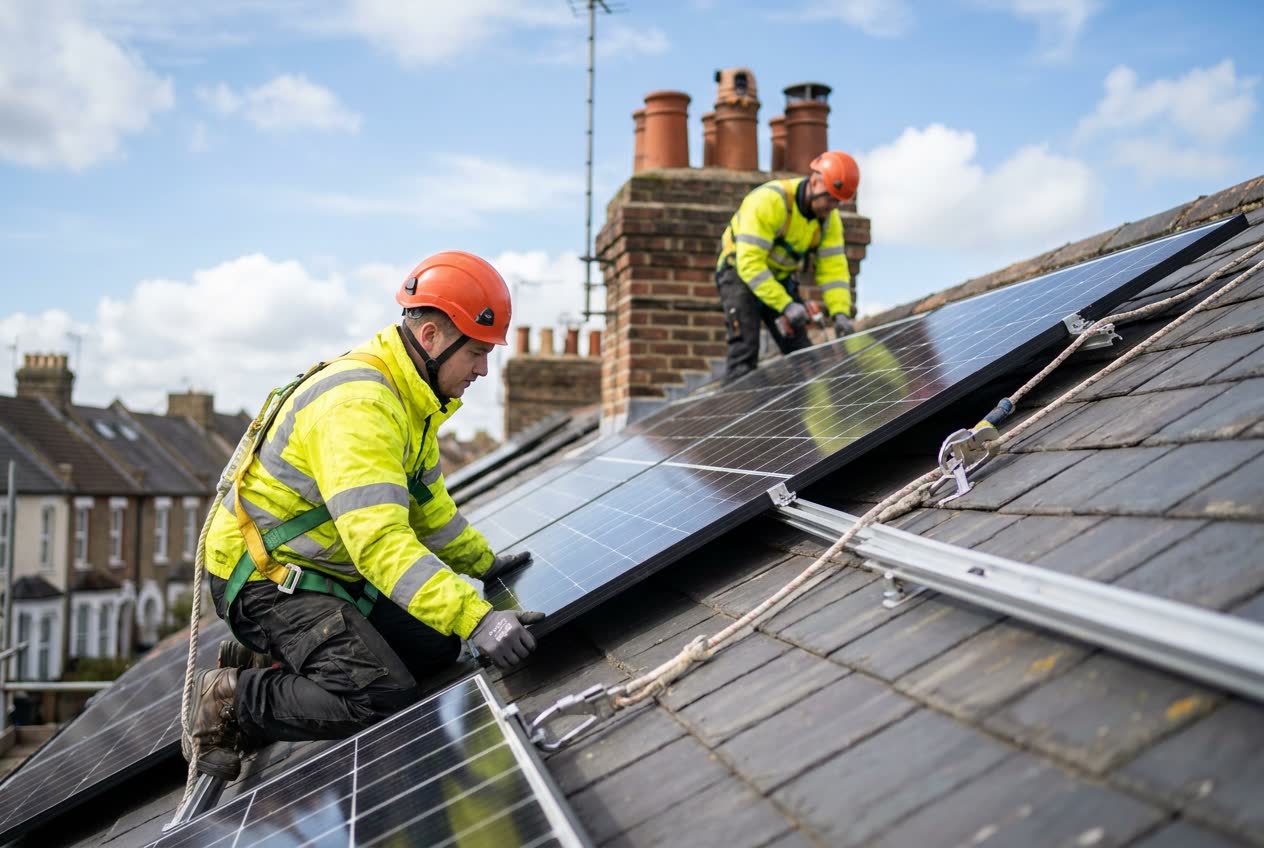
Solar panels go on roofs. Heat pump pipework, condensate runs and flues often mean ladders, towers or scaffold. This is not a theoretical hazard: HSE's provisional figures for 2025/26 record 126 workers killed in work-related accidents in Great Britain, of which 31 were falls from a height — more than any other kind of accident. Construction accounted for 25 worker deaths, more than any other industry.
The Work at Height Regulations 2005 do not ban working at height. They require it to be properly planned, supervised and carried out by competent people, and they set a hierarchy: avoid work at height where you can, prevent falls where you cannot avoid it, and minimise the distance and consequences of a fall where a risk remains.
In practice that means a team that knows how to select and inspect access equipment, when scaffold or a tower is the right answer, and — the point people get wrong most often — when a ladder is not. Underpinning knowledge courses such as working at height awareness and ladder safety awareness cover that ground before anyone leaves the floor. They are awareness training, not a substitute for site-specific planning or for practical scaffold competence — but they are the foundation the rest sits on.
Asbestos is the hidden risk in older homes
Britain's housing stock is old. Asbestos was not banned outright here until 1999, so Victorian terraces modernised in the seventies, thirties semis and post-war housing may all contain asbestos-containing materials — in soffits, textured coatings, floor tiles, cement sheet, and around old boilers and flues. Retrofit is exactly the work that disturbs them: drilling through a wall for refrigerant pipework, lifting floorboards, pulling out an old airing cupboard, fixing solar roof hooks near a soffit.
Under Regulation 10 of the Control of Asbestos Regulations 2012, anyone whose work could foreseeably disturb asbestos must have suitable information, instruction and training. HSE is explicit that asbestos awareness training exists so that workers can avoid disturbing asbestos — it will not prepare anyone to carry out work with asbestos-containing materials, and it is nowhere near sufficient for licensable work.
Worth being blunt about this. Asbestos awareness (Category A) training teaches an installer to recognise likely asbestos, stop, and get the right people in. It does not authorise anyone to remove asbestos, and any installer who suggests otherwise is telling you something that is not true. If asbestos is found in your home mid-install, the correct outcome is that work stops and a licensed contractor is brought in — not that someone presses on.
Heat pump units and panels are heavy
A monobloc air source unit, a 210-litre unvented cylinder, a pallet of framed panels: heavy, awkward loads, usually moved through a side gate, up a loft ladder or across a roof. Musculoskeletal injuries from poor handling never reach the fatality statistics, but they end careers early.
The Manual Handling Operations Regulations 1992 use the same shape of hierarchy as work at height: avoid hazardous manual handling where reasonably practicable, assess what cannot be avoided, and reduce the risk. Manual handling awareness covers that, along with team lifting and why how far a load is held from the body matters as much as what it weighs.
Risk assessment is the thread that ties it together
Every install is a different site. A different roof pitch, a different loft hatch, a different set of neighbours, a different guess at what is behind the plasterboard. Under Regulation 3 of the Management of Health and Safety at Work Regulations 1999, employers must make a suitable and sufficient assessment of the risks — and that means this job, not last week's.
Understanding how a risk assessment actually works — identify the hazards, decide who could be harmed, put proportionate controls in place, record it, review it — is what turns a set of individual competencies into a safe way of working. It is also the part most likely to be skipped on a job that is running late.
Refrigerants and electricity: where awareness training stops
Heat pumps contain refrigerant and solar arrays are live DC systems. Both need real qualifications, and it is worth being clear where CPD awareness training ends. Working on a refrigerant circuit is a regulated qualification, obtained separately from an approved awarding body. GOV.UK puts it plainly: it is against the law to work with F gas without the correct qualification. The relevant certificate for refrigeration, air conditioning and heat pump equipment (commonly referenced by its City & Guilds scheme number, 2079) is issued by approved awarding organisations — City & Guilds, BESA and LCL Awards among them. No CPD awareness course replaces it. Awareness training complements specialist competence; it does not stand in for it. The same applies to electrical competence and to having a trained first-aider on site.
Doing the work cleanly
Retrofit is about cutting carbon, which makes it worse, not better, when the work itself is done messily. Environmental awareness for construction workers covers duty of care for waste, pollution prevention and site housekeeping. It is the least dramatic item on this list and the one you are most likely to notice from your kitchen window.
What to actually ask an installer
Four questions, none of which should be difficult to answer:
- Who is coming to my house — employed, or subcontracted? Either can be fine. Vagueness is the warning sign.
- What is your access plan for my roof? A team that has thought about it will describe scaffold or a tower, not say “we'll be fine with ladders”.
- Does everyone on site hold current asbestos awareness training? It is a legal requirement, and the certificates are dated.
- Who holds the F Gas qualification, and what category? Ask to see it.
Ask for certificates rather than assurances. Training certificates carry dates and issuing bodies, and a firm that takes it seriously will not mind being asked.
Where ByEco stands
The awareness courses linked above are CPD-accredited online courses from Nexis CPD, an independent UK online CPD training provider and ByEco's training partner. They build underpinning health and safety knowledge and issue dated certificates that can be checked. Regulated qualifications — F Gas being the obvious one — are obtained separately from an approved awarding body, and always will be.
We are also going through MCS and TrustMark certification, which brings its own audited requirements around competence and safe working. Until that is complete we will say so plainly — the same way we would rather tell you what training does not cover than let you assume it covers everything.
Sources
Every figure on this page was checked against primary sources on 30 August 2026. Grant rules and energy prices change — if you are reading this much later, verify before acting.
- HSE — Work-related fatal injuries in Great Britain (2025/26, provisional)
- The Work at Height Regulations 2005
- The Control of Asbestos Regulations 2012
- HSE — Asbestos: information, instruction and training
- The Manual Handling Operations Regulations 1992
- Management of Health and Safety at Work Regulations 1999, regulation 3
- GOV.UK — Qualifications to work with F gas
Talk it through
Every home is different, and the honest answer to “is this worth it?” depends on your heat demand, your insulation and your tariff. Send us your postcode and we will give you a realistic figure rather than a hopeful one.