The short version
- The Boiler Upgrade Scheme gives £7,500 towards an air source heat pump in England and Wales. It is a grant, not a loan, and GOV.UK sets no income test.
- A typical ByEco air source installation is around £7,000, so in many cases the grant may cover the full installation. Every home is different, so your price comes from a survey of your home. ByEco’s MCS certification is in progress, so we cannot claim the grant for you yet.
- To qualify you must own the property and be replacing fossil fuel or electric heating. Your installer must be MCS certified, applies for you and takes the grant off your quote.
- Some lower-income households may get a heat pump fully funded through the Warm Homes: Local Grant (England, via councils, with its own version in Greater Manchester) or the Nest scheme (Wales). Councils, GMCA and the Welsh Government run these, not installers.
- Be wary of anyone who cold calls offering a “free heat pump”. Check the scheme yourself first.
If you have searched for a “free heat pump”, this guide sets out when a heat pump may cost you nothing, when it probably will not, and how to check which group you are in before anyone visits your home.
Can you get a heat pump at no cost?
You may, in England and Wales, if your quote comes in at or under the grant. The Boiler Upgrade Scheme (BUS) pays £7,500 towards an air source heat pump and your installer takes it off the price before you pay, so with a quote of £7,500 or less you may have nothing left to pay. Above that, you pay the difference.
A typical ByEco air source heat pump installation is around £7,000, so in many cases the £7,500 grant may cover the full installation. ByEco’s MCS certification is in progress, so we cannot claim the grant for you yet (more below).
What decides the cost of your installation
Every home is different, so there is no single price. The cost of your installation depends on:
- The size of system your home needs. A room-by-room heat loss calculation sets how powerful the heat pump has to be, so a bigger or draughtier house needs a larger unit.
- Your radiators. Some rooms may need a larger radiator to stay warm at heat pump temperatures, while others can stay as they are. Our guide to whether you need new radiators explains how that is decided.
- Your pipework. Whether the existing pipes can be reused or some need upgrading.
- Where the outdoor unit goes. How far it sits from where the pipes enter the house, and how straightforward that route is.
- Hot water and electrics. How your hot water will be provided, and whether any electrical work is needed.
That is why the only way to know your figure is a survey. Get in touch and we will arrange a free survey of your home, explain what your system needs and give you an itemised quote. If you are happy with it, we can go ahead.
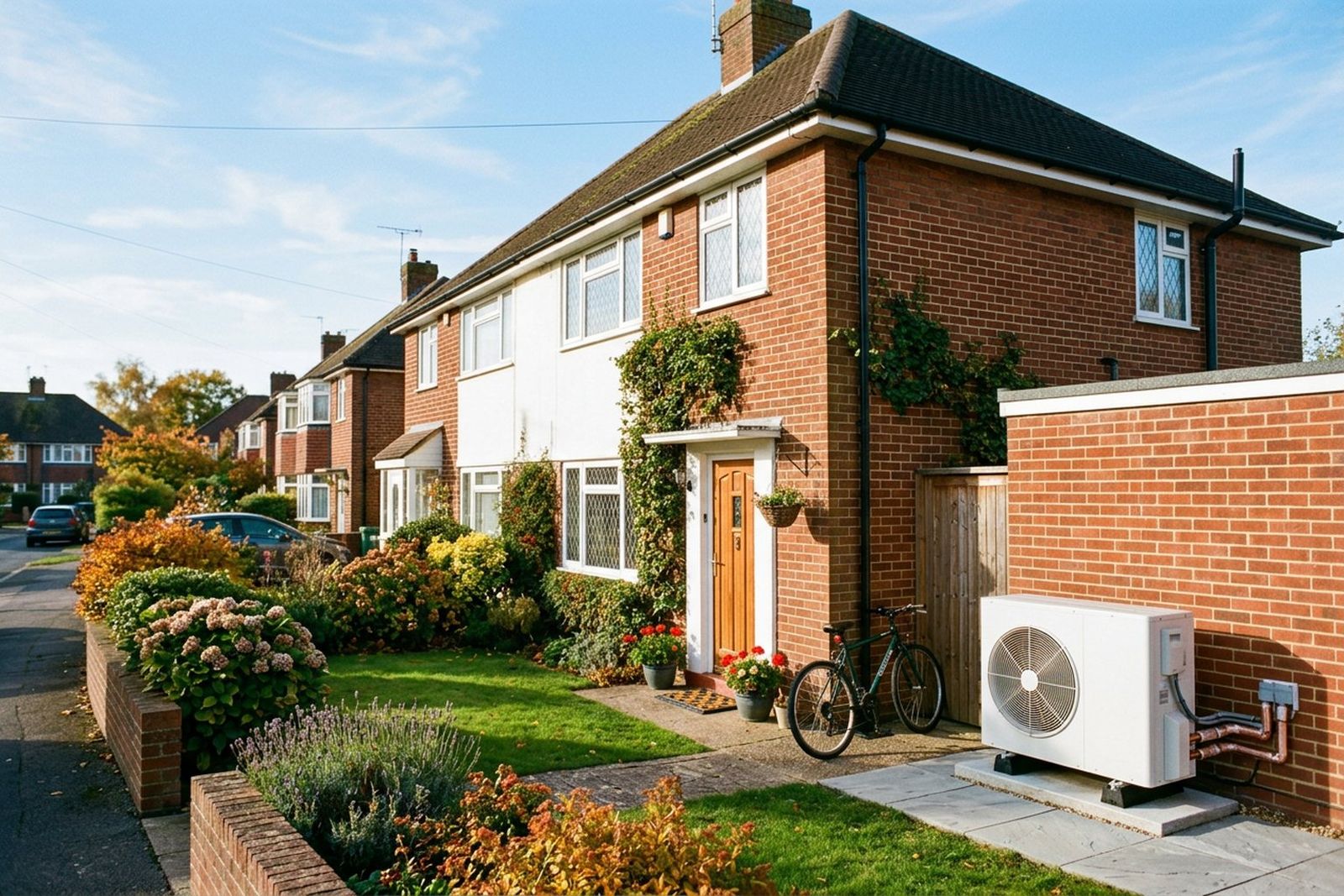
Who qualifies for the heat pump grant in 2026
GOV.UK says you are eligible for the Boiler Upgrade Scheme if you:
- own the property, including a business, a second home or a property you rent out to tenants;
- are replacing fossil fuel heating, such as oil, gas, electric or LPG (GOV.UK’s examples).
GOV.UK lists no income or benefits condition alongside those two, so the grant is not means-tested: you do not need to be on a low income or on benefits to apply. The property must be in England or Wales. Having had help with insulation before does not stop you; GOV.UK says you are still eligible if your property has already had energy efficiency funding.
You cannot get the grant for:
- most new builds (a self-build can qualify if it meets GOV.UK’s conditions, and you may be able to get the grant if you move into a finished new build with a fossil fuel boiler);
- social housing;
- a property that has already had government funding for a heat pump or biomass boiler;
- a hybrid system that keeps a gas boiler alongside the heat pump (see our guide to hybrid heat pumps);
- replacing a heating system that is already low carbon.
Since 28 April 2026 you can apply without an Energy Performance Certificate. If your home has a valid one, the installer still gives its number with the application.
How the £7,500 grant works
You do not apply yourself. The scheme is installer-led:
- You get quotes from MCS-certified installers and agree one. The quote should show the grant taken off.
- The installer applies to Ofgem on your behalf.
- Ofgem contacts you to confirm you agree. Its guidance for property owners says to give that consent within 14 days.
- Ofgem issues a voucher. For an air source heat pump it is valid for three months from the date it is issued, and the installation must be finished and claimed in that time.
- You pay the quoted price less the grant. Ofgem pays the grant to the installer.
On top of the grant, installing a heat pump in a home is currently zero-rated for VAT. HMRC’s notice says the zero rate runs to 31 March 2027 and returns to 5% from 1 April 2027. The Boiler Upgrade Scheme guide covers the rules in more detail.
Schemes that may fully fund a heat pump for lower-income households
Separately from the Boiler Upgrade Scheme, there are schemes that may fully fund home improvements, sometimes including a heat pump, for households on lower incomes. ByEco does not run any of them: you apply through the council, the scheme or the scheme’s own advisers, and they decide what is installed. Unlike the Boiler Upgrade Scheme, these schemes do look at your home’s EPC rating.
| Scheme | Where | Broad eligibility | How to apply |
|---|---|---|---|
| Warm Homes: Local Grant | England, except Greater Manchester and the West Midlands Combined Authority area | Privately owned home rated EPC D to G; household income usually £36,000 or less, or certain benefits, or an eligible postcode | GOV.UK online service or your council |
| Greater Manchester’s Warm Homes: Local Grant schemes | Greater Manchester | Privately owned home rated EPC D to G (rented homes have extra rules); eligible postcode, certain means-tested benefits, household income below £36,000, or other low-income and health routes | GMCA Retrofit Portal |
| Nest | Wales | Own or privately rent; means-tested benefit or low household income; EPC rating thresholds | Call Nest on 0808 808 2244 |
| ECO4 | Great Britain | People on certain benefits, or referred by their council | Energy supplier or council; ends 31 December 2026 |
Warm Homes: Local Grant (England)
GOV.UK says you “could get free energy saving improvements” if you are on a low income, get certain benefits or live in a certain postcode area. If you are eligible and your council has funding available, the council arranges a survey and may suggest measures including air source heat pumps; it then “will organise and pay for” the work it agrees with you. Your home must be in England, privately owned and rated EPC D, E, F or G. Household income must usually be £36,000 a year or less. The government’s guidance for councils gives a delivery window running to 31 March 2028. If you rent, your landlord may need to pay part of the cost.
In Greater Manchester the route is different. The government’s July 2026 guidance for councils says the Greater Manchester Combined Authority (GMCA) and its councils are not part of the national scheme, because they received their Warm Homes: Local Grant funding through a separate settlement. GMCA runs its own schemes instead. Its GM Wide Scheme page, checked in October 2026, is for low-income households in privately owned homes rated EPC D to G. You may qualify through an eligible postcode, certain means-tested benefits, a household income below £36,000, or a combination of other low-income and health criteria. For an owner occupier, the grant may cover the cost of low carbon heating, such as an air source heat pump, up to a maximum of £15,000. Owner occupiers, landlords and tenants apply through the GMCA Retrofit Portal. The page gives no closing date, so check the portal for what is available when you apply.
Nest (Wales)
Nest is the Welsh Government’s scheme. Gov.wales says Nest can confirm whether you are eligible for “a package of free home energy efficiency improvements”, which can include a heat pump. You must own or privately rent your home, receive a means-tested benefit or live in a low-income household, and your home must have an EPC rating of 54 (E) or lower, or 68 (D) or lower if someone in your household has an eligible health condition. You apply by phone or by asking for a callback.
ECO4 (closing)
The Energy Company Obligation is run through energy suppliers rather than as a grant. The government has confirmed that ECO4 ends on 31 December 2026 with no successor supplier obligation, and Citizens Advice warns that suppliers and councils might stop taking applications sooner. Ofgem says that in some cases you may be asked to contribute to the cost, so ECO4 is not always a no-cost route.
One rule cuts across all of these: you cannot combine them with the Boiler Upgrade Scheme to pay for the same heat pump.
The catches
- The grant is fixed. It is £7,500 and does not grow with your quote. If your home needs a larger heat pump, extra radiators or electrical upgrades, anything above the grant is yours to pay (see whether you need new radiators).
- Only an MCS-certified installer can claim it. An installer without MCS certification for heat pumps cannot get you the grant, however good the price looks. You can check an installer on the MCS website.
- The three-month deadline. If the installation slips past the voucher’s expiry, the installer has to withdraw and re-apply, and you give consent again.
- The budget is finite. Ofgem cannot issue new vouchers once the scheme budget is used up, and may run a queue until budget becomes available.
- Running costs are separate. A no-cost installation does not mean lower bills. That depends on the design and your tariff; see heat pump vs gas boiler running costs.
The pros and cons guide covers the wider trade-offs.
Be wary of cold callers offering a free heat pump
Unexpected calls, texts and doorstep visits promising a free heat pump or a “government grant” are worth treating with caution. Citizens Advice says a scam often starts when someone you do not know contacts you unexpectedly, and that it might be a scam if you are asked to transfer money quickly, asked for personal information, or have no written confirmation of what has been agreed. For the ECO scheme, Ofgem notes that people may be approached by several companies, and that you do not have to sign a contract for any work you do not think suits your home.
The safe way round is to start from the scheme, not the caller. For the Boiler Upgrade Scheme, choose your own MCS-certified installer and expect Ofgem to contact you to confirm the application. For council schemes, go through GOV.UK, your council or the GMCA portal. One exception to the “unexpected contact” rule: under its area-based scheme, GMCA says officers from GMCA or the council will contact residents in selected parts of Greater Manchester. It says all those officers carry official photo identification and asks you to check it before letting anyone into your home.
How to find out if you may be eligible
- Check the basics: you own the home, it is in England or Wales, and it is heated by gas, oil, LPG or electric heating that is not a heat pump.
- Rule out the exclusions: not social housing, not a developer’s new build, and no previous government-funded heat pump at the address.
- If your income is lower, look up your EPC rating and check the Warm Homes: Local Grant (or the GMCA portal in Greater Manchester) or Nest in Wales before anything else.
- Get a survey and an itemised quote from an MCS-certified installer showing the grant taken off. That figure, not the headline, tells you whether you may pay nothing.
- Compare at least two quotes, and ask each installer how hot water will be provided (see what happens during an installation).
Where ByEco stands
ByEco’s MCS and TrustMark certification is in progress, so we cannot apply for the Boiler Upgrade Scheme grant on your behalf yet. Only an MCS-certified installer can. We will tell you plainly where that stands, and whether our timing suits yours, before you commit to anything. You can read more on our heat pumps page and our grants page, or get in touch to talk through your home.
Sources
Every figure on this page was checked against primary sources on 10 October 2026. Grant rules, planning rules and prices change — if you are reading this much later, verify before acting.
- GOV.UK — Apply for the Boiler Upgrade Scheme: what you can get
- GOV.UK — Apply for the Boiler Upgrade Scheme: check if you’re eligible
- GOV.UK — Apply for the Boiler Upgrade Scheme: how to apply
- Ofgem — Boiler Upgrade Scheme: Guidance for Installers, Version 5.1
- Ofgem — Boiler Upgrade Scheme: Guidance for Property Owners, Version 5.1
- legislation.gov.uk — Boiler Upgrade Scheme (England and Wales) Regulations 2022, regulation 15
- legislation.gov.uk — Boiler Upgrade Scheme (England and Wales) Regulations 2022, regulation 5
- HMRC — VAT on energy-saving materials and heating equipment (Notice 708/6)
- GOV.UK — Apply for the Warm Homes: Local Grant to improve a home
- DESNZ — Warm Homes: Local Grant policy guidance for local authorities (July 2026)
- Greater Manchester Combined Authority — Warm Homes: Local Grant GM Wide Scheme
- Greater Manchester Combined Authority — Warm Homes: Local Grant Area Based Scheme
- Welsh Government — Get free home energy efficiency improvements (Nest): eligibility
- DESNZ — Extending the ECO4 end date: government response
- Ofgem — Energy Company Obligation: homeowners and tenants
- Citizens Advice — Get help paying for energy efficiency home improvements
- Citizens Advice — Check if something might be a scam
Get a figure for your house
National averages only get you so far. Send us your postcode and a little about your home, and we will come back with a realistic price and an honest view on whether a heat pump suits it.