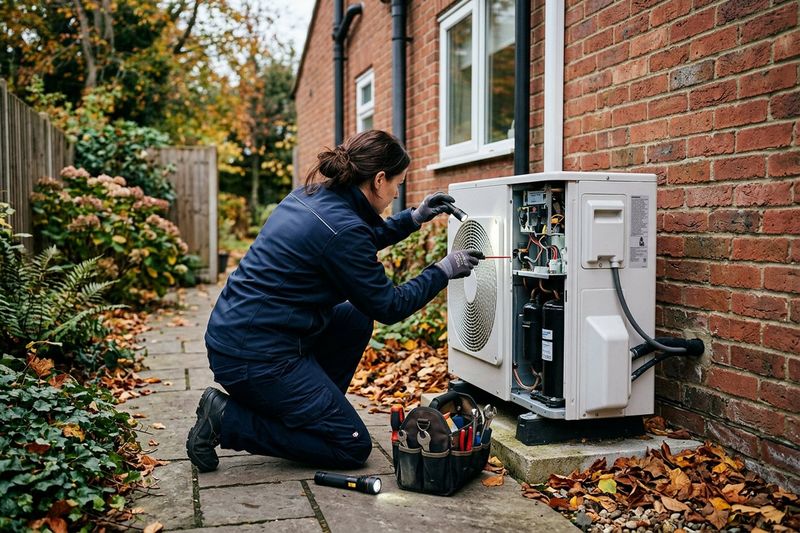
The short version
- Much of the process happens before installation day: a survey with a room-by-room heat loss calculation, a written design and quote, the grant application and a check on your electricity supply.
- The Energy Saving Trust says the installation itself typically takes around three days, with your heating typically off for a couple of days.
- Once Ofgem issues a £7,500 Boiler Upgrade Scheme voucher for an air source heat pump, it is valid for 3 months: the installation has to be finished and the grant claimed within that time.
- It ends with commissioning, a demonstration of the controls and a handover pack, with the MCS certificate to follow.
This guide follows the order you live it in, from the survey to the first winter.
Two versions of the rules. MCS is moving certified installers onto a redeveloped scheme as their certification bodies move them over. The Customer Commitment and MCS 031 a) quoted below belong to the redeveloped scheme; installers still on the original scheme work to MCS 001 and a consumer code approved by the Chartered Trading Standards Institute. Some timings also differ, so ask which version your installer works under.
Before the day: the survey and heat loss calculation
It starts with a visit. The Energy Saving Trust’s installer toolkit says the surveyor completes “a full room by room heat loss assessment”: how much heat each room loses on a cold day. That sets the size of the heat pump and shows whether each radiator is big enough at heat pump temperatures (see what size heat pump do I need, do I need new radiators for a heat pump and how an air source heat pump works).
The Customer Commitment asks you to give true information about who lives there, your insulation, planned improvements and how you use energy. The surveyor also looks at where the outdoor unit could go, the pipe route and your electricity supply, which MCS’s design standard makes the installer responsible for checking is adequate.
The design and the written quote
Before you sign, MCS 031 a), the redeveloped scheme’s pre-sale standard for heat pumps, requires a written performance estimate, the manufacturer’s datasheet for the heat pump and any proposed hot water cylinder, the share of your heating and hot water the heat pump is designed to cover, and details of any subcontractors. The Customer Commitment adds a detailed written quotation, the make, model and power rating in the contract, estimated installation dates and how your deposit is protected.
The detailed design covers room heat losses, radiator sizes, the design flow temperature and expected seasonal efficiency (SCOP). The older MIS 3005-D requires it in writing to you before installation; the redeveloped MIS 3005-D:2025 requires it in writing to the installer, so ask for a copy. If the design changes what you were quoted, you are owed a written variation, and if the change is significant you can cancel without further cost and have your deposit refunded.
The Boiler Upgrade Scheme voucher and its deadlines
The Boiler Upgrade Scheme gives £7,500 towards an air source heat pump in England and Wales. The installer applies on your behalf and the grant comes off the price on your quote and invoice. Ofgem contacts you to confirm the installer is acting for you, and may phone or visit.
Under the scheme regulations and Ofgem’s installer guidance, a voucher for an air source (air-to-water) heat pump expires 3 months after it is issued: the installation must be finished and the grant claimed within that time, and an expired voucher cannot be extended, though the installer can re-apply. If the installer applies after commissioning instead, it must do so within 120 days of the commissioning date. GOV.UK’s homeowner pages give a looser “within 120 days of applying”, so ask when your installer will apply and how that fits your installation date. Costs are covered in heat pump costs in Manchester.
Planning, noise and the electricity network
In England an air source heat pump on a house can be permitted development if the installation meets the conditions, including the MCS 020(a) sound calculation; Wales has its own rules. See are heat pumps noisy? and heat pumps for terraced houses. Under the Customer Commitment, the installer must tell you about every permission and approval needed before you sign.
The electricity network operator (DNO) must be told too: MCS standards require the installer to notify it under the Energy Networks Association’s national procedures, which have two routes:
- Connect and notify: where the new maximum demand is 60 amps or less and all the other criteria are met, the heat pump can be connected and the DNO notified within 28 days of installation.
- Apply to connect: where it is above 60 and up to 100 amps, the installer must apply before installing, and the DNO should assess the supply capacity within 10 working days.
The national form warns that any reinforcement costs may be charged to you. One operator, SP Electricity North West, says most domestic customers pay nothing for the connection but larger heat pumps may need a supply upgrade that could incur a cost.
What happens on heat pump installation day
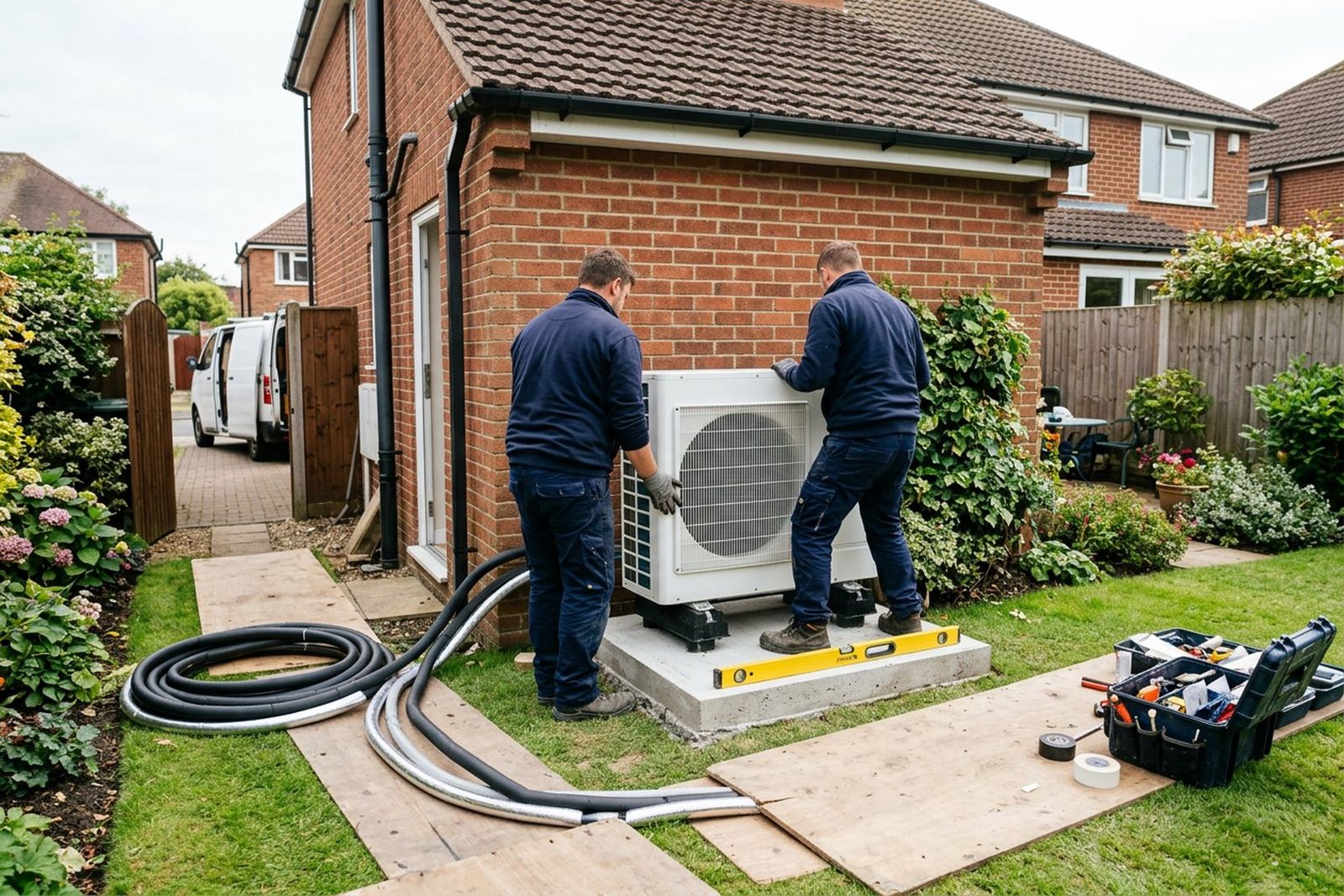
The Energy Saving Trust lists the typical work as a plinth for the outdoor unit, pipes through the wall to where your boiler is, work on the hot water system, radiator upgrades where needed and underfloor heating where it is part of the design.
The outdoor unit and its base
The unit needs a solid, level base. As one example, Grant’s Aerona³ manual asks for a 150 mm concrete base or paving slabs on compacted hardcore, the unit raised about 100 mm on anti-vibration mounts, and never grass, soil, shingle or gravel. MCS requires condensate to drain safely to a drain or soakaway.
Pipework and hot water
Pipes run through the wall to the indoor equipment. How hot water is provided varies from house to house, so your installer should spell out exactly how yours will work, and where each piece of equipment goes, before the day.
Radiators and the heating water
Radiators change only where the design calls for it. The Energy Saving Trust says the system should be flushed to remove sediment, and the Heat Pump Association’s commissioning checklist asks the engineer to confirm it was flushed and cleansed to BS 7593, the British Standard for central heating water, and to record the inhibitor used.
Electrical work
The Energy Saving Trust says many installers bring in a separate electrician to connect the supply and the controls. Grant’s manual calls for a dedicated supply with a correctly sized circuit breaker and a lockable isolator outside. In England, the Building Regulations make a new circuit notifiable, as Approved Document P explains, so it has to be certified through a registered competent person, a registered third-party certifier or building control. Wales publishes its own Approved Document P.
The old boiler and the gas supply
The Gas Safety (Installation and Use) Regulations 1998 count disconnecting and removing a gas fitting as gas work, and HSE says anyone employed to work on gas appliances in a home must be Gas Safe registered, so check the engineer’s ID card. If the boiler was your only gas appliance, the Energy Saving Trust says you can have the gas connection removed via your energy supplier or installer, ending the gas standing charge; there may be a charge.
How long does a heat pump installation take?
The Energy Saving Trust says the installation itself “typically takes around three days”, and warns that the wait beforehand can be several months because of demand. We do not publish timings of our own.
It can take longer with a complex building or heating system, a lot of radiators or pipework to replace, underfloor heating, or ground source digging or drilling. Before the day, an “apply to connect” supply means waiting for the DNO’s assessment, which should take up to 10 working days. The Customer Commitment requires the installer to tell you how long your installation will take, agree a timeline and tell you about delays.
Heat pump installation disruption: heating, access and mess
- Heating off. Typically a couple of days, says the Energy Saving Trust, and in winter your installer will probably lend you electric heaters. Ask separately about hot water.
- Staying at home. Usually possible while the work goes on.
- Access. The installer should agree access with you; MCS asks you to follow their access requests, such as keeping pets and small children away from the work, showing them where to park and letting them use a toilet.
- Mess. Expect pipes through the wall, and floor coverings and floorboards up if underfloor heating is going in. Under the Customer Commitment the installer must clean up, dispose of waste responsibly and put right any damage within a reasonable time.
Heat pump commissioning: what gets checked
Commissioning means switching the system on and proving it works: the Energy Saving Trust describes checking for leaks, bleeding air out and balancing the radiators. MIS 3005-I:2025 requires a documented procedure confirming the system is safe and working to its design.
MCS’s example checklist covers electrical tests, control settings such as the heating curve and hot water temperatures, clearances and condensate drainage at the outdoor unit, F gas registration for whoever charged the refrigerant on split systems, and whether the heating water was flushed and treated. MCS says weather compensation should be enabled where it can optimise efficiency, and passwords on internet-connected controls updated in consultation with you.
The heat pump handover: what you should be given
Under the Customer Commitment the installer should demonstrate the system, show you how to use it, agree the most effective way to control it for your needs and check you are happy. The handover pack should contain at least a list of key parts, health and safety guidance, a servicing and maintenance schedule, the manufacturer’s manuals and all warranties, and the installer must tell you what keeps those warranties valid and how to contact them if something goes wrong. Under the older standard the pack also includes the commissioning forms and checklists, with a signed handover document giving the recommended interval before the first inspection.
| Document | When you should get it |
|---|---|
| MCS certificate | Older MIS 3005-D: generated within 10 working days of commissioning, then sent to you. Redeveloped scheme: provided within 30 calendar days of commissioning |
| Building Regulations compliance certificate, where needed | Within 30 calendar days under the Customer Commitment; GOV.UK says 8 weeks for a competent person scheme certificate |
| Proof of DNO notification or approval, where needed | Within 30 calendar days under the Customer Commitment |
GOV.UK lists installing or replacing a heating system among work that may need Building Regulations approval; a competent person scheme certificate shows up in solicitors’ searches when you sell.
After the installation: the grant, the first winter and servicing
The grant came off your price; to claim it, the installer redeems the voucher with Ofgem using the MCS certificate number. GOV.UK says MCS may contact you to carry out its own checks.
The Energy Saving Trust suggests keeping an eye on how the heat pump runs, particularly in colder weather, so you learn what is normal and spot problems early (see heat pumps in cold weather), and says it should be serviced annually: see how long heat pumps last.
If something is not right, go to your installer first. Under the Customer Commitment they must acknowledge a complaint within two working days, point you to the MCS complaints process if you are unhappy with the outcome, and take part in alternative dispute resolution if that process does not settle it.
Questions to ask an installer before the day
- Will you do a room-by-room heat loss calculation, and can I have the design in writing?
- Which version of the MCS scheme are you under, and when will I get the MCS certificate?
- When will you apply for the grant voucher, and how does that fit my installation date?
- Is my supply “connect and notify” or “apply to connect”?
- How will my hot water be provided, and where will the indoor equipment go?
- Which radiators and pipes are changing, and how will the system be flushed and treated?
- How many days will you be here, and how long will heating and hot water be off?
- Who does the electrical and gas work, and are they registered with a competent person scheme and Gas Safe?
- What health and safety training does the team have for this job — for example working at height, or asbestos awareness in an older house? Our guide to health and safety training for installers covers what to look for.
Where ByEco stands
ByEco’s MCS and TrustMark certification is in progress. Until it is complete we cannot apply for the Boiler Upgrade Scheme grant, which only an MCS-certified installer can claim. Put the questions above to any installer, us included: see our heat pumps page and heat pumps in Manchester, or get in touch.
Sources
Every figure on this page was checked against primary sources on 8 October 2026. Grant rules, planning rules and prices change — if you are reading this much later, verify before acting.
- Energy Saving Trust — Heat pump installation: a step-by-step guide (15 July 2026)
- Energy Saving Trust — Heat pump installer toolkit: who do I need in my team?
- Energy Saving Trust — Heat pump installer toolkit: electrical load check
- Energy Saving Trust — Heat pump installer toolkit: heat pump installation (information for customers)
- MCS — Customer Commitment, MCS:2025 2.0, Issue 1.1 (8 September 2026)
- MCS — Installer Operating Requirements, MCS:2025 2.0, Issue 2.0 (8 September 2026)
- MCS — Getting prepared for the redeveloped installer Scheme
- MCS — MIS 3005-D:2025 Heat Pump Design Standard, Issue 2.0 (5 December 2025)
- MCS — MIS 3005-D The Heat Pump Design Standard, Issue 3.0 (5 December 2025)
- MCS — MIS 3005-I:2025 Heat Pump Installation Standard, Issue 1.0
- MCS — MCS 031 a): 2025 Hydronic Heat Pump Pre-sale Information and System Performance Estimate Standard, Issue 2.0
- MCS — Heat Pump Handover Document (handover checklist for heat pumps, Version 1.0)
- MCS — Notifying DNOs
- SP Electricity North West — Heat pumps: connect and notify or apply to connect
- GOV.UK — Apply for the Boiler Upgrade Scheme: how to apply
- GOV.UK — Apply for the Boiler Upgrade Scheme: check if you’re eligible
- GOV.UK — Apply for the Boiler Upgrade Scheme: what you can get
- Ofgem — Boiler Upgrade Scheme: guidance for installers (V5.1, last updated 2 July 2026)
- GOV.UK — Building regulations approval: when you need approval
- GOV.UK — Building regulations approval: use a competent person scheme
- GOV.UK (DCLG) — Approved Document P: Electrical safety – dwellings, 2013 edition (England)
- legislation.gov.uk — Gas Safety (Installation and Use) Regulations 1998, regulation 2
- legislation.gov.uk — Gas Safety (Installation and Use) Regulations 1998, regulation 3
- HSE — Gas safety: frequently asked questions
- Heat Pump Association — HPADOC0001 Air to Water Heat Pump Commissioning Checklist & Service Record, v2.0 (8 September 2025)
- Energy Networks Association — EVCP & HP Connections Form v3.4 (hosted by MCS)
- legislation.gov.uk — Boiler Upgrade Scheme (England and Wales) Regulations 2022, regulation 15
- Ofgem — Boiler Upgrade Scheme guidance for installers V5.1 (PDF)
- MCS — MCS 001-1 The MCS Contractor Standard, Part 1: Requirements for MCS Contractors, Issue 4.2
- Welsh Government — Approved Document P: electrical safety (dwellings), Wales
- Grant UK — Aerona³ R32 Installation and Servicing Instructions (DOC 0136 Rev 2.4)
Book your free home survey
Every home is different. The cost depends on the size of system, any radiators that need upgrading, the pipework and where the outdoor unit goes. Get in touch and we will arrange a free survey of your home and give you a clear quote. If you are happy with it, we can go ahead.