Manchester in short
- Huge stock of late-Victorian and Edwardian byelaw terraces with solid brick walls.
- Solid walls lose heat fast — but Manchester terraces are also small, which partly cancels it out.
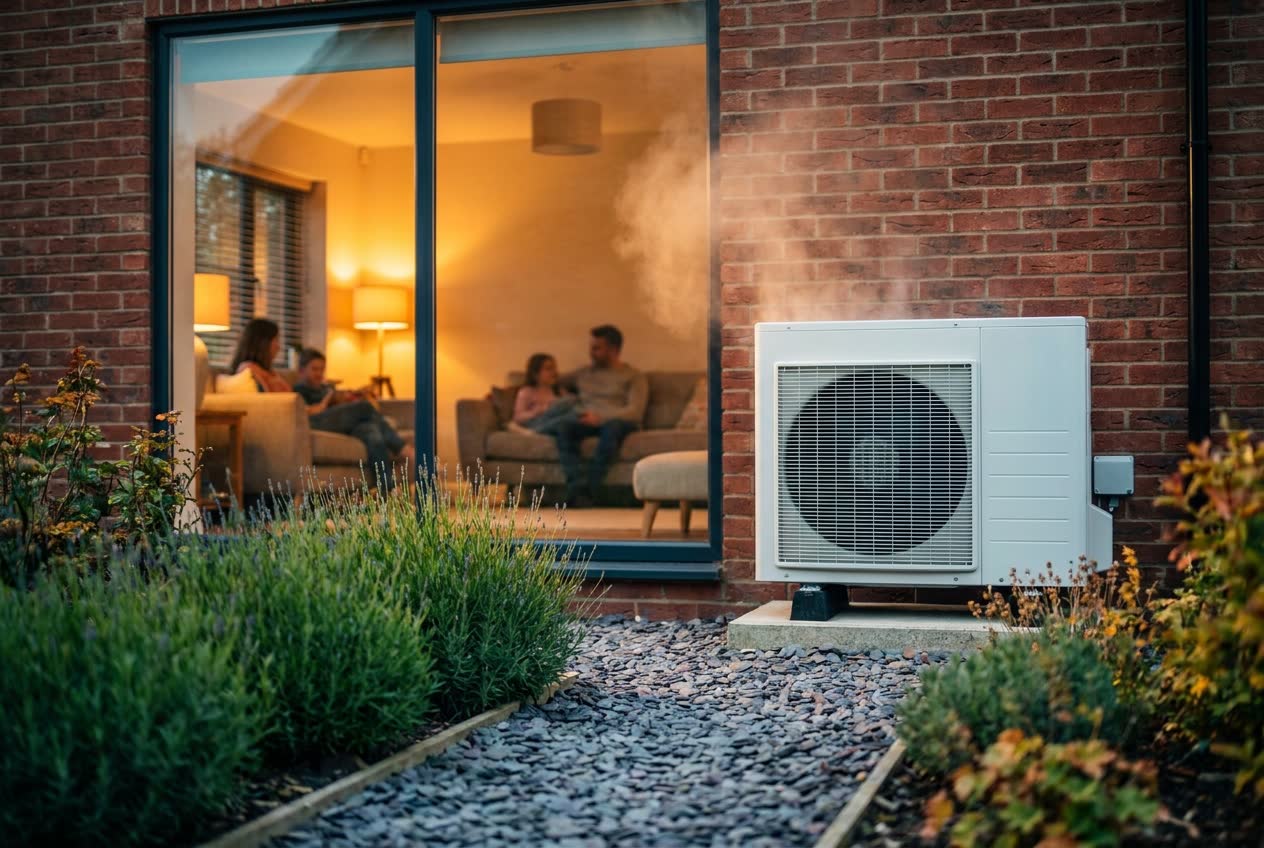
- The real constraint on a mid-terrace is usually where the outdoor unit goes, not the heat pump itself.
- Virtually all of the city is on the mains gas grid, so the grant is £7,500.
- More than thirty conservation areas, including Ancoats, Castlefield and Victoria Park in Rusholme.
Manchester's residential stock is unusually skewed towards one thing: the two-up two-down and the larger bay-fronted terrace, built in bulk between roughly 1875 and 1910 across Levenshulme, Longsight, Moss Side, Rusholme, Gorton, Harpurhey and Openshaw. Almost all of it is solid brick, one brick thick, with no cavity to fill.
What solid walls mean in practice
A solid nine-inch brick wall has a U-value somewhere around 2 W/m²K — roughly four times the heat loss of a cavity wall that has been filled. That is the number that makes people assume a heat pump is off the table for a Victorian terrace. It is not, for two reasons.
First, these houses are small. A mid-terrace has only two external walls and is buffered on both sides by neighbours. The total heat loss of a 75m² mid-terrace is often lower than that of a much better-insulated detached house in Cheshire. Second, what matters for a heat pump is not the heat loss in isolation but whether you can emit that heat at a low flow temperature. A well-designed system in a Manchester terrace runs at around 45–50°C rather than the 70°C-plus a gas boiler uses, which usually means some radiators get bigger — not all of them, and rarely the whole system.
Where solid walls genuinely change the answer is on the bigger three-storey terraces and the large villas in Whalley Range, Victoria Park and Didsbury. On those, internal or external wall insulation before or alongside the heat pump changes the sizing materially. We cover the fabric-first argument on our insulation page, and the running-cost arithmetic in heat pump vs gas boiler running costs.
Where the outdoor unit goes on a terrace
This is the question that actually decides most Manchester jobs. A monobloc air source unit needs clear air in front of it and space behind for the fan to draw from, a route for condensate to a drain, and a sensible pipe run to the cylinder. On a semi you put it down the side and stop thinking about it. On a mid-terrace with no side access, the options are the rear yard, the back of an outrigger, or occasionally a flat roof.
Rear yards on byelaw terraces are small, walled and often shared with the bins and the back gate onto the ginnel. That is workable — we site plenty of units in yards like that — but it needs surveying rather than guessing. The things that catch people out are airflow clearance to the yard wall, the acoustic assessment relative to the neighbour's window a few metres away, and where the condensate actually goes in winter so it does not ice the yard.
Most air source heat pumps in England go in under permitted development rather than a full planning application. They are still conditional — there are limits on the size and siting of the unit, and an MCS 020 noise assessment is normally part of demonstrating compliance. Conservation areas, listed buildings and flats are treated differently, and the council's planning team is the authority on your specific address. Assume nothing; check first.
If your house is in a conservation area — Ancoats, Castlefield, Victoria Park and the Didsbury areas among others — or is listed, the front elevation is where restrictions bite hardest. That affects solar more than it affects heat pumps, because a rear-yard unit is usually invisible from the street anyway.
City-centre flats and apartments
An individual air source heat pump in a city-centre apartment is rarely straightforward. You need somewhere structurally and acoustically sensible for an outdoor unit, and you need the freeholder's or management company's consent, which for most blocks means it is not happening. Some developments are on communal or district heating already, in which case an individual heat pump is not the route at all. If you own a flat and are being sold a heat pump without anyone having asked who owns the external walls, be sceptical.
Grants available in Manchester
The Boiler Upgrade Scheme (BUS) covers England and Wales and is administered by Ofgem, so Manchester homeowners are eligible on exactly the same terms as anywhere else in England. The amounts are fixed:
- £7,500 towards an air source, ground source or water source heat pump.
- £5,000 towards a biomass boiler — off gas grid, rural, emissions certificate required.
- £2,500 towards an air-to-air heat pump. Residential only.
In practice almost every home inside the city boundary is connected to mains gas, so the figure that applies to you is £7,500.
Two details worth knowing. First, you no longer need an EPC — that requirement was removed on 28 April 2026, which means outstanding loft or cavity wall recommendations can no longer block an application. Second, the grant voucher for an air source heat pump is valid for three months from the date it is issued, so the installation has to be completed within that time — the grant is not something to sit on. The MCS-certified installer applies for you and takes the grant off your bill; you never handle the money yourself.
Separately, domestic heat pumps, solar and battery storage are currently at 0% VAT, which is due to end on 31 March 2027. Our full write-up is in the Boiler Upgrade Scheme explained.
Where ByEco stands right now. Boiler Upgrade Scheme applications can only be lodged by an MCS-certified installer. ByEco has MCS & TrustMark certification in progress and cannot submit a BUS application on your behalf yet. If you are planning work to a fixed date, tell us the date and we will say honestly whether we can meet it or whether you should go elsewhere.
Solar in Manchester
Manchester gets less sun than the south coast and it is worth being honest about that: a 4kW array here sits at the lower end of the national range rather than the top of it. It still works — panels rely on daylight, not heat, and generate perfectly well under cloud, just less. The bigger local variable is orientation. Terraced streets run in long parallel rows, so whole neighbourhoods have roofs facing east and west rather than south, which typically costs 15–20% against a south-facing equivalent but spreads generation across the morning and evening, which can suit self-consumption better than the numbers suggest. Chimney stacks and the neighbour's roofline are the other thing to survey properly. See are solar panels worth it for the full arithmetic, or our solar page for what we fit.
Heat pump detail is on our heat pumps page. For prices, see what a heat pump costs in Greater Manchester; if you live in a terrace, can a terraced house have a heat pump? covers siting and planning. The other areas we cover are listed on our service areas.
Get a realistic figure for your house
Send us your postcode, roughly when the house was built and how it is heated now. We will come back with a straight answer about what would suit it — including if the answer is that the fabric work should come first.
Or email [email protected]. Our office is at 12–14 Midland Street, Manchester M12 6LB.