Trafford in short
- Street after street of inter-war semis in Sale, Urmston, Stretford, Timperley and Flixton.
- Cavity walls, side passages and simple roofs — the easy end of retrofit for both heat pumps and solar.
- Bowdon, Hale and parts of Altrincham hold large Victorian and Edwardian houses in conservation areas, some listed.
- The rural west — Dunham, Warburton, Carrington, Partington — is where any off-gas-grid properties are likely to be.
- Apartments in central Altrincham and Sale bring the usual freeholder-consent problem.
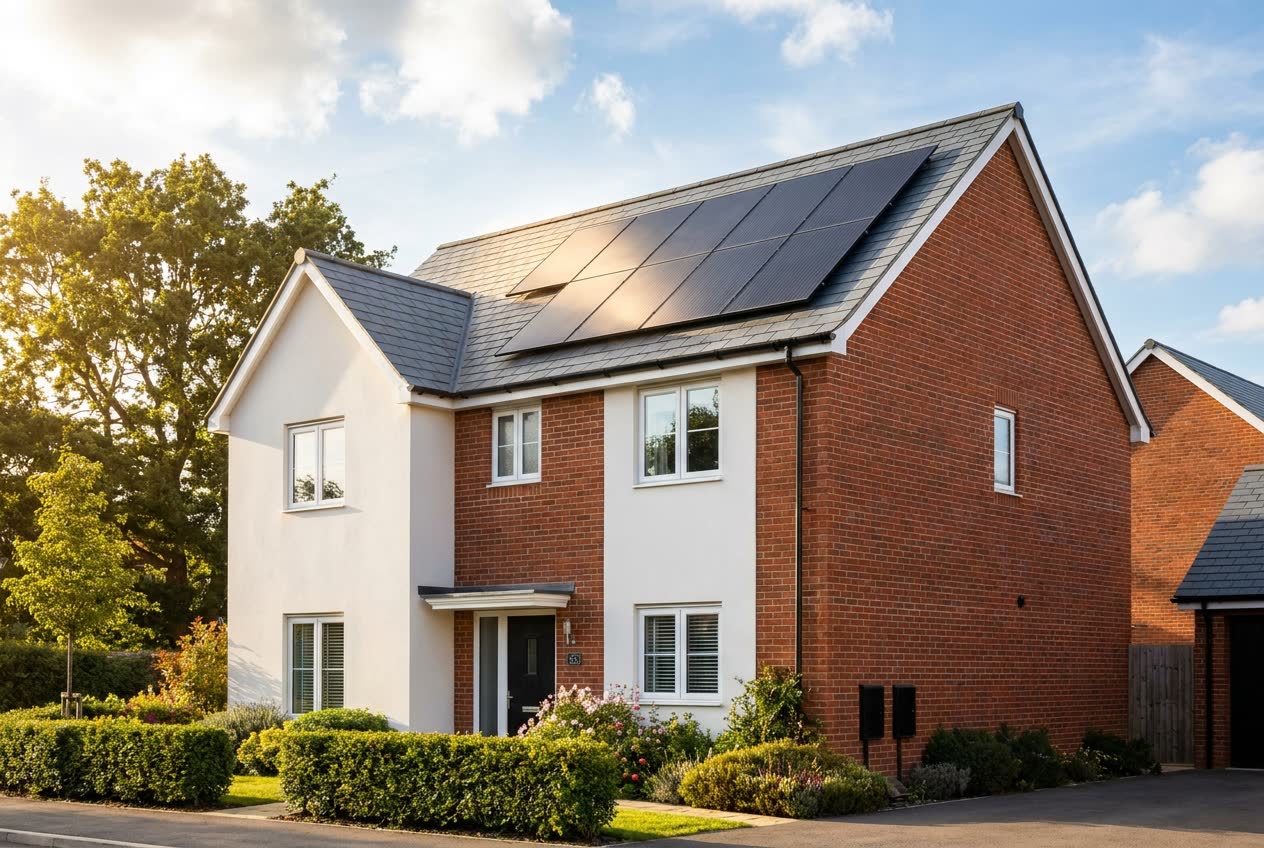
Most of Trafford's housing was built in the residential expansion between the wars, and it happens to be well suited to a heat pump. A typical Sale or Urmston semi has a fillable cavity, a side passage wide enough for an outdoor unit, and a straightforward pitched roof. The design work is real but the constraints are few, which is the opposite of a Manchester mid-terrace.
The inter-war semi belt
What we usually find in these houses: original radiators that were sized for an older, colder standard and are therefore already close to adequate for a 45–50°C flow temperature; loft insulation that has been topped up at some point; and a cavity that is either filled or fillable. The result is a lower design heat loss than the age of the house suggests, so the unit is smaller, quieter and cheaper to run than people expect.
Two things still need surveying. Pipework in properties re-plumbed during the 1970s can be microbore, which limits flow rate. And the hot water cylinder has to go somewhere — if the house was converted to a combi boiler at some point, the airing cupboard has usually been repurposed, and finding cylinder space is often the most disruptive part of the whole job. It is better to know that at survey stage than at installation.
Bowdon, Hale and Altrincham
South Trafford is a different job. The large Victorian and Edwardian villas around Bowdon and Hale have high ceilings, generous volumes and solid walls, so heat demand is substantially higher — these are houses where getting the heat loss calculation right genuinely decides whether the system works. Several of these areas carry conservation area designation and some properties are listed, which changes what you can do outside.
In practice that affects two decisions. The siting of the outdoor unit, which may need to be out of view from the street or screened, and solar panels on visible roof slopes, which is where restrictions bite hardest. Neither is necessarily a refusal — large plots usually offer somewhere sensible, and rear roof slopes are often unaffected — but it is a conversation to have with Trafford Council's planning team before you commit to a design.
Most air source heat pumps in England go in under permitted development rather than a full planning application. They are still conditional — there are limits on the size and siting of the unit, and an MCS 020 noise assessment is normally part of demonstrating compliance. Conservation areas, listed buildings and flats are treated differently, and the council's planning team is the authority on your specific address. Assume nothing; check first.
The rural west
West of the built-up borough — around Dunham, Warburton, Carrington and Partington — the density drops and you find older detached and estate properties. This is the part of Trafford where a home may not be on the mains gas grid, and if it runs on an oil or LPG tank the running-cost case for a heat pump is at its strongest.
Grants available in Trafford
The Boiler Upgrade Scheme (BUS) covers England and Wales and is administered by Ofgem, so Trafford homeowners are eligible on exactly the same terms as anywhere else in England. The amounts are fixed:
- £7,500 towards an air source, ground source or water source heat pump.
- £5,000 towards a biomass boiler — off gas grid, rural, emissions certificate required.
- £2,500 towards an air-to-air heat pump. Residential only.
The great majority of Trafford is on mains gas, so £7,500 is the figure for most homes here. If you are in the rural west of the borough on an oil or LPG tank rather than mains gas, swapping oil for a heat pump is a much clearer win on running cost than swapping mains gas.
Two details worth knowing. First, you no longer need an EPC — that requirement was removed on 28 April 2026, which means outstanding loft or cavity wall recommendations can no longer block an application. Second, the grant voucher for an air source heat pump is valid for three months from the date it is issued, so the installation has to be completed within that time — the grant is not something to sit on. The MCS-certified installer applies for you and takes the grant off your bill; you never handle the money yourself.
Separately, domestic heat pumps, solar and battery storage are currently at 0% VAT, which is due to end on 31 March 2027. Our full write-up is in the Boiler Upgrade Scheme explained.
Where ByEco stands right now. Boiler Upgrade Scheme applications can only be lodged by an MCS-certified installer. ByEco has MCS & TrustMark certification in progress and cannot submit a BUS application on your behalf yet. If you are planning work to a fixed date, tell us the date and we will say honestly whether we can meet it or whether you should go elsewhere.
Solar in Trafford
The semi belt is good solar territory: unobstructed roof planes, reasonable pitch, and enough space for an array worth having. Pairing solar with a heat pump matters more than it looks — the heat pump raises your electricity demand, so more of what you generate gets used at home rather than exported at whatever your supplier's Smart Export Guarantee rate happens to be. In Bowdon and Hale, check the conservation area position before assuming a front slope is available. See are solar panels worth it, our solar page, and the grants overview.
Heat pump detail is on the heat pumps page, and the rest of our coverage is on our service areas.
Get a realistic figure for your house
Send us your postcode, roughly when the house was built and how it is heated now. We will come back with a straight answer about what would suit it — including if the answer is that the fabric work should come first.
Or email [email protected]. Our office is at 12–14 Midland Street, Manchester M12 6LB.