The short version
- DESNZ’s December 2024 options assessments assume 18 years for an air source heat pump, 20 for ground source and 15 years for a gas boiler. MCS says an air source heat pump lasts up to 20 years on average.
- Those are modelling assumptions. No published UK measurement of how often heat pumps fail exists yet.
- Yes, heat pumps need servicing, normally once a year. Vaillant states that a heat pump not serviced annually has an invalid warranty; Grant extends its 12-month warranty to two years only if the unit is registered within 30 days and serviced every twelve months.
- Every MCS-certified installation must carry a workmanship warranty of at least two years, plus insurance covering it if the contractor stops trading.
- You can keep the unit clear and watch the system pressure. The refrigerant circuit is never owner territory.
The answer has two halves: the published numbers, and the maintenance those numbers quietly assume.
How long do heat pumps last?
The clearest published figures come from the Department for Energy Security and Net Zero. The options assessment issued with its December 2024 consultation on space heating product standards states that “an average product lifespan of 18 years for ASHPs and 20 years for GSHPs was used”. MCS, which sets the installation standards the industry works to, tells homeowners that “on average, an air source heat pump lasts up to 20 years”.
Read those numbers carefully. DESNZ used its figure to project how many heat pumps will be in the stock in future years, not how long any particular machine survives, and we could not find a published UK failure rate or survival curve for domestic heat pumps at all. The largest UK monitoring exercise, the DESNZ-funded Electrification of Heat Demonstration Project, installed 742 heat pumps and found 85% of participants had recommended one or were likely to after a heating season, reliability among the more positively rated characteristics — a satisfaction result over a few years, not a failure rate over twenty.
Heat pump lifespan compared with a gas boiler
The fair comparison comes from one source using one method. The same consultation costs its boiler proposals “over the 15-year life of the boilers”, and its gas boiler options assessment says plainly: “We assume the average lifetime of gas boilers to be 15 years.”
| Heating system | Lifespan assumed in the DESNZ December 2024 options assessments |
|---|---|
| Air source heat pump | 18 years |
| Ground source heat pump | 20 years |
| Gas boiler | 15 years |
Assumptions used for policy appraisal, not warranties or measured outcomes. See air source versus ground source heat pumps for the differences, and heat pump versus gas boiler running costs for the other half of the comparison.
What wears out, and what makes a heat pump last longer
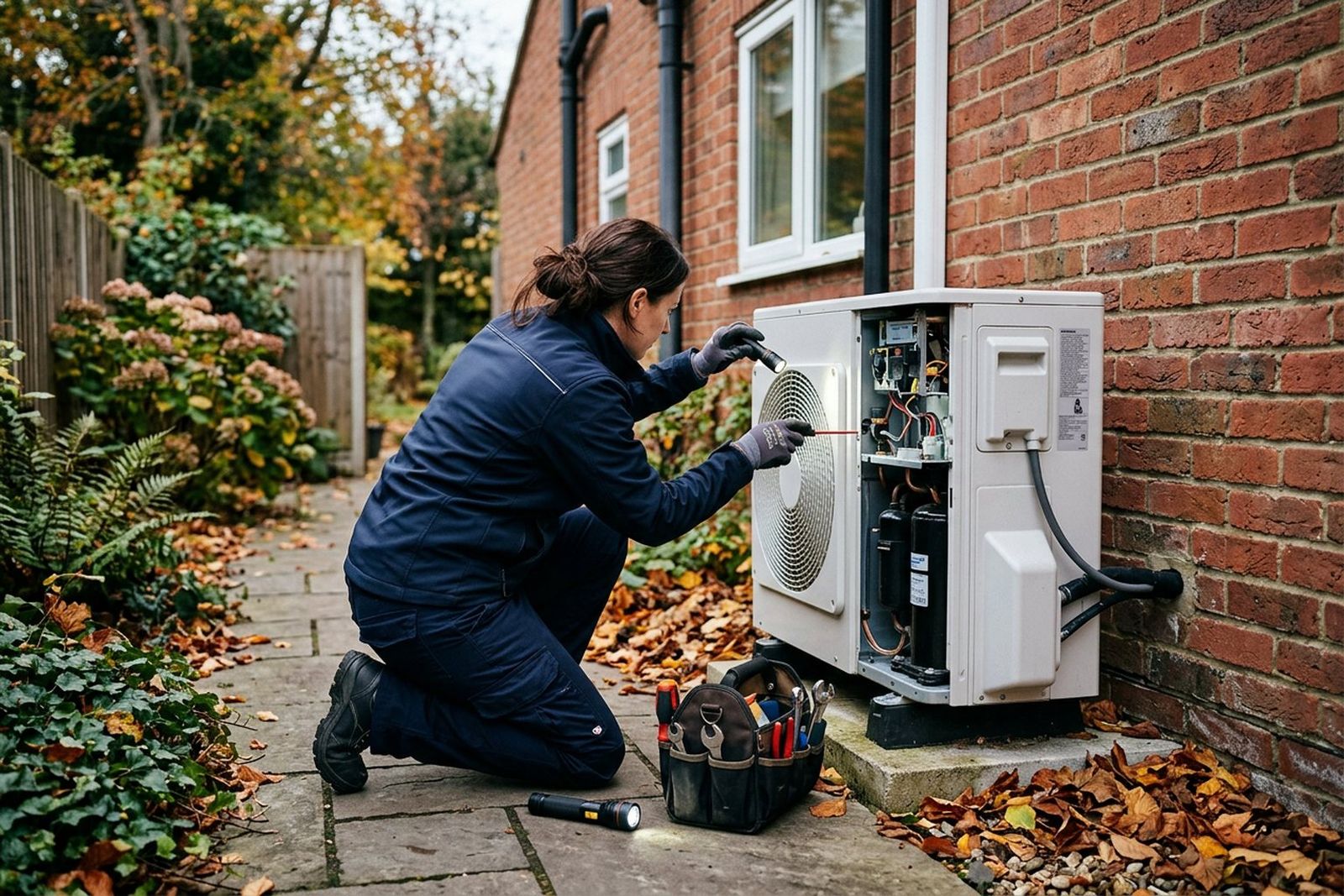
An air source heat pump is several machines in one box: Grant’s Aerona³ manual lists a compressor, a plate heat exchanger, a fan motor, a circulating pump and valves, with the finned evaporator coil outside them (how an air source heat pump works). Three things shorten the life of that assembly, and all three appear in the manufacturers’ own terms:
- Dirty system water. Grant may charge for a repair caused by “contamination of parts due to system contamination, sludge, scale, debris or trapped air”, and says failing to flush the system and use a suitable thermal fluid invalidates the product warranty. Vaillant asks that the water is inhibited before installation and kept clean and inhibited throughout the heat pump’s life cycle.
- Blocked airflow. Grant tells owners to keep the air inlet grille clear at all times, and never to stack anything against the unit or cover it.
- Missed maintenance. MCS’s noise guidance lists loose parts and missed maintenance among the reasons a heat pump gets louder over time, often the first thing an owner notices.
What makes one last longer is mostly decided before it is switched on. The Energy Saving Trust says sizing a heat pump accurately to the heat load at the design outside temperature “is important for efficiency and system longevity”; see what size heat pump you need and do I need new radiators for a heat pump. Grant also requires the system to be flushed to BS 7593, the British Standard on treating central heating water, before a thermal fluid goes in, and recommends an in-line magnetic filter.
Do heat pumps need servicing, and what does a service cover?
Yes. MCS advises a yearly check-up with a professional, and both manufacturers whose terms we read make it a condition of cover rather than a suggestion. The heat pump service interval in practice is twelve months.
Grant’s manual sets out what an annual service consists of, which is a useful checklist to hold an engineer to. On the unit: visual condition, obstructions to airflow in or out, a clear condensate drain opening, flexible hoses and pipe insulation, controller settings, no refrigerant leaks, and electrical connections and the circuit board checked for scorching or dry cables. The evaporator is cleaned — brushed or vacuumed, then a neutral detergent at low pressure, never a pressure washer. On the heating system: expansion vessel pressure, the pressure relief valve, system pressure, the concentration of corrosion and antifreeze protection, control settings, leaks, and the magnetic filter cleaned.
Get it written down. Vaillant requires service details to be recorded in the Benchmark logbook and available for inspection at any engineer’s visit; Grant asks for proof of purchase, the commissioning report, service documents and the system design criteria on request. For warranty purposes, an undocumented service is close to no service at all.
What you can check yourself, and what needs an engineer
Owner jobs are simple, and most of these come straight from manufacturer instructions:
- Keep the air inlet and the fan outlet clear of leaves, snow and debris; do not let planting grow over the unit, stack anything against it or cover it.
- Keep the ground around it tidy. Vaillant asks that the site is clear of debris or vegetation that may attract rodents and insects.
- Glance at the system pressure gauge now and then. A pressure that keeps dropping means a leak somewhere.
- Leave the operating parameters alone — Grant says only the installer or a service engineer should change them.
The condensate drain hole in the bottom of the unit has to be clear too, but that one sits on the engineer’s checklist rather than yours.
Two things are off limits. Electrical work is for a qualified electrician. And the refrigerant circuit is never owner territory. Where the unit contains an F gas, that is the law: GOV.UK says you must hold qualifications to install, service and maintain, leak check or recover refrigerant from stationary refrigeration, air conditioning and heat pump systems, and that working with F gas without them is against the law. Grant says the same in the manual for its R32 range. Not every heat pump is filled with an F gas — the rules cover fluorinated gases such as HFCs, and some newer units use propane — but the circuit needs a refrigeration engineer either way. MIS 3005’s commissioning checklist carries that step for split systems only, because a monobloc keeps its refrigerant circuit inside the one outdoor box.
Heat pump maintenance cost: what to ask for
We could not find an official UK average for annual heat pump servicing, and we are not going to invent one. The one published price we can point at belongs to a single manufacturer: Grant UK lists its own air source heat pump ServicePlan 1 at £174.24 a year and ServicePlan 2, which adds a cylinder service, at £275.88. Read that as one company’s plan for its own products, mainland UK only, rather than a typical price for servicing any heat pump — and check the page, because prices change.
Instead of chasing a number, ask for a specification: a fixed price for the visit and what happens if parts are needed, the checklist the engineer works through set against the manufacturer’s own service section, whether a hot water cylinder is included if you have one, and confirmation the visit goes in the Benchmark service record. Installation cost is a separate question — see heat pump costs in Manchester.
Heat pump warranties: the unit and the workmanship
Two separate protections cover a heat pump, and people routinely confuse them.
The workmanship warranty on the installation
MCS 001-1, the MCS Contractor Standard (Issue 4.2, still the current issue), requires a contractor’s workmanship to be warranted for at least two years following installation, and customers to be given an insurance policy covering it if the contractor ceases to trade. TrustMark’s Framework Operating Requirements point the same way: financial protection covering product warranty and workmanship, minimum duration two years, with any service or maintenance requirements stated.
The manufacturer’s warranty on the equipment
| Manufacturer | Published warranty | Main conditions |
|---|---|---|
| Grant (Aerona heat pumps) | 12 months standard, 2 years once registered; 7 years through a G1 accredited installer | Registered within 30 days of installation and serviced at twelve-monthly intervals |
| Mitsubishi Electric (Ecodan) | Up to 3, 5 or 7 years | Depends on the installer’s status: standard account, accredited installer or business solutions partner |
| Vaillant heat pumps | Reverts to 12 months if not registered | Register within 30 days; serviced every calendar year or the warranty becomes invalid |
Three manufacturers’ published terms as at 26 September 2026, summarised — not a survey of the market. The longer periods depend on who installs the unit.
What voids a heat pump warranty
These are the conditions in the two sets of terms we read in full, Grant’s and Vaillant’s — not a universal rule, so check the wording that comes with your own unit.
- A missed annual service. Vaillant: an unserviced heat pump has an invalid warranty. Grant will not cover a unit not serviced by a competent person to the instructions.
- Bad water. Grant treats failure to flush the system and use a suitable thermal fluid as invalidating the product warranty.
- Unauthorised changes. Vaillant: moving the unit to another property without written consent invalidates it, and non-genuine spare parts may do the same. Grant excludes tampering, unauthorised adjustment, neglect and misuse.
- Someone else’s fault. Both exclude faults caused by external components they did not supply, such as pipework; Grant also excludes an incorrectly sized or charged expansion vessel.
- The service itself. Neither pays for it: Grant excludes servicing, descaling and flushing, and Vaillant says the annual service cost is not included.
Signs your heat pump needs attention
Most faults announce themselves through the controller. Grant’s user instructions run the sequence: check the external isolator is on, check the heat pump is on at the remote controller, check the heating controls are calling for heat, then read the error code before calling the installer. Beyond that, watch for a system pressure that keeps falling, a change in the sound the unit makes — MCS lists missed maintenance and loose parts among the causes, see are heat pumps noisy — and ice on the coil that does not clear, though occasional defrosting is normal, as heat pumps in cold weather explains. Two things that are not faults: radiators cooler to the touch than they were with a boiler, which Grant says is normal on a system designed around lower temperatures, and the circulating pump running on a cold night with the heat pump off, which is frost protection working.
When to replace a heat pump
The practical test is economic, not calendar-based. Vaillant’s terms make the point: the warranty covers major components against manufacturing defects provided the heat pump is not beyond economic repair, and stops covering replacements once it is. A compressor failure on a fifteen-year-old unit usually settles it.
At end of life the outdoor unit goes as one item: Grant’s manual says a qualified refrigeration engineer removes the refrigerant and the complete unit, compressor and oil included, goes to a licensed waste facility because it stays contaminated. Whether your emitters, pipework and controls carry over is a separate question, for a fresh survey. The wider trade-offs are in heat pump pros and cons.
What to ask your installer
Before you sign, get these in writing:
- Which manufacturer warranty applies to this exact model, for how long, and your installer’s accreditation status with that manufacturer.
- The registration deadline, and who registers the unit — you or them.
- The workmanship warranty period and who underwrites it if the company stops trading.
- What the annual service includes, what it costs, and whether the first year is in the quote.
- Confirmation the system will be flushed and treated to BS 7593, with the cleaner, inhibitor and quantity recorded on the Benchmark checklist, and whether a magnetic filter is fitted.
- Who will service the unit, and whether anyone touching the refrigerant circuit holds the right qualification for that unit — our guide to installer training explains where awareness courses stop and regulated qualifications begin.
Ask us the same questions. ByEco’s MCS and TrustMark certification is in progress: the two-year workmanship requirement above is an MCS rule binding MCS-certified contractors, and the £7,500 Boiler Upgrade Scheme grant can only be claimed by an MCS-certified installer. See our heat pumps page or get in touch; we cover Manchester and our other service areas.
Sources
Every figure on this page was checked against primary sources on 8 October 2026. Grant rules, planning rules and prices change — if you are reading this much later, verify before acting.
- GOV.UK (DESNZ) — Raising product standards for space heating: consultation, 17 December 2024
- GOV.UK (DESNZ) — Raising product standards for space heating: consultation document (PDF)
- GOV.UK (DESNZ) — Raising minimum energy performance standards for heat pumps: options assessment
- GOV.UK (DESNZ) — Raising product standards for space heating (gas boiler policies): options assessment
- MCS — Air source heat pumps: consumer guidance
- MCS — MCS 001-1 The MCS Contractor Standard, Part 1: Requirements for MCS Contractors, Issue 4.2
- MCS — MIS 3005-I:2025 Heat Pump Installation Standard, Issue 1.0
- MCS — Installation guidance for mitigating noise from air source heat pumps
- TrustMark — Framework Operating Requirements V2.7
- Grant UK — Aerona³ R32 Installation and Servicing Instructions (DOC 0136 Rev 2.4)
- Grant UK — Aerona³ User Instructions (DOC 0112 Rev 1.1)
- Grant UK — Product guarantees (standard and G1 extended periods)
- Grant UK — ServicePlan options and prices
- Vaillant — Heat pump guarantee terms and conditions
- Mitsubishi Electric — Ecodan residential warranty
- GOV.UK — Qualifications required to work on equipment containing F gas
- GOV.UK — Fluorinated gases (F gases): guidance
- HHIC — Benchmark air to water heat pump commissioning checklist and service record
- Energy Systems Catapult / DESNZ — Electrification of Heat Demonstration Project: Summary Report
- Energy Saving Trust — Heat pump installer toolkit: sizing a heat pump
Book your free home survey
Every home is different. The cost depends on the size of system, any radiators that need upgrading, the pipework and where the outdoor unit goes. Get in touch and we will arrange a free survey of your home and give you a clear quote. If you are happy with it, we can go ahead.