The short version
- A heat pump and solar panels work well together, but solar cannot run a heat pump through winter. For a south-facing 4 kWp array in Manchester, PVGIS estimates December to February produce about 11% of the year’s output, while those months hold about 46% of the UK’s heating degree days.
- The pairing earns its keep from spring to autumn: hot water, lighter shoulder-season heating and using more of your own solar rather than exporting it.
- On a standard tariff at the October–December 2026 price cap a unit you use yourself is worth 26.32p; the simple average of export tariffs on offer in 2024–25, Ofgem found, was 10.8p.
- The £7,500 Boiler Upgrade Scheme grant is for the heat pump, not the panels. Both are zero-rated for VAT when installed in a home until 31 March 2027.
- On tariffs, the Energy Saving Trust suggests a good export tariff plus a dynamic or heat pump import tariff, usually from the same supplier.
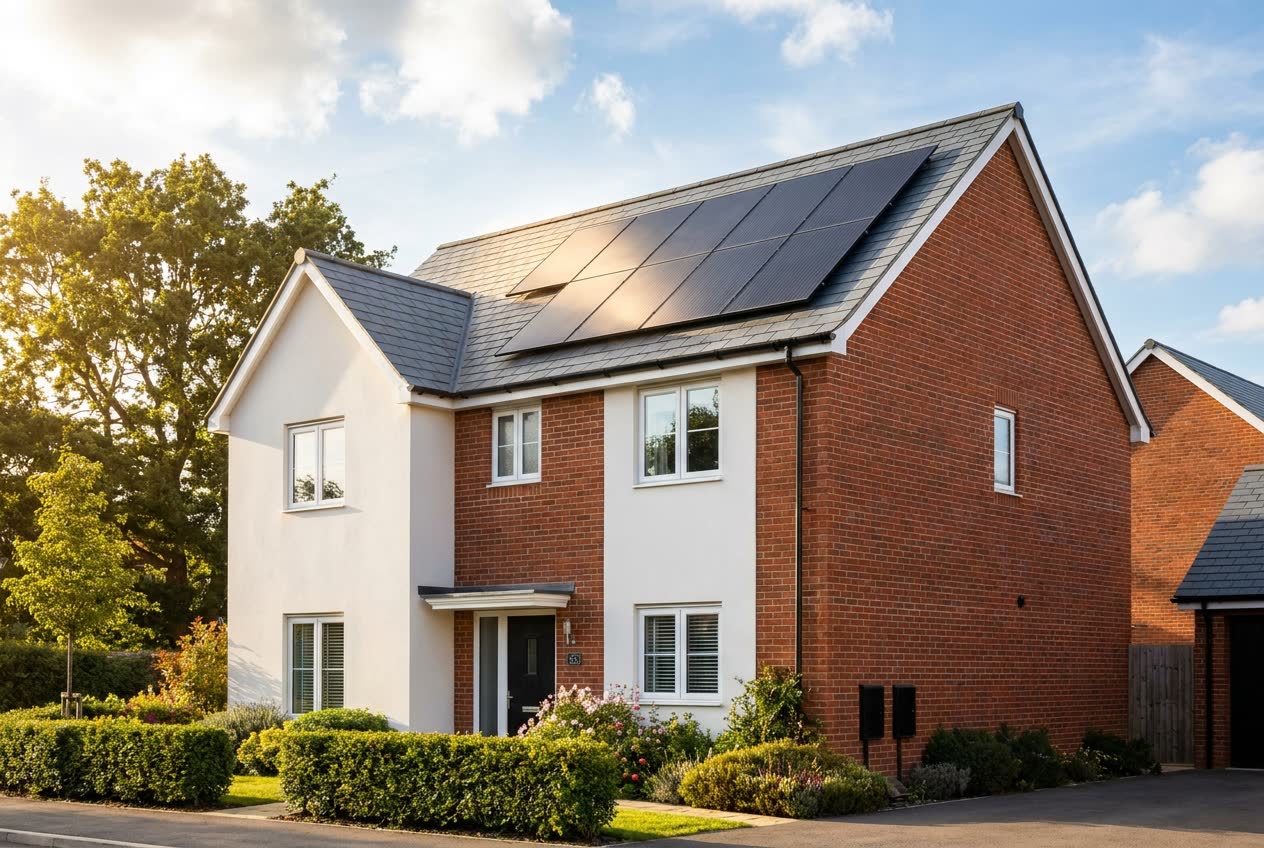
One makes electricity and the other uses it, so solar panels look like the obvious partner for a heat pump. In practice they overlap well for about half the year and barely at all in the coldest months.
Can solar panels power a heat pump?
Not through the winter. The table sets estimated monthly output for a 4 kWp south-facing array on a 35° roof in Manchester, from the European Commission’s PVGIS tool, against the UK’s long-term average heating degree days, a standard measure of heating weather that DESNZ counts against a base of 15.5°C: the colder the day, the higher the number.
| Month | Solar output, 4 kWp south-facing in Manchester (kWh) | Heating degree days per day, UK average |
|---|---|---|
| January | 107 | 10.6 |
| February | 178 | 10.3 |
| March | 312 | 8.7 |
| April | 419 | 6.6 |
| May | 452 | 3.9 |
| June | 443 | 1.7 |
| July | 432 | 0.6 |
| August | 388 | 0.7 |
| September | 324 | 1.9 |
| October | 226 | 4.6 |
| November | 150 | 7.9 |
| December | 113 | 10.3 |
| Year | 3,544 | 5.6 |
Solar: PVGIS 5.3, Manchester, 4 kWp, south-facing, 35° pitch, default 14% system losses. Heating degree days: DESNZ Energy Trends table 7.1, UK average per day, 1991–2020 mean.
Added up, December to February deliver about 11% of the array’s yearly output but about 46% of the year’s heating degree days. May to August flip it: about 48% of the solar and about 10% of the heating degree days.
So plan on buying most of a heat pump’s winter electricity from the grid. That is why the tariff matters as much as the panels, and why the heat pump has to be designed to run efficiently on its own: see do heat pumps work in cold weather? and how an air source heat pump works.
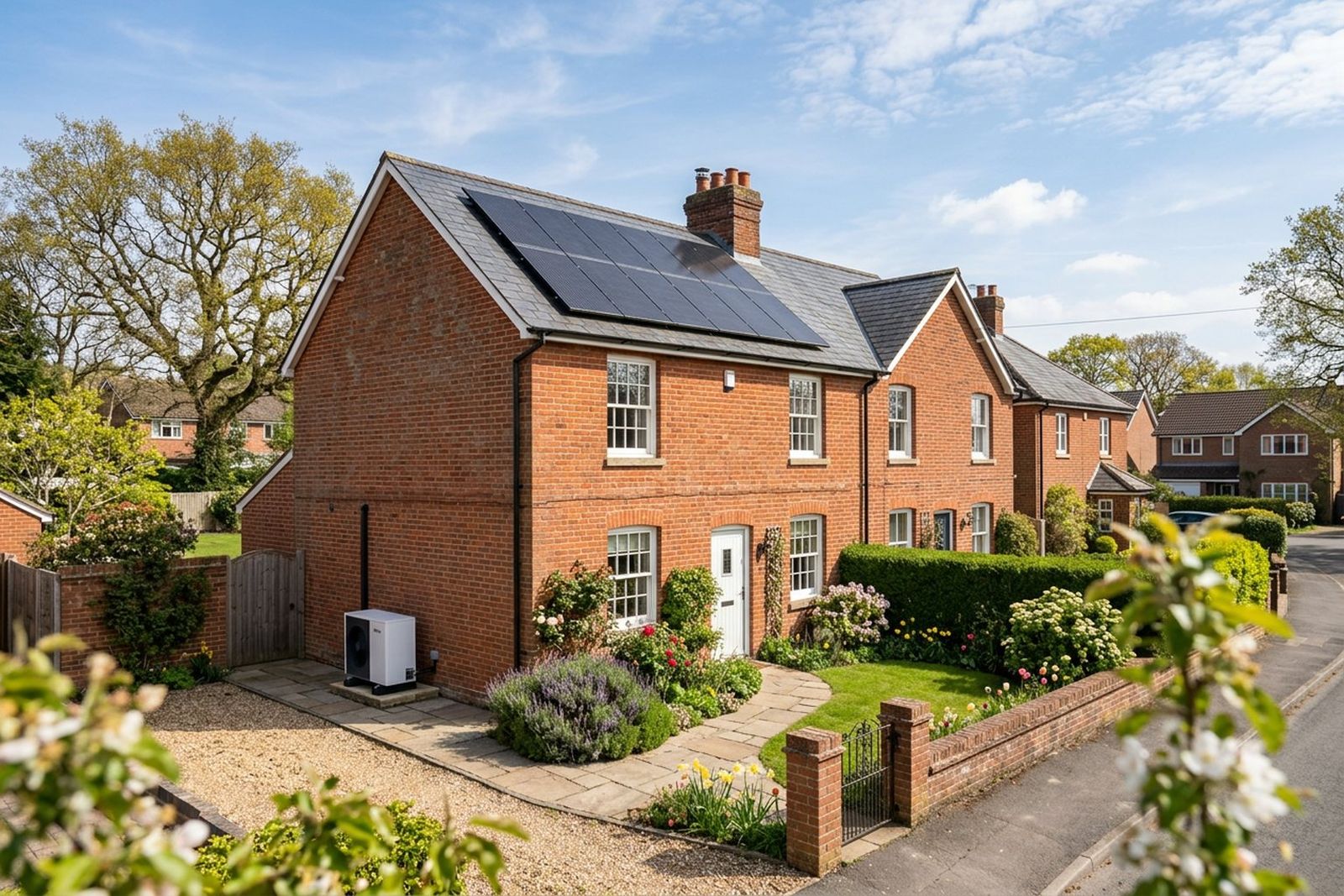
Where solar panels with a heat pump genuinely help
- Hot water from spring to autumn. You need hot water all year. Where your heat pump also heats it (your installer should spell out exactly how yours will be provided), ask whether that can be timed for the middle of the day, when the panels are producing.
- Shoulder-season heating. In March, April, September and October there is both meaningful solar output and real heating demand, so on sunny days more of the heat pump’s electricity can come straight from the roof.
- Using more of your own solar. Without a battery, much of what panels generate is exported because little is running at midday. A heat pump adds daytime demand, so more is used at home, where it is worth more. Our guide to whether solar panels are worth it covers self-consumption in more detail.
- Diverting surplus. A smart diverter automatically sends surplus solar to appliances in the home; HMRC’s VAT guidance names air and ground source heat pumps among the systems one can feed.
One catch when you compare quotes: MCS’s method for estimating how much solar a household uses, MGD 003, does not account for the extra self-consumption from heat pumps, electric water heating or diverters. A solar quote built on it leaves out what your heat pump adds, so treat that part as unknown rather than assume a figure.
What a unit of solar is worth: a worked illustration
An illustration, not a quote or a promise. It shows how the value of a unit you use differs from a unit you export, on the assumptions below. Your roof, usage, tariff and prices will differ, and the price cap changes again on 1 January 2027.
- Generation: the Manchester array above, 3,544 kWh a year.
- Self-consumption: a household using 2,500 to 2,999 kWh a year before the heat pump, with someone in half the day. MCS’s MGD 003 lookup table gives 20% with no battery and 59% with a battery of 5.1 to 6.1 kWh usable capacity, both without the heat pump.
- Electricity you avoid buying: 26.32p per kWh, Ofgem’s cap for 1 October to 31 December 2026 (GB average, Direct Debit).
- Export: 4.5p, 10.8p and 15.4p per kWh, Ofgem’s average rates for export tariffs offered from April 2024 to March 2025: untied (no conditions), all tariffs, and tied to conditions such as buying your electricity, or certain products, from the same supplier. These are simple averages of the tariffs on offer, not of what households actually receive.
| Scenario | Used at home | Exported | Value at 4.5p export | At 10.8p | At 15.4p |
|---|---|---|---|---|---|
| No battery, 20% used at home | 709 kWh | 2,835 kWh | £314 | £493 | £623 |
| Battery of 5.1–6.1 kWh, 59% used at home | 2,091 kWh | 1,453 kWh | £616 | £707 | £774 |
Value = units used at home × 26.32p + units exported × the export rate, for one year, to the nearest pound. It is the value of the panels’ output, not a saving on your current bill, and it does not deduct the cost of the panels or the battery. Ofgem’s report summary gives slightly lower tied and untied averages (14.54p and 4.39p); we use its detailed tables, which match the 10.8p overall figure.
The per-unit gap is where the heat pump comes in. Every 100 kWh it takes straight from the panels, instead of those units being exported, is worth £26.32 rather than £4.50 to £15.40: £10.92 to £21.82 more on these assumptions. How many units depends on your heat pump, hot water and weather, which the MCS tables leave out.
Two cautions. On a time-of-use tariff the electricity your solar displaces may cost less than the cap rate, so self-use is worth less than shown. And the Energy Saving Trust’s August 2026 research found that, strictly on savings, adding a battery to solar panels alone may not justify its cost, because export rates now earn almost as much.
Heat pump, solar and battery: which tariff?
That research, using measured data from 546 homes, found most heat pumps on a standard flat-rate tariff cost the same as or more than an efficient gas boiler to run, while dedicated heat pump tariffs did much better (see heat pump vs gas boiler running costs). It also found batteries paired better with heat pumps than with solar panels, given a suitable tariff: the battery charges off-peak and runs the heat pump through dearer periods.
The Energy Saving Trust does not recommend named tariffs, and neither do we. Its general guidance:
- Heat pump and solar panels: a good Smart Export Guarantee (SEG) tariff for export and a dynamic or heat pump tariff for import, usually from the same company to get a good export rate. Avoid a heat pump tariff with a peak rate, because the heat pump often has to keep running through it.
- Add a battery: the same pairing, but a heat pump tariff with a peak rate may now suit, because the battery can cover the peak and recharge in the cheap periods. If no one company offers both tariffs you want, consider a solar and battery tariff.
Ofgem’s figures support the “same company” point: in 2024–25, export tariffs tied to conditions on offer averaged 15.4p per kWh against 4.5p for untied ones, though some tied tariffs also require a battery or other product from that supplier. Each supplier sets its own rates, which must always be above zero. One rule before you set a battery to export: if your export meter also records electricity from a battery charged from the grid, Ofgem’s guidance says the supplier is not obliged to pay SEG rates on that export. Read our notes on home battery fire safety too.
Roof, orientation and whether to install together
Orientation matters most in winter. PVGIS puts the same array facing east at 2,869 kWh a year against 3,544 kWh facing south, but in December at about 46 kWh against 113 kWh. An east or west roof still helps from spring to autumn; expect very little winter support from it. Our solar sizing calculator gives a first estimate for your roof.
Together or one at a time? Either works. Together, one survey can look at the roof, where the heat pump’s outdoor unit will go and your electricity supply. The network operator must be told about each:
- The national heat pump connection form asks for existing equipment, including solar panels and batteries, alongside a load survey to work out the property’s maximum demand.
- Solar of up to 16 amps per phase is notified within 28 days of commissioning; above that, permission is needed first. MCS says solar and a battery installed together are likely to exceed 16 amps per phase, which means applying before the work.
One at a time is fine too. Size the heat pump from a heat loss calculation (see what size heat pump do I need) and the panels from your roof and usage; neither should be stretched to suit the other. If you already have panels, the Energy Saving Trust suggests adding a heat pump as the most cost-effective next step. And once a grant voucher is issued for an air source heat pump it expires after three months, so do not let solar work delay the heat pump.
Grants, VAT and export payments
- Grant: the Boiler Upgrade Scheme gives £7,500 towards an air source heat pump in England and Wales. Solar panels are not on GOV.UK’s list of what it funds, but Ofgem’s installer guidance confirms a heat pump working with solar panels can still be eligible. See grants and funding and heat pump costs in Manchester.
- VAT: HMRC zero-rates the installation of energy-saving materials in homes until 31 March 2027, including solar panels with their inverter, air source heat pumps, home batteries and smart diverters. From 1 April 2027 the rate is due to return to 5%.
- Export payments: under the SEG you apply to any supplier offering an export tariff, not necessarily your own. You need an export meter capable of half-hourly readings and an export MPAN, and for solar up to 50 kW you must show the installation and installer are suitably certified, for example with an MCS certificate or an equivalent scheme’s. Without that, a supplier is not obliged to pay you, though it may.
Who it suits, and who should wait
The combination tends to make most sense if you are replacing your heating anyway, have a south, south-east or south-west roof with little shade, can use electricity in the middle of the day, already have panels, or are willing to move to a tariff that suits it.
Wait, or do one at a time, if your roof needs replacing soon, is heavily shaded or faces north, you expect to move, or the budget only stretches to one. Then remember the grant covers only the heat pump, and a well-designed heat pump on a suitable tariff matters more to winter bills than panels. See heat pump pros and cons and how to run a heat pump efficiently.
Questions to ask, and where ByEco stands
- What will the panels generate each month, not just each year?
- Does your self-consumption estimate include the heat pump?
- How will my hot water be provided, and can it be timed to use solar?
- What are the figures with and without a battery?
- Which network notifications are needed, and who submits them?
- Will both installations be MCS certified, for the grant and export payments?
ByEco installs both heat pumps and solar panels in England and Wales. Our MCS and TrustMark certification is in progress. Until it is complete we cannot apply for the Boiler Upgrade Scheme grant, which only an MCS-certified installer can claim, so check with any installer how their work will meet the certification that the grant and export payments rely on. Put the questions above to any installer, us included, or get in touch.
Sources
Every figure on this page was checked against primary sources on 5 October 2026. Grant rules, planning rules and prices change — if you are reading this much later, verify before acting.
- European Commission JRC — PVGIS 5.3: Manchester, 4 kWp, 35°, south-facing (queried 5 October 2026)
- DESNZ — Energy Trends: UK weather (ET 7.1, published 29 September 2026)
- Ofgem — Energy price cap: 1 October to 31 December 2026
- Ofgem — Smart Export Guarantee Annual Report, SEG Year 5 (1 April 2024 to 31 March 2025)
- Ofgem — Smart Export Guarantee (SEG): generators
- Ofgem — SEG: Guidance for Generators
- Energy Saving Trust — What really cuts energy bills: heat pump, technology and tariff combinations (12 August 2026)
- Energy Saving Trust — Which energy tariffs are best for renewable technology combinations? (12 August 2026)
- MCS — MGD 003 Issue 2.0: Solar PV Self-Consumption
- MCS — Notifying DNOs
- Energy Networks Association — EVCP & HP Connections Form v3.4 (hosted by MCS)
- GOV.UK — Apply for the Boiler Upgrade Scheme: what you can get
- Ofgem — Boiler Upgrade Scheme guidance for installers V5.1
- legislation.gov.uk — Boiler Upgrade Scheme (England and Wales) Regulations 2022, regulation 15
- HMRC — VAT on energy-saving materials and heating equipment (VAT Notice 708/6)
Book your free home survey
Every home is different. The cost depends on the size of system, any radiators that need upgrading, the pipework and where the outdoor unit goes. Get in touch and we will arrange a free survey of your home and give you a clear quote. If you are happy with it, we can go ahead.