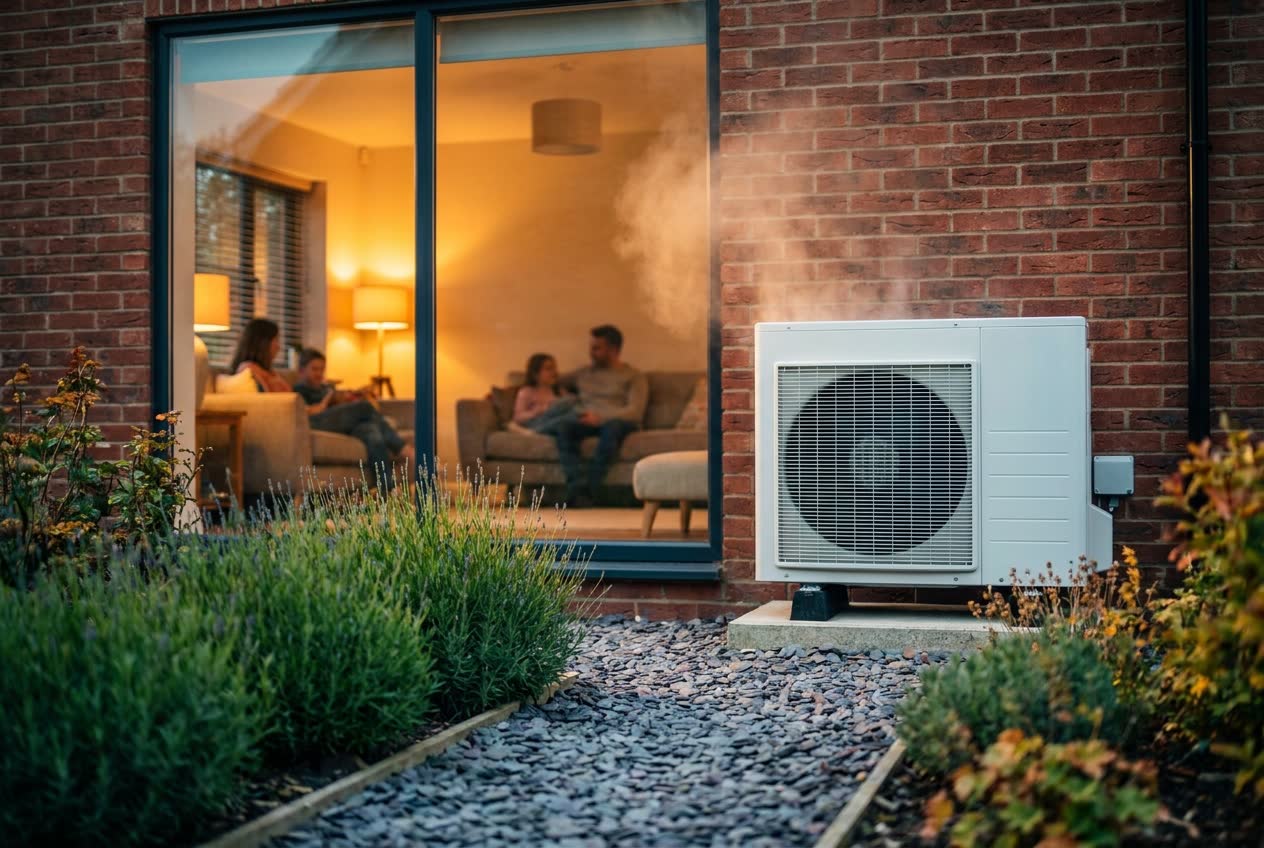
The short version
- Cooler water, less electricity. In the Electrification of Heat trial, the median heat pump made 3.50 units of heat per unit of electricity at a 35°C flow temperature and 2.38 at 55°C.
- Leave it on and use a set-back of a few degrees overnight or when you are out, as the Energy Saving Trust advises.
- Lower the heating curve one degree at a time until the house feels too cold, then go back up one, as the Energy Saving Trust suggests — if your controls let you, and after asking your installer.
- Use TRVs to trim a few rooms, not to shut the house down.
- Your tariff matters. Energy Saving Trust research found most heat pumps on a standard flat-rate tariff cost the same or more to run than an efficient gas boiler.
Boiler habits — short bursts of very hot water, heating off when you go out — work against a heat pump. Here are the settings you can change, the ones to leave to your installer, and what the evidence says.
The one rule: low and steady
The hotter the water a heat pump sends round your radiators (the flow temperature), the more electricity each unit of heat costs; our guide to how an air source heat pump works explains why. The government-funded Electrification of Heat trial measured it in real homes:
| Flow temperature | Median COP (units of heat per unit of electricity) |
|---|---|
| 35°C | 3.50 |
| 55°C | 2.38 |
| Above 65°C | 2.02 |
Source: Electrification of Heat, Heat Pump Performance Data Analysis Report (December 2024), sections 1.4.4 and 10.3. Medians of half-hourly readings across the trial’s air source and ground source heat pumps, measured at the heat pump unit.
By our arithmetic, at those medians each unit of heat needed about 47% more electricity at 55°C than at 35°C (3.50 ÷ 2.38 = 1.47). Treat that as a rough guide: the report notes that hotter water is needed in colder weather, so not all of the gap is down to flow temperature alone. Its conclusion was that systems should be designed and set up to run at low flow temperatures for as much of the time as possible.
Steady matters too. Water hotter than a mild day needs makes a heat pump switch on and off (cycle), which the Energy Saving Trust’s installer toolkit says will significantly reduce its efficiency and product life.
Should I leave my heat pump on all the time?
The Energy Saving Trust’s answer is yes. It says to keep a heat pump on all the time and let a ‘set-back’ hold a lower temperature when you are out or asleep. It adds that, in its view, the longer running time is offset by the heat pump running more efficiently, so overall running costs do not rise.
The reason is speed. The trial’s householder guide says a gas boiler typically heats a house in about half an hour, but a heat pump may take a few hours if the house has gone cold — and turning the thermostat up will not speed it up. Switch off for a few hours and, the toolkit notes, the heat pump has to run at a high temperature to catch up when you return.
Heat pump night setback: keep it modest
The Energy Saving Trust and the trial guide both describe a set-back of a few degrees; neither gives a single right number, so start small. The trial guide warns that letting the temperature drop too low takes more time and energy to recover. The Energy Saving Trust also advises against heating the house or hot water overnight, when the air can be 5°C or more colder, unless you are on a time-of-use tariff.
One catch: in University of Salford tests in a single laboratory test house, a 2°C set-back on a heat pump running on weather compensation alone left rooms short of their target in the heating periods too. The researchers concluded some room influence is needed where the curve closely matches the house’s heat loss, so if your house never quite catches up after a set-back, ask your installer.
Going away? Use the holiday setting, not the power switch: Grant says frost protection on its Aerona³ will not operate if the supply is switched off at the external isolator. See do heat pumps work in cold weather? for frost and defrosting.
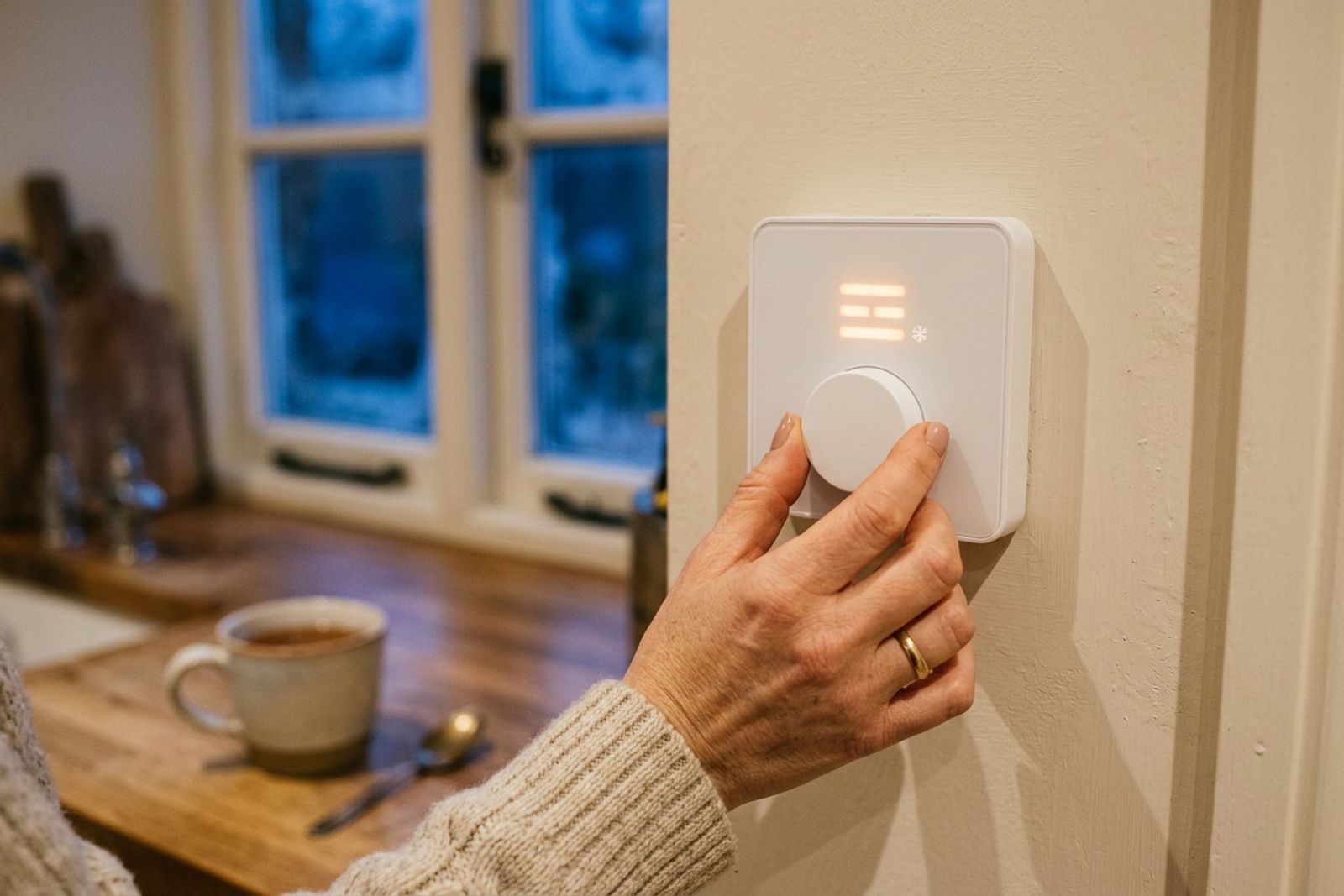
Heat pump flow temperature and weather compensation
Weather compensation automatically adjusts the flow temperature as the outside temperature changes, using a sensor on the outdoor unit or an outside wall: warmer water on a frosty day, cooler in a mild spell. The MCS installation standard says it should be enabled wherever it can optimise efficiency. The setting that links outdoor temperature to flow temperature is the heating curve; controllers set it as a line between a maximum and minimum, as numbered curves, or with a simple offset.
How to adjust it gradually
The Energy Saving Trust says installers sometimes set the curve high to be safe, and you may be able to lower it significantly without feeling cold. If your controls allow it, turn it down one degree at a time through the winter until your home feels too cold, then put it back up one. Lower water temperatures make the house slower to warm in cold weather, so give each change time to settle. The Salford researchers suggest lowering the flow temperature until the least well-heated room is just comfortable, then fine-tuning other rooms. Ask your installer first which settings are yours to change: the Energy Saving Trust also says some settings, including weather compensation, should not be changed unless you know what you are doing.
Signs the curve is set too high or too low
- Too high: rooms overshoot, TRVs keep shutting, or the heat pump stops and starts a lot in mild weather. A ‘heating blocked’ message might mean it is running too hot, says the Energy Saving Trust.
- Too low: the house misses your set temperature on cold days, or you need the ‘heating boost’ backup heater regularly — which the Energy Saving Trust says can mean the curve is wrong or the radiators are too small (see do I need new radiators?).
Heat pump thermostat settings and TRVs
Set the room thermostat as low as you are comfortable with. The trial guide says a lower setting makes the heat pump more efficient, and that most UK households report being comfortable at 18 to 21°C. If the house has reached its setting and you are still cold, go up a degree. Radiators feeling less hot than with a boiler is normal.
Thermostatic radiator valves (TRVs) need care. A laboratory study reported in January 2026 used one test house: the University of Salford Energy House, a replica Victorian end-terrace inside a climate chamber, funded by BEAMA, a trade association for manufacturers and providers of energy technologies. Using TRVs to trim three rooms (43% of the house’s volume) by 2 to 3°C cut space heating energy by 6–8% without affecting efficiency. But smart TRVs on every radiator, used for a whole-house set-back, significantly increased cycling and cut efficiency by 5%, so no energy was saved. The researchers concluded that whole-house set-backs belong on the heat pump controller, with TRVs as a secondary control, and that a curve set too high can make TRVs close so much that, in extreme cases, flow drops below the minimum.
They also caution that the result may not apply to all households, heating systems and heat pumps; the test system had a volumiser (extra water volume) and an automatic bypass valve. They say using TRVs needs enough water volume and flow, and recommend fitting both.
Turning radiators right down in unused rooms was not tested, so do not turn TRVs right down in lots of rooms at once, and ask which radiators should stay fully open.
Heat pump hot water schedule and the legionella cycle
How your hot water is provided depends on your system, and your installer should spell it out at handover. Where a heat pump heats stored water, lower is more efficient: the Energy Saving Trust’s toolkit says most heat pumps heat hot water to 50–55°C very efficiently, with a periodic sterilisation cycle taking it to 60°C.
For timing, the Energy Saving Trust suggests the lowest-priced period on a time-of-use tariff; when solar panels generate most if you have them; otherwise the middle of the afternoon, when the air is generally warmest. Grant recommends that on its Aerona³ hot water periods are set for when the heat pump is not heating the house.
The anti-legionella cycle
The Health and Safety Executive says legionella bacteria can grow in water between 20 and 45°C, and its guidance says stored hot water should be at least 60°C to kill them. That guidance is aimed at employers, landlords and others in control of premises, but it explains why a system that stores hot water may run a legionella cycle. MCS design standards require hot water systems to include a means of preventing bacterial growth, noting that a risk assessment can help set how often a pasteurisation cycle runs.
Frequency affects bills. The Energy Saving Trust says high bills can mean the cycle runs too often, and that for most households weekly is safe. Ask your installer what frequency and temperature they set, and have it run when electricity is cheaper. Do not just switch it off: on the Grant example, turning off the immersion timer’s isolation switch stops the anti-legionella function working.
Choosing a heat pump tariff
A single-rate tariff charges the same all day; under Ofgem’s price cap for 1 October to 31 December 2026 that averages 26.32p per kWh for electricity (Great Britain, Direct Debit). A multi-rate tariff such as Economy 7 has peak and off-peak rates.
In research published in August 2026, the Energy Saving Trust modelled around 1.1 million technology and tariff combinations using data from 546 homes. Most heat pumps on a standard flat-rate tariff cost the same or more to run than an efficient gas boiler. It estimated a heat-pump-appropriate tariff (a dedicated heat pump tariff, or a dynamic tariff whose price can change every 30 minutes) could be worth up to £330 a year on heating bills — a modelled scenario, not a promise for your home.
The catch: time-of-use tariffs charge more at some times of day, so you could still be better off on a standard tariff, and Economy 7 suits heat pumps poorly because they often run through the day at the peak rate. Check when your heat pump actually uses electricity before switching. Our running costs comparison does the sums, and heat pumps and solar panels covers pairing the two.
Simple upkeep that keeps it efficient
- Keep the outdoor unit clear of bikes, bins, leaves and snow, and never cover it.
- Act on warning messages: check the fault log and report repeat faults.
- Water treatment and a filter: if you have neither, the Energy Saving Trust says to consider them as soon as possible.
- Know your normal pressure. On the Vaillant aroTHERM plus, for example, the heating circuit is filled to 1.5 to 2.0 bar and the unit shuts down with a fault below 0.5 bar. Report a falling reading.
- Check pipe insulation has not slipped or been missed.
- Get it serviced, usually once a year — see how long do heat pumps last?
Your first winter: a checklist
- Get the installer to show you the controls and leave the handover pack.
- Leave it on, with a modest set-back instead of off periods.
- Lower the heating curve a degree at a time; go back up one when it gets too cold.
- Set the thermostat as low as is comfortable, and trim rooms with TRVs sparingly.
- Move hot water heating to a cheaper or warmer time, and check the legionella cycle frequency.
- Check whether a heat pump or time-of-use tariff suits you.
- Keep the unit clear, and call your installer if the boost heater runs often in ordinary weather.
What to ask your installer, and where ByEco stands
- What flow temperature was the system designed for? (The MCS handover document records it.)
- What is the heating curve set to, and which settings can I change?
- Which radiators should stay fully open?
- How is my hot water provided and scheduled, and how often does the legionella cycle run?
- When should the backup heater come on, and what should the pressure read?
ByEco is based in Manchester and installs air source heat pumps in England and Wales, mostly across Greater Manchester (see heat pump installation in Manchester). ByEco’s MCS and TrustMark certification is in progress. The £7,500 Boiler Upgrade Scheme grant can only be claimed through an MCS-certified installer; see our Boiler Upgrade Scheme guide. For a straight answer on setting up a heat pump for your home, get in touch.
Sources
Every figure on this page was checked against primary sources on 5 October 2026. Grant rules, planning rules and prices change — if you are reading this much later, verify before acting.
- Energy Systems Catapult for DESNZ — Electrification of Heat Demonstration Project: Heat Pump Performance Data Analysis Report (December 2024)
- Energy Systems Catapult — Electrification of Heat: Your new heat pump (householder guide)
- Energy Saving Trust — The most efficient way to run a heat pump (updated 19 May 2026)
- Energy Saving Trust — Your heat pump questions answered by our experts (updated 27 May 2026)
- Energy Saving Trust — We looked at over a million heat pump, technology and tariff combinations (12 August 2026)
- Energy Saving Trust Green Heat toolkit — Weather compensation and other controls
- Energy Saving Trust Green Heat toolkit — Heat pump myths
- University of Salford Energy House Labs for BEAMA — Air Source Heat Pump TRV Salford Energy House Test (January 2026)
- MCS — MIS 3005-D:2025 The Heat Pump Design Standard, Issue 2.0
- MCS — MIS 3005-I:2025 The Heat Pump Installation Standard, Issue 1.0
- MCS — Heat Pump Handover Document
- Health and Safety Executive — What Legionnaires’ disease is and typical symptoms
- Health and Safety Executive — Hot and cold water systems: things to consider
- Health and Safety Executive — Legionella and Legionnaires’ disease
- BEAMA — The trade association for energy infrastructure and systems
- Ofgem — Energy price cap unit rates and standing charges
- Grant — Aerona³ air to water heat pump range: User Instructions (DOC 0112 Rev 1.1, January 2023)
- Vaillant — aroTHERM plus VWL 35/6 to 75/6 A S2 operating, installation and maintenance instructions
Book your free home survey
Every home is different. The cost depends on the size of system, any radiators that need upgrading, the pipework and where the outdoor unit goes. Get in touch and we will arrange a free survey of your home and give you a clear quote. If you are happy with it, we can go ahead.