The short version
- Household main fuses typically range from 60A to 100A, and heat pumps typically demand between 16A and 32A, so many homes have room. The real test is the maximum demand of the whole home.
- The installer checks the main fuse, consumer unit, earthing and bonding, cable route and other big loads.
- A looped supply (one cable shared with a neighbour) is the usual complication. It means applying to the network operator before connecting, and may mean new cabling and groundworks.
- Your Distribution Network Operator (DNO) must be told every time, either within 28 days after installation or by application before connection.
- Standard unlooping is not normally charged to the customer. A move to three phase is.
A supply issue found late can hold up a job, so it is worth knowing what is involved. For how this fits into the whole visit, see what happens in a heat pump survey.
Why many homes need no upgrade, and when they do
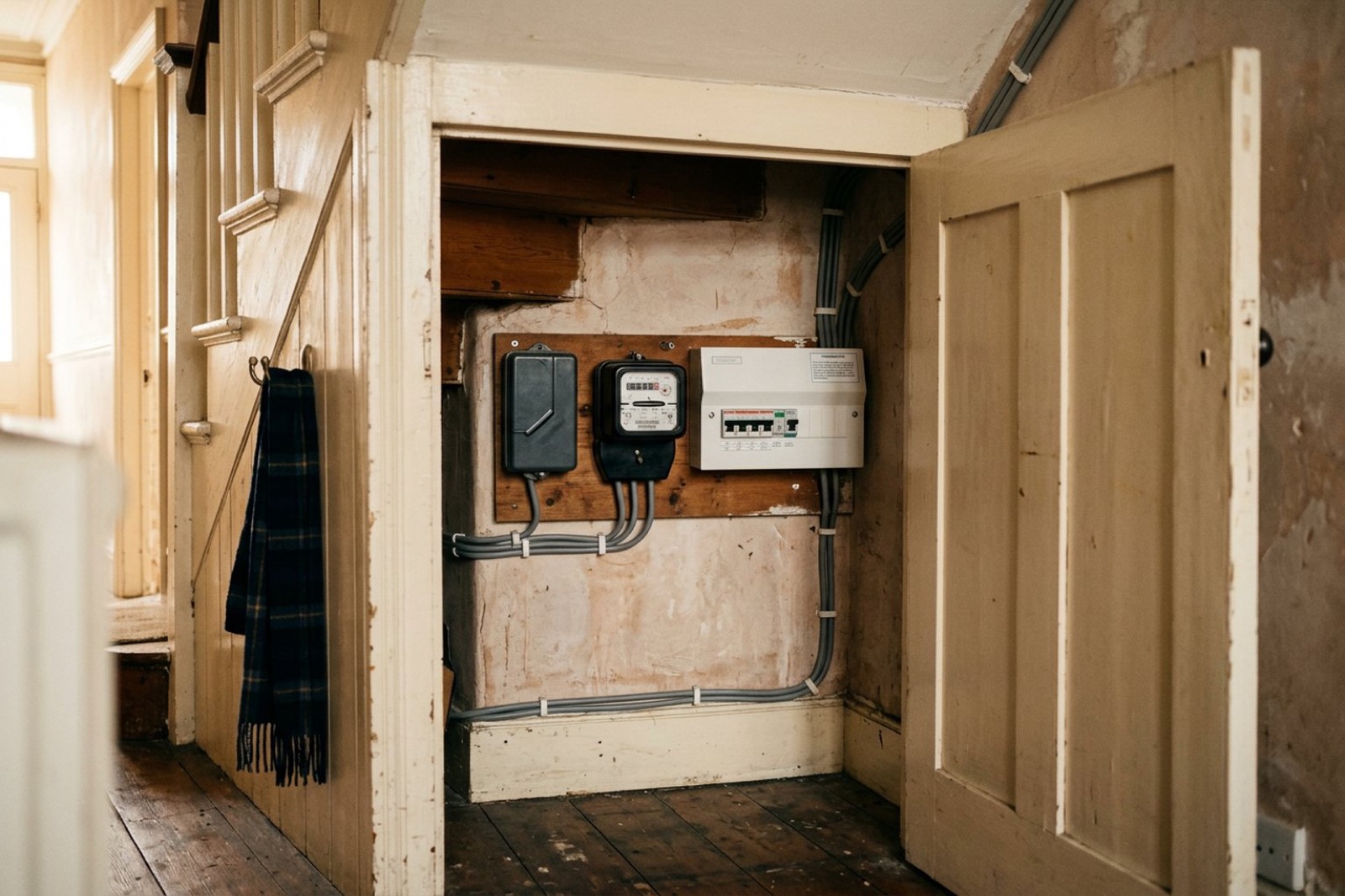
Your home’s supply ends at the cut-out, the sealed unit that houses the main fuse. A government-commissioned report on looped connections says that fuse typically ranges from 60A to 100A, while heat pumps typically demand between 16A and 32A depending on the home’s heating needs. It adds that in operation a heat pump “is almost never going to draw the full power”.
So the question is what else runs at the same time. The same report puts an electric shower at 7–10kW and a single-phase EV charger at up to 32A (7kW). Add those to a heat pump and a 60A fuse starts to look tight. SP Electricity North West, the network operator for the North West of England, says heat pumps can use as much electricity as a domestic power shower “but for much longer”.
That is why the installer works out your maximum demand: the national connection form requires a load survey of the whole home plus the new equipment. You are more likely to need work if demand comes close to your fuse rating, the supply is looped, the equipment at the meter has a safety problem, or the heat pump is large. See also how much electricity does a heat pump use?
What is checked on your electrics
MCS’s design standard, MIS 3005-D, says the installer must make sure the electricity supply is adequate for the size of heat pump specified. For new electrical work, Approved Document P says the existing installation should be checked so that existing equipment, including the distributor’s, can carry the extra load, adequate protective measures are used, and earthing and bonding are satisfactory. In practice, expect these checks:
| What is checked | What they are looking for |
|---|---|
| Main fuse (cut-out) rating | The rating sets the limit. If it is unknown, the DNO can confirm it, and a photo can be sent with the form. |
| Maximum demand | A load survey of the whole home plus the heat pump. |
| Consumer unit and spare way | Whether there is space for the new circuit, or whether a separate or replacement unit is needed. |
| Earthing and bonding | Whether the arrangements are satisfactory before new work is added. |
| RCD and circuit protection | What protection the new circuit needs, which the electrician decides under BS 7671, the UK wiring standard. |
| Cable run | The route and size of the cable from the consumer unit to the outdoor unit. |
| Other big loads | EV chargers, batteries, solar, electric heating, electric showers and similar. |
| Looped supply and meter details | Signs of a shared cable, the meter type and the MPAN (your supply number). |
Do not open the cut-out yourself: the form says it must not be opened unless authorised. Approved Document P says the existing wiring only has to be upgraded if the new work affects its safety or cannot be operated safely because of its condition, so ask your electrician what must change and what is merely advisable. If you have or plan solar panels, a battery or an EV charger, mention them at the survey.
What if you have a looped supply?
A looped service is where two or more properties share a single service cable from the main network. The cable enters the first house, then a second cable runs from that meter position to the next. SSEN says this is no longer installed today but is still found in many older terraced and semi-detached homes, and the government report estimates that 11–17% of homes in Great Britain may be affected. If you live in one, see also our guides to terraced houses and semi-detached houses.
A looped service is safe to use, National Grid says, but may need to be removed if you or your neighbour need more power, for example for a heat pump. A common sign is two cables entering the bottom of the cut-out, below the fuse, rather than one. It is not always visible, so the operator may need a photo or a visit.
Unlooping means running a new cable from the main network. It normally involves digging, often on a driveway, and your neighbour has to be involved. The operator reinstates the surface and discusses the work with you both first. The government report says several operators may fit a load limiter as a short-term measure until unlooping can be scheduled, though this is more likely for EV chargers, and other operators do not use them.
Watch the timing. One operator told the government’s researchers unlooping takes 3–12 weeks where there are no complications, and up to 6 months to a year or longer if there are issues such as a neighbour dispute. Under the scheme regulations, an air source heat pump voucher from the Boiler Upgrade Scheme expires three months after it is issued. That is not a rule linking the two, but if your supply is looped it makes sense to raise it with your installer early, ideally before the grant is applied for.
Single phase or three phase?
Most homes have a single-phase supply. SP Electricity North West describes a standard domestic supply as single phase, and the government report calls three-phase homes rare. The operator’s standard three-phase connection offers 80 amps per phase.
The threshold that matters for most heat pumps is 32A. That is the limit for the simpler notification route, and SP Electricity North West expresses it as 7.36kW of AC electrical input. This is the power the heat pump draws, not the heat output quoted in its name, so a heat pump’s rated size is not a direct guide. The installer should check the figure for the specific model, and heat pump sizing matters here. SP Electricity North West says an upgrade to three phase comes in where a single-phase supply rated between 60 and 100A would need more than 100A after the demand calculations.
Connect and notify or apply to connect?
MIS 3005-D says the installer must make sure the installation is notified to the DNO under the procedures published by the Energy Networks Association (ENA), with permission sought in advance where necessary. Both routes use the same national form.
Connect and notify means the installer can connect the heat pump, then notify the DNO within 28 days of installation. On the form, all of these must be true:
- Only one additional piece of equipment is being connected.
- The cut-out rating is known, there are no safety concerns or other issues with the DNO’s equipment, and the supply is metered.
- It is not a looped service.
- Maximum demand is below the cut-out rating and, on ordinary whole-current metering, below 13.8kVA per phase (60A) unless the load is limited to below the fuse rating.
- The heat pump system is under a single controller, with a maximum demand of 32A or less.
- The model is marked “Connect and Notify” in the ENA’s heat pump database.
Apply to connect applies if any of those fail. The application must go in before the equipment is connected, and the installation may only take place after DNO approval. Where maximum demand is above 60A and up to 100A, the DNO should assess the supply capacity and confirm within 10 working days of receiving the completed form. Above 100A, different timescales apply. Installing an EV charger at the same time as a heat pump also fails the one-device test, so it needs an application.
Who submits it? Normally the installer, and MCS puts the duty on them, though the Energy Saving Trust notes the homeowner can do it too. To find your DNO, use the first two digits of the MPAN on your bill. For example, SP Electricity North West covers the North West of England, SP Energy Networks covers Merseyside and North Wales, and National Grid covers the Midlands, South West and South Wales.
Who pays for a supply upgrade?
It depends on the work, and it is the network operator’s charge rather than the installer’s.
| Work | Who usually pays |
|---|---|
| Standard unlooping | Usually not you. The government report says all DNOs state the customer does not pay and the cost is spread across bill payers. SSEN says this depends on eligibility criteria, such as a typical household supply of up to 100A per phase. |
| Extra work during unlooping (such as moving the meter) | You may have to pay. |
| Main fuse, cut-out or service cable upgrade | Often the DNO, but ask your network operator before you rely on it. Ofgem said in 2021 that DNOs funding this was in consumers’ interests, for fuses up to that operator’s standard size at single premises fused at 100A or less per phase. |
| Network reinforcement | Usually not you, but check. Since April 2023 network operators have funded reinforcement for most customers taking power from the network. SP Electricity North West’s charging statement says it fully funds it for an existing home that stays on a service fused at 100A or less per phase with ordinary metering, subject to conditions. The national form still warns it may be charged to you, and the operator says larger heat pumps may need an upgrade that could incur a cost. |
| Single phase to three phase | You. The government report says the consumer is responsible for this cost. |
Policies can change. SP Electricity North West’s Lancaster trial page says unlooping is currently done at no charge “but this could change in future”, and Ofgem accepted in 2021 that it might not be able to enforce its view on fuse and cut-out funding, so ask your operator what applies to you now. The cost of any chargeable network work depends on your property, and the network operator quotes it.
Work inside your home, such as a new circuit or consumer unit, is separate and part of the installer’s quote. Installers on MCS’s redeveloped MCS:2025 scheme commit to telling you about additional work and its cost at the quotation stage. MCS is moving installers to that scheme in phases, so if yours is not yet on it, ask for the same thing. The total depends on your property: the system size, any radiator or pipework changes, the outdoor unit position and pipe run, hot water and electrical work. See heat pump costs in Manchester and how to compare heat pump quotes.
Part P and your electrical certificates
Part P is the electrical safety part of the Building Regulations. In England, Approved Document P makes a new circuit or a replacement consumer unit notifiable, and a heat pump normally has its own circuit. The Welsh edition likewise lists new circuits back to the consumer unit as notifiable.
In England the work must be certified in one of three ways: by a registered competent person who self-certifies, by a registered third-party certifier, or by a building control body. The Welsh edition sets out two routes: a registered competent person or a building control body. A registered installer should give you a BS 7671 electrical installation certificate, and the occupier should receive a Building Regulations compliance certificate.
Keep both with your heat pump paperwork. GOV.UK says a competent person certificate shows up in solicitors’ searches when you sell. Your installer may use a separate electrician, as long as you know who certifies the work.
What to ask, and where ByEco stands
Before you sign, ask any installer:
- What is my main fuse rating and calculated maximum demand with the heat pump?
- Is my supply looped, and how do you know?
- Is this model connect and notify, and who sends the form?
- Is any work needed from the network operator, and who pays for it?
- Who will certify the electrical work?
We are MCS certified for air source heat pump installation (certificate IAA10330), and we apply for the £7,500 Boiler Upgrade Scheme grant on your behalf, where you may be eligible. Get in touch for a free survey: we will check your electrics alongside the rest of your home, explain anything the network operator needs to do and give you an itemised quote. If you are happy with it, we go ahead. See our air source heat pump service, read about grants and rebates or book a free survey.
Sources
Every figure on this page was checked against primary sources on 31 October 2026. Grant rules, planning rules and prices change — if you are reading this much later, verify before acting.
- Energy Networks Association — EVCP & HP Connections Form v3.4 (copy hosted by MCS)
- MCS — Notifying DNOs
- MCS — MIS 3005-D:2025 Heat Pump Design Standard, Issue 2.0 (5 December 2025)
- MCS — MIS 3005-D The Heat Pump Design Standard, Issue 3.0 (5 December 2025)
- MCS — Customer Commitment, MCS:2025 2.0, Issue 1.1 (8 September 2026)
- MCS — Transitioning to the redeveloped scheme
- SP Electricity North West — Heat pumps
- SP Electricity North West — Unlooping
- SP Electricity North West — Lancaster unlooping trial
- SP Electricity North West — Three phase power connection
- SP Electricity North West — Upgrade or reduce your supply
- SP Electricity North West — Statement of methodology and charges for connection, v5.9 (1 June 2026)
- DESNZ / Eunomia — Unlooping Electricity Network Connections Research: summary report (2026)
- Ofgem — Clarification on the treatment of service upgrades for existing distribution connections (3 December 2021)
- Ofgem — Access and Forward-looking Charges Significant Code Review: final decision (2022)
- Ofgem — Decision on DCUSA DCP406, Access SCR changes to the charging methodology (2023)
- National Grid — Identifying Looped Services
- SSEN — Looped Service
- Energy Saving Trust — Heat pump installer toolkit: Electrical load check
- GOV.UK — Approved Document P: Electrical safety – dwellings, 2013 edition (England)
- Welsh Government — Approved Document P: electrical safety (dwellings), 2006 edition incorporating 2010 amendments
- GOV.UK — Building regulations approval: use a competent person scheme
- legislation.gov.uk — The Boiler Upgrade Scheme (England and Wales) Regulations 2022, regulation 15
Book your free home survey
Every home is different. The cost depends on the size of system, any radiators that need upgrading, the pipework and where the outdoor unit goes. Get in touch and we will arrange a free survey of your home and give you a clear quote. If you are happy with it, we can go ahead.