The short version
- There is no universal answer. An older boiler in a home that suits a heat pump points one way; a newer boiler in a draughty house points the other.
- Your boiler does not appear to need to be broken for the Boiler Upgrade Scheme. GOV.UK and Ofgem talk about replacing your heating system, and we found no rule that it must have failed.
- It must be fully replaced, though. Ofgem says you cannot keep a fossil-fuel system alongside a grant-funded installation, so a working gas or oil boiler cannot stay as a backup.
- You may be eligible for £7,500 towards an air source heat pump. Installed heat pumps in homes are zero-rated for VAT until 31 March 2027, then 5%.
- A survey does not commit you to anything, and it can turn a guess into a plan before your boiler makes the decision for you.
A boiler breakdown is a poor moment to weigh up a bigger change. This guide sets out the case both ways, so you can decide on your own timetable.
Should you replace a boiler that still works?
You might, if your boiler is getting old, your home suits a heat pump and you have decided you want one. You might sensibly leave it, if the boiler is fairly new or the house needs other work first. Age alone does not settle it.
The useful question is often not “now or later?” but “what will I do on the day it stops working?” If you have had a survey and know your answer, you can keep using the boiler for as long as it makes sense. If you do not, a breakdown in cold weather may choose for you.
The government’s Warm Homes Plan sets an aim for heat pumps to become increasingly the choice for households “replacing an existing heating system at the end of its life”, and says consumer choice is at the heart of the plan. So waiting for the end of a boiler’s life is a route the plan itself anticipates. The risk is arriving there unprepared.
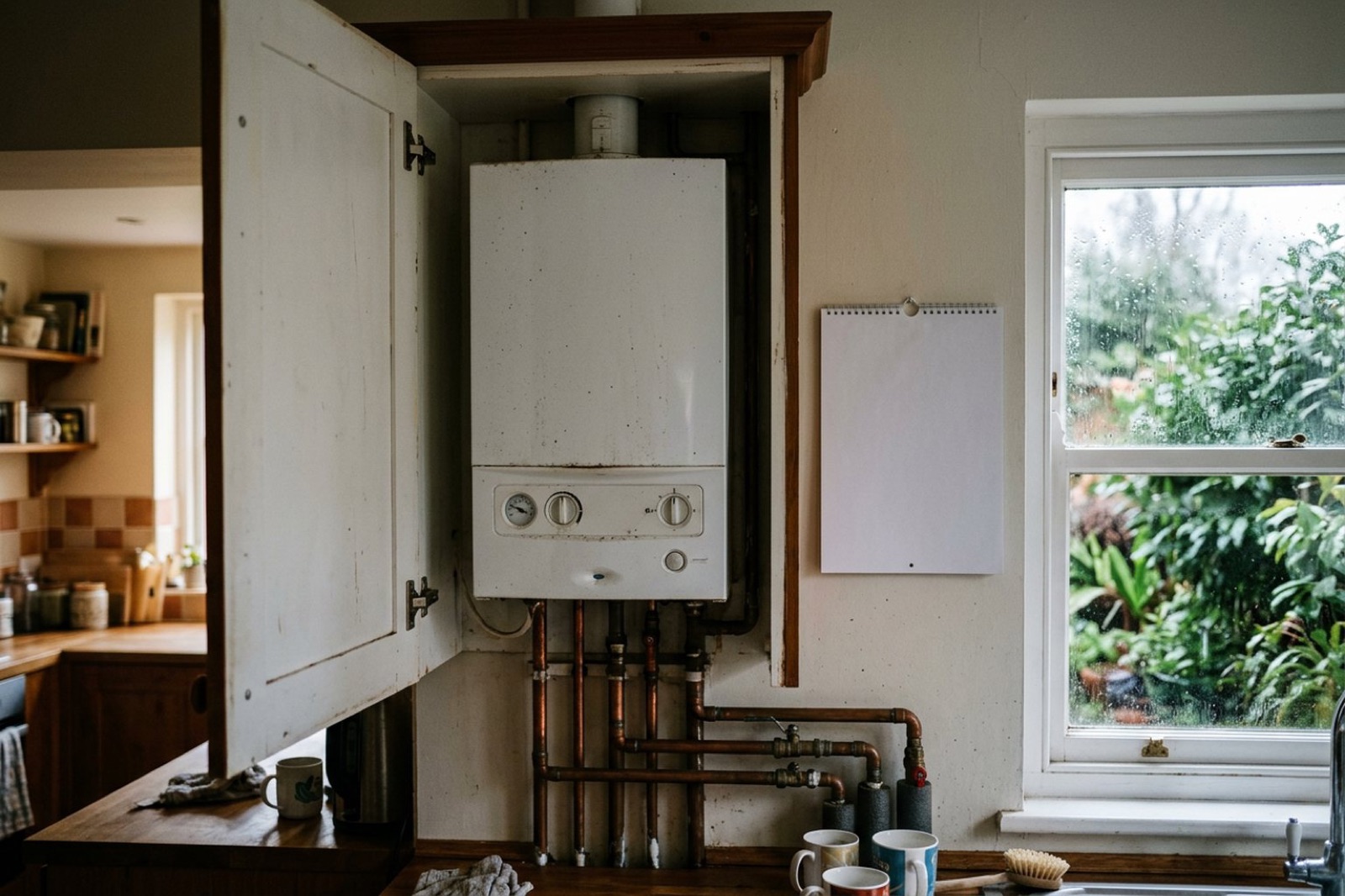
Does your boiler have to be broken to get the grant?
As far as we can find, no. GOV.UK says you must own the property and be replacing fossil fuel heating, such as oil, gas, electric or LPG. Ofgem’s guidance says the previous system “being replaced” must have been fossil-fuel based or electric without a heat pump. We read both, along with the regulations, and none of them says the old system must have stopped working. It is the rules’ silence that we are relying on, though, not a sentence saying so, and your installer should confirm your eligibility before applying.
The firm requirement is the other way round. Ofgem says “any existing fossil-fuel heating system (such as a gas or oil boiler) must be fully replaced”, and “You cannot keep a fossil-fuel heating system alongside a BUS-funded installation.” GOV.UK also says you cannot get a grant for a hybrid system such as a gas boiler plus a heat pump. So keeping a good boiler as a spare is not an option under the grant. If that appeals, read our guide to hybrid heat pumps.
Not everything has to go. Ofgem’s installer guidance says components can be kept if they are in good condition and suitable, and lists pipework, radiators, hot water cylinders and heating controls among them. Whether yours are suitable is a design question. You can read more in do I need new radiators for a heat pump? and our full guide to the Boiler Upgrade Scheme.
The case for planning ahead
A boiler swap is usually a fairly contained job. A heat pump is a design exercise, and each stage below needs some time and some decisions from you:
- Survey. Ofgem says your installer should come to your property to carry out a heat loss assessment and provide a quote and bill impact assessment.
- Design. Under the MCS design standard, the heat pump has to meet at least 100% of the calculated heat load without help from a supplementary electric heater. That sets the size. See what size heat pump do I need?
- Possible radiator or pipework changes. Some homes need few, others need more, and you may want to schedule them around decorating.
- Outdoor unit and hot water. You will need to agree where the unit goes, and your installer should spell out how hot water will be provided.
- The grant. Your installer applies and Ofgem contacts you to confirm that the installer is acting on your behalf. Ofgem says a voucher can only be issued once it has assessed the information it needs.
- Comparing quotes. This takes time you will not have in a hurry. Our guide to comparing heat pump quotes explains why it matters.
When a boiler fails in cold weather, the pressure is to get heating back quickly, and a replacement boiler is usually the faster way to do it. That is a perfectly reasonable choice. But it is a long-term decision made in a hurry.
What is time-limited, and what is not
These are the dates that matter as of November 2026. None of them should push you into a rushed decision.
VAT: a real date
HMRC Notice 708/6 says a zero rate applies to installing energy-saving materials, which include air source heat pumps, in homes until 31 March 2027, and that from 1 April 2027 these installations revert to the reduced rate of 5%. If you are already planning to go ahead, it is worth asking your installer whether your job can realistically be finished by 31 March 2027 and how VAT would be handled if it cannot. If you are not ready, it is not a reason to skip a proper design.
The grant: funded for now, no promises either way
You may be eligible for £7,500 towards an air source heat pump. In the Budget on 28 October 2026 the government said it would “maintain the Boiler Upgrade Scheme at current funding levels of £400 million in 2027‑28 and rising broadly in line with inflation thereafter”. That is about the scheme’s budget, not any individual application. Separately, Ofgem gives 31 December 2029 as the final date on which it can issue vouchers under the current regulations. That is some way off and could change. We are not predicting that the grant will end sooner, and we would not tell you to act because it might. The rules and amounts can change, so check GOV.UK when you are ready.
The grant also has its own timing. Once Ofgem issues a voucher for an air source heat pump, it is valid for three months from the date of issue. That is another reason to apply when you are ready to install, rather than “just in case”.
Your boiler: the date nobody can give you
An older boiler, one with repeat faults, or one where an engineer warns that parts are getting hard to find is a reason to plan sooner. It is not proof that it will fail this winter. A boiler that is well maintained and working safely can reasonably stay while you do that.
Gas standing charges: a plan, not a fact yet
The Budget also said the government has asked Ofgem to abolish gas standing charges on domestic bills, “aiming for delivery by the end of 2027 or as soon as possible after then”, with the costs recovered through gas unit rates instead. That could change the sums for some households, in either direction, and the details are not settled. We would not base a heating decision on it yet. For what happens to your gas connection after a switch, see your gas supply after a heat pump.
The case for waiting
There are good reasons not to replace a working boiler yet.
- Your boiler is fairly new. It is a working asset that you have already paid for. Taking out a modern, efficient boiler early is hard to justify unless you have other reasons to switch.
- The building needs work first. Ofgem says heat pumps perform best in a well-insulated home, and that insulation such as cavity wall or loft insulation can significantly reduce heat loss. Reducing heat loss first may mean a smaller system or fewer radiator changes. Ofgem suggests discussing this with your installer as part of the design, so ask what, if anything, is worth doing first.
- A heat pump may not suit your home yet. Space for the outdoor unit, the state of the pipework, or planned building work may all make it better to wait.
- You are moving or extending. A design is for the house as it will be, so finish those plans first.
- The budget is not there yet. Cost depends on your property, and there is nothing wrong with waiting until the numbers work. Our heat pump cost guide explains what affects the price, and heat pump pros and cons gives a balanced view.
Running costs are part of this too, and we cannot make a promise about yours. They depend on your home, your tariff and how the system is designed and run. See our comparison of heat pump and gas boiler running costs, and ask your installer for the bill impact assessment.
A simple decision list
These are our rules of thumb, not formal guidance. Your survey may change the answer.
| Your situation | A sensible next step |
|---|---|
| Older boiler, repeat faults, and you want a heat pump | Get a survey and quotes now, and plan the switch before it fails |
| Older boiler, working well, undecided | Get a survey so you know your options, then keep servicing the boiler until you decide |
| Fairly new boiler, working well | Keep it for now, and do any insulation and draught-proofing work you have planned |
| Boiler working, but the home needs fabric work | Do the fabric work first, or ask an installer to design around it |
| Boiler has failed and the house is cold | Ask an installer what is possible and when, then choose with the facts. A replacement boiler may be the right call |
| Planning to move soon | Leave the decision until you know where you will be living |
What a survey tells you, and where ByEco stands
A proper survey replaces guesses with facts about your home. It should tell you:
- how much heat your home loses, and what size of heat pump that points to;
- which radiators or pipework may need changing, and which can stay;
- where the outdoor unit could go, and how hot water would be provided;
- whether insulation work is worth doing first;
- whether you look likely to be eligible for the grant, and how it would appear on your quote.
Ofgem says your quote must be clear and itemised, showing the total cost before any grant, the value of the grant and the remaining amount you will pay. You can then put it away and come back to it later, though prices and rules can change, so check the quote’s validity. For the detail, read what to expect from a heat pump survey.
ByEco is MCS certified for air source heat pump installation (certificate IAA10330), and we apply for the £7,500 Boiler Upgrade Scheme grant on your behalf. We install for homeowners in England and Wales. The cost depends on your property: the size of system it needs, whether radiators or pipework need upgrading, where the outdoor unit goes and how far the pipe run is, hot water and any electrical work. If you would like to know where you stand before your boiler decides for you, get in touch for a free survey and an itemised quote, and go ahead only if you are happy. You can also see our grants page.
Sources
Every figure on this page was checked against primary sources on 1 November 2026. Grant rules, planning rules and prices change — if you are reading this much later, verify before acting.
- GOV.UK — Apply for the Boiler Upgrade Scheme: check if you’re eligible
- GOV.UK — Apply for the Boiler Upgrade Scheme: what you can get
- GOV.UK — Apply for the Boiler Upgrade Scheme: how to apply
- Ofgem — Boiler Upgrade Scheme: Property Owner Guidance V5.1
- Ofgem — Boiler Upgrade Scheme: Installer Guidance V5.1
- legislation.gov.uk — Boiler Upgrade Scheme (England and Wales) Regulations 2022, regulation 15
- legislation.gov.uk — Boiler Upgrade Scheme (England and Wales) Regulations 2022, regulation 9
- HMRC — VAT on energy-saving materials and heating equipment (VAT Notice 708/6)
- HM Treasury — Budget 2026
- DESNZ — Warm Homes Plan
- MCS — MIS 3005-D Heat Pump Design Standard, Issue 3.0
Book your free home survey
Every home is different. The cost depends on the size of system, any radiators that need upgrading, the pipework and where the outdoor unit goes. Get in touch and we will arrange a free survey of your home and give you a clear quote. If you are happy with it, we can go ahead.