The short version
- Your gas supply does not end by itself. The meter and account stay until you ask your energy supplier to end them.
- With the £7,500 Boiler Upgrade Scheme grant, Ofgem says an existing gas boiler “must be fully replaced”. You cannot keep it as a backup.
- Ofgem’s current guidance does not mention gas hobs, cookers or gas fires by name. Get the answer for your home confirmed before you sign.
- The gas standing charge is 29.68p a day on average under the price cap for 1 October to 31 December 2026, which would be about £108 over a year at that rate.
- The Government has asked Ofgem to abolish gas standing charges, aiming for the end of 2027 or as soon as possible after. It has not happened yet.
- To stop gas altogether, start with your energy supplier, not the gas network. Ask about any charge first.
- Any work on gas pipes or appliances is a job for a Gas Safe registered engineer.
The boiler, the meter, the hob, the gas fire and the daily charge on your bill are separate decisions. For the running costs, see heat pump vs gas boiler running costs.
Do you have to disconnect your gas for a heat pump?
No. Neither Ofgem’s property owner guidance nor its installer guidance for the Boiler Upgrade Scheme tells you to take out your gas meter or close your gas account when you get a heat pump. For a heat pump, those rules are about your heating system, not your connection to the gas network.
That leaves three options:
| Your choice | What happens to the gas | What you pay |
|---|---|---|
| Keep the supply for other appliances | Meter and account stay in place | Standing charge plus the gas you use |
| Leave the meter connected but use no gas | Meter and account stay in place | Standing charge, even at zero use |
| Have the meter removed | Supply contract ends and the pipe is capped | No more standing charge or gas bills; ask whether removal itself has a charge |
What the Boiler Upgrade Scheme says about your boiler
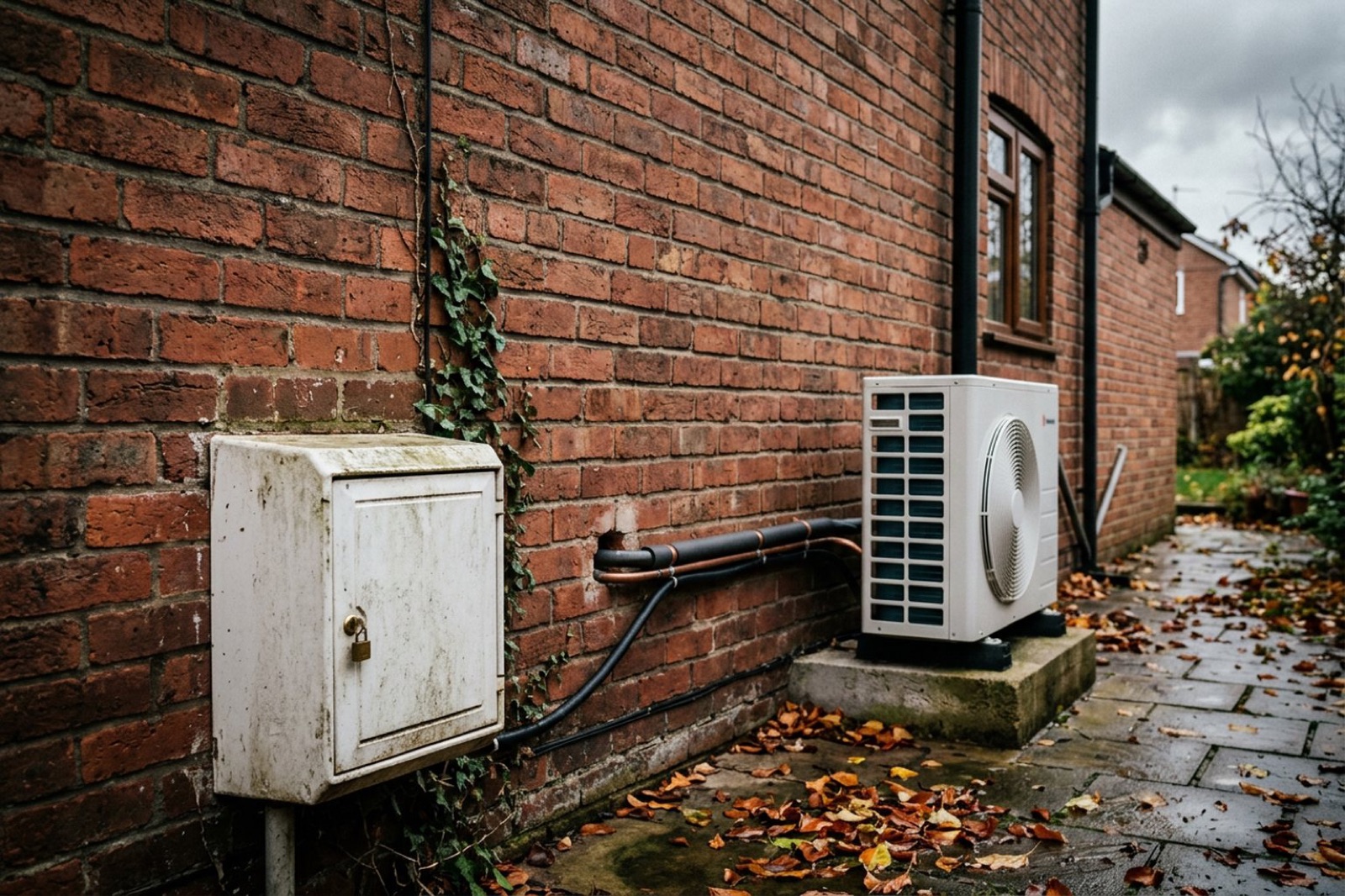
You may be eligible for £7,500 towards an air source heat pump through the Boiler Upgrade Scheme. The grant comes with a clear condition. Ofgem’s property owner guidance (V5.1) says any existing fossil fuel heating system, “such as a gas or oil boiler”, “must be fully replaced”, and adds: “You cannot keep a fossil-fuel heating system alongside a BUS-funded installation.”
The installer guidance adds that any supplementary heating appliances must not be fossil fuel based, and Ofgem defines fossil fuel to include natural gas.
Ofgem’s examples of non-compliance include that “fossil fuel appliances are retained or installed, (e.g. a fossil fuel system that is retained to provide additional space heating)”. So a gas boiler left on the wall “just in case” is not an option with the grant.
A heat pump alongside a boiler is also out. GOV.UK says you cannot get a grant for a hybrid system, such as a combination of gas boiler and air source heat pump. If you want to keep a boiler, read our guide to hybrid heat pumps first. Ofgem says pipework, radiators and hot water cylinders can be retained if they are in good condition and suitable. Your installer is responsible for making sure the overall system complies, and should tell you how your hot water will be provided.
Can you keep a gas hob, cooker or gas fire?
Ofgem’s current guidance does not give a simple answer. We read both V5.1 documents, and neither mentions a gas hob, a gas cooker or a gas fire.
Gas hobs and cookers
A question-and-answer document from the scheme’s launch event in 2022, published by the Renewable Energy Association, says “A gas connection may be retained or reconnected for cooking purposes.” Its answers are written as Ofgem’s, but it is over four years old, the rules have changed since, and V5.1 does not repeat it.
Our own reading of the current rules points the same way. The regulations describe the original heating system as “the system providing space heating or water heating”, and a hob or cooker does neither. But that is our reading, not a statement from Ofgem: the non-compliance example uses the broader phrase “fossil fuel appliances”, and V5.1 does not state that cookers are exempt. So tell your installer you plan to keep it, and ask them to confirm in writing before you sign.
Gas fires
A gas fire is a different case, because it does heat your home. Ofgem’s own example of non-compliance is a fossil fuel system kept for additional space heating, and it says supplementary heating must not be fossil fuel based. It does not name gas fires, but in our reading a gas fire you keep for extra warmth looks much closer to that example than a cooker does. If you have one, raise it at the survey and get a clear answer on whether it needs to come out before the grant is applied for.
If you do keep any gas appliance, your supply stays live, so the usual gas safety advice still applies. HSE says that if you suspect a gas leak you should call the gas emergency number, 0800 111 999.
Will you still pay a gas standing charge?
Yes, for now, as long as your meter stays connected. The Government describes the standing charge as a fixed daily fee added regardless of how much gas has been used, and says a household could use no gas at all but still must pay it.
The Budget document likewise puts gas standing charges at £108 a year on average for the typical billpayer.
The plan to abolish gas standing charges
On 28 October 2026 the Government said it had asked Ofgem to abolish gas standing charges on domestic bills, aiming for delivery by the end of 2027 or as soon as possible after. The Budget document says suppliers would recover these costs through gas unit rates instead, so the cost moves rather than disappears.
If that goes ahead, a home that keeps gas only for cooking would pay through the price per unit, not a daily charge. There is no final design or date yet, so check the current position before you pay to have a meter removed simply to escape the charge.
How to stop your gas supply altogether
Two companies are usually involved. Guidance from Future Energy Networks, published on the Institution of Gas Engineers and Managers website, sets out the split: your energy supplier bills you for gas, and your gas distribution network operator looks after the pipes in your area. Start with your supplier.
- Wait until nothing in the house needs gas. Have the boiler replaced and any other gas appliance dealt with first.
- Contact your energy supplier. Ask to end your gas supply contract and remove the gas meter, and ask what it will cost before you agree. Their details are on your bill.
- The supplier arranges the removal. Your gas pipe is sealed (“capped”) at the emergency control valve, normally found in the meter box or inside your home. The capped pipe is still live, but you no longer pay standing charges or for gas used.
- Check your final bill. Make sure the standing charge has stopped, and that the end date matches what your supplier told you.
- Expect contact from the gas network later. If no new meter is fitted within 12 months, the network operator will contact the property owner. It may then look at whether the pipe needs to be removed too.
Be clear about the words you use with your supplier. British Gas says a gas meter can be capped “but you will still need to pay the standing charge”. If your aim is to stop paying, ask for the meter to be removed and the account closed, and ask directly when the standing charge will end.
Who is your gas network?
Ofgem lists eight gas distribution networks. Cadent runs the North West network, along with West Midlands, East of England and North London. Wales & West Utilities runs the Wales and West network. British Gas points customers to Ofgem’s website to find theirs. You only need the network directly if you want the pipe to your property removed, for example for building work. Even then, it will not disconnect pipes and equipment until your supplier has safely removed the meter.
If you rent, this is not your decision to make alone: British Gas says tenants should speak to their landlord or managing agent.
Does it cost anything to remove a gas meter?
It depends on what you are asking for and who your supplier is. Future Energy Networks says some suppliers may charge to remove a meter, but many do it at no charge.
| Work | Who does it | Cost |
|---|---|---|
| Remove the meter and cap the pipe | Your energy supplier | Varies by supplier; some charge, many do not |
| Later disconnection by the network, after 12 months with no meter | Gas network operator | Future Energy Networks says the network will not charge |
| Removing the pipe to your property at your request | Gas network operator | You will be charged; ask for a quote |
The last row can be expensive. British Gas says these charges vary with the network and the circumstances and “can be up to £2,000”. You might need it for building work or a substantial renovation.
Think about whether you might want gas again. The network may leave plastic pipes live, but metal pipes will usually be disconnected unless they also supply your neighbours, so removing the meter can be the first step to losing the connection, and getting one back would mean applying to the network.
The old boiler, flue and capped pipes: staying safe
Do not attempt any of this yourself. The Gas Safety (Installation and Use) Regulations 1998 count disconnecting and removing a gas fitting as work, and they require anyone doing it to be competent. HSE says anyone employed to work on gas appliances in a home must be a Gas Safe registered engineer and competent in that area of gas work.
- Disconnecting the boiler. Whoever disconnects a gas fitting must seal off every outlet of every pipe it was connected to, using the appropriate fitting. HSE gives leaving open-ended pipes as an example of an appliance removed unsafely.
- Check the engineer. HSE says the back of the Gas Safe Register ID card shows the areas of gas work an engineer is competent in. You can look one up through the Gas Safe Register or call 0800 408 5500.
- The boiler, flue and any gas fire. Ask what the quote includes: who disconnects the boiler, who takes it and the flue away, and who fills and makes good the hole in the wall. See heat pump installation: what to expect for how this fits with the rest of the job.
What to ask, and where ByEco stands
Before you sign anything, ask:
- Who will disconnect my boiler, and can I see their Gas Safe ID card?
- Does the quote include taking away the boiler and flue and making good the wall?
- I plan to keep my hob, cooker or gas fire. Does that affect my grant application? Can you confirm in writing?
Our guide to comparing heat pump quotes helps you spot whether boiler removal is included, can you get a free heat pump? explains what the grant does not do, and our grants page covers the scheme in brief.
ByEco is MCS certified for air source heat pump installation (certificate IAA10330), and we apply for the £7,500 Boiler Upgrade Scheme grant on your behalf. We install air source heat pumps for homeowners in England and Wales. The cost depends on your property: the size of system it needs, whether radiators or pipework need upgrading, where the outdoor unit goes and how far the pipe run is, hot water and any electrical work. See what affects heat pump cost. Tell us at the survey about any gas appliances you plan to keep. Please get in touch for a free survey and an itemised quote, then go ahead if you are happy.
Sources
Every figure on this page was checked against primary sources on 31 October 2026. Grant rules, planning rules and prices change — if you are reading this much later, verify before acting.
- Ofgem — Boiler Upgrade Scheme: Property Owner Guidance V5.1 (July 2026)
- Ofgem — Boiler Upgrade Scheme: Installer Guidance V5.1 (July 2026)
- legislation.gov.uk — Boiler Upgrade Scheme (England and Wales) Regulations 2022, regulation 5
- Renewable Energy Association — Boiler Upgrade Scheme Launch Event: Question and Answer (2022)
- GOV.UK — Apply for the Boiler Upgrade Scheme: what you can get
- Ofgem — Energy price cap unit rates and standing charges
- HM Treasury — Budget 2026
- GOV.UK — Chancellor abolishes standing charges on gas bills to make payments fairer (28 October 2026)
- Future Energy Networks (IGEM) — Disconnecting from the gas network
- Ofgem — Energy terms explained: who operates the gas distribution network?
- British Gas — Meter removals and disconnection
- HSE — Domestic gas: frequently asked questions
- HSE — Check an engineer: are they Gas Safe registered?
- legislation.gov.uk — Gas Safety (Installation and Use) Regulations 1998, regulation 2
- legislation.gov.uk — Gas Safety (Installation and Use) Regulations 1998, regulation 3
- legislation.gov.uk — Gas Safety (Installation and Use) Regulations 1998, regulation 6
Book your free home survey
Every home is different. The cost depends on the size of system, any radiators that need upgrading, the pipework and where the outdoor unit goes. Get in touch and we will arrange a free survey of your home and give you a clear quote. If you are happy with it, we can go ahead.