Free heat pump for 1 and 2 bedroom flats.*
Own a 1 or 2 bedroom flat heated by gas, oil, LPG or electricity? The heat pump we fit in flats — a compact indoor air-to-water unit, installed entirely inside your flat — is 100% covered by the Boiler Upgrade Scheme grant, so you pay nothing. Every one of the 192 flats we’ve had installed so far paid nothing. Book your free, no-obligation assessment.
*Terms and conditions apply. You must own the flat (landlords included); social housing and shared ownership aren’t eligible. It must replace gas, oil, LPG or electric heating, and the flat must not have had government heat pump funding before. Ofgem must approve the Boiler Upgrade Scheme grant, and our assessment and the installer’s heat loss survey must confirm the unit suits your flat. Any lease or freeholder consent must be in place. Installation is by our partner MCS certified installer, and the offer is subject to grant funding being available.
The short version
- Ofgem’s guidance for property owners says your installer must give you a clear, itemised quote that includes the total cost before any BUS discount, the value of the BUS grant and the remaining amount you will pay after the grant is deducted.
- Ofgem’s guidance for installers says the full grant must be deducted from the quote before you make any payment, and that the discount must appear at the quote stage and on the invoice.
- MCS standards add a clear and detailed written quotation, a performance estimate before you enter a contract, and design details, including room heat losses, in writing before installation starts.
- A heat pump may be free of charge for an eligible flat, subject to survey and eligibility. Whether anything is left to pay is confirmed in the written quote after the survey. We state no prices here.
If you have been told a heat pump may be free for your flat, the paperwork still matters. The written quote is what you will be asked to agree to. This article sets out what Ofgem, MCS and GOV.UK say a quote and its paperwork should contain. It does not repeat our guide to comparing heat pump quotes or our guide to what happens in a heat pump survey.
What should a heat pump quote for a flat show?
Ofgem’s guidance for property owners (version 5.2) says: “Your installer must give you a clear, itemised quote that includes:” the total cost before any BUS discount, the value of the BUS grant, and the remaining amount you will pay after the BUS grant is deducted. It adds: “This is a legal requirement. Your installer must apply the full value of the BUS grant as an upfront discount and must not request or accept payment of the discounted amount.” GOV.UK says something similar: “The value of the grant will be taken off the amount you pay for installation. This will be shown on your quotation and invoice.”
A heat pump may be free of charge for an eligible flat, subject to survey and eligibility, and the quote is where that is confirmed. Whether anything is left to pay is confirmed in the quote after the survey. Our advice, not a scheme rule: if the amount left to pay is nil, expect to see it written as a figure on the quote.
What Ofgem says about the quote and the grant deduction
Ofgem’s property owner guidance says you should expect your installer to “provide a clear, itemised quote showing the grant deduction”, and that the installer “should come to your property to undertake a heat loss assessment and provide a quote and bill impact assessment”. The term appears only once in the two Ofgem V5.2 guidance documents, without a definition, so ask what it contains.
The installer guidance is firmer on timing: “Installers must deduct the full BUS grant value from the quote before any payment is made by the property owner. This discount must appear at the quote stage (pre-installation) and on the invoice after the installation.” It also says: “Failure to deduct the grant value upfront may lead to the rejection of a voucher application or revocation of a voucher.”
Ofgem collects details of the quote, and its installer guidance says installers must submit the total with and without the grant, a quote reference number and the date on the quote. It adds: “Please ensure the values submitted match the quote issued to the property owner.” Our reading, not a scheme rule: it is reasonable to expect your quote to carry a reference number and a date. Ofgem also says: “Quotes can be final or provisional, recognising that costs may change over a project’s lifetime.” Ask which yours is.
Finally, what if the application is rejected or the voucher is revoked? Ofgem’s property owner guidance says: “If an application is rejected or a voucher is revoked, whether your installer can seek payment of the deducted amount will depend on the contractual terms you have agreed with your installer.” Read that part of the contract before you sign. If your quote does not show the discount, Ofgem says to contact its BUS Enquiries Team.
What MCS says you should be given before you sign
MCS standards sit alongside the grant rules. The heat pump design standard, MIS 3005-D (issue 3.0), says the estimate of system performance “shall be communicated to the client before the point that the contract is awarded and accompanied by the Key Facts”. The Key Facts say the estimate is “given as guidance only”. The standard also lists minimum technical information to be communicated in writing before the contract is awarded, including the result of the performance estimate, the manufacturer’s datasheet for the proposed heat pump, any other requirements stipulated by the consumer code (if applicable) and details of any subcontractors proposed to undertake installation.
MCS’s Customer Commitment says an MCS certified installer will, among other things, “Provide you with a clear and detailed written quotation”, “Inform you of any additional work needed and what the cost for this is, at the quotation stage” and “Explain how a grant or incentive you qualify for (if applicable) is applied to the cost of your installation”.
One caution on scope. The Customer Commitment and Installer Operating Requirements are headed MCS:2025 2.0, MCS’s redeveloped installer scheme, and MCS says the current scheme will close on 31 March 2027. Ofgem says installers who have not yet moved continue under the previous scheme. We found no MCS page saying whether those two documents apply to them, so ask which scheme your installer is on. MIS 3005-D is not headed MCS:2025; it says compliance is mandatory for MCS Contractors certified in accordance with it from 5 December 2025. See also what MCS certification means.
What should be in writing before installation starts
MIS 3005-D says that “Prior to the installation commencing, the customer shall be provided in writing with” a list that includes:
- “All specific room heat losses (in W/m2)”;
- “The type and dimensions of emitter(s) to be used in the system”;
- “The design emitter temperature based on the worst performing room”;
- “The design flow temperature of the water leaving the heat pump and before any blending valves”; and
- “The installation’s SCoP/SPER (as taken from the MCS website)”.
The list also covers hot water details. Our advice, not a scheme rule: ask your installer to spell out in writing how hot water will be provided.
The timing matters. A note in the same standard says “The full system design information (as defined in clause 5.9) can be provided before or after the point that the contract is awarded.” So these written design details may arrive after the contract is awarded, though before installation starts. If the design or estimated performance then changes, the standard says the customer shall be given an updated estimate, “A variation to contract” and “The opportunity to cancel the contract without further cost, obligation or liability”. See what size heat pump you need.
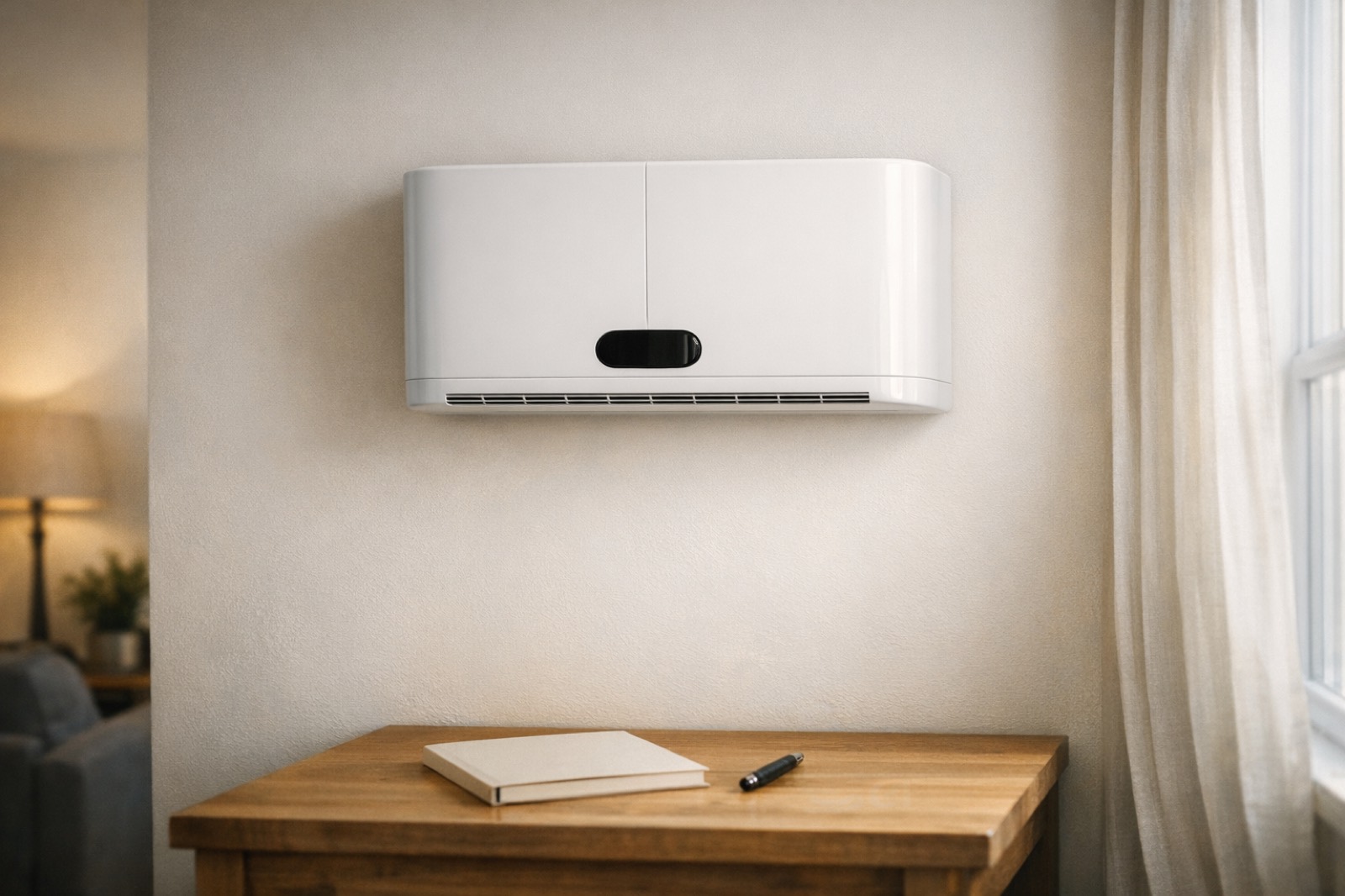
What the survey feeds into the quote
The offer box at the top of this page says ByEco’s assessment and the installer’s heat loss survey must confirm the unit suits your flat. Ofgem’s property owner guidance puts a heat loss assessment before the quote. ByEco’s brochure says: “We visit, measure and calculate the heat loss of every room before recommending anything.” It describes the quote as “Itemised and in writing.” We do not describe ByEco’s quote beyond that, so ask at your free survey what it will list. For the visit itself, see what happens at the survey of a flat.
What to look for in your quote: a checklist
Each point is marked Rule where a source states it, or Advice where it is our suggestion.
- Who is installing (Rule, then Advice). The Customer Commitment says the installer will “Clearly state who they are and what they do”. The offer box says installation is by ByEco’s partner MCS certified installer. Advice: ask for the company name and its MCS certificate number. MIS 3005-D says the handover document gives the certification number, but asking earlier does no harm.
- The system described (Rule). The Customer Commitment says the installer will “Clearly state the product details” in the contract.
- The grant deduction line (Rule). The value of the grant, as above.
- What is left to pay, as a figure (Rule, then Advice). Ofgem lists “the remaining amount you will pay after the BUS grant is deducted”. Advice: see it as a written figure, whatever it is.
- Extra work (Rule). Any additional work and its cost, at the quotation stage.
- Final or provisional (Rule). Ofgem says quotes can be either.
- Dates and any deposit (Rule). The Customer Commitment says your contract should include information on any deposit and “the installation dates”, and that the installer will “Tell you how your deposit is protected”.
- If the grant is rejected (Rule). What the contract says about the deducted amount, as above.
- Changes and cancellation (Rule). The contract should have “Clear cancellation rights”, and the installer will “Explain your cancellation rights, including when you have the right to have your deposit returned”.
- The guarantee (Rule). The Installer Operating Requirements say that for a domestic contract the installer shall provide a written guarantee for the system’s design and the workmanship of the installation. We state no length: ask. See warranty and servicing for a flat.
- Who to complain to (Rule). The installer will “Give clear information on how to contact them with any questions, concerns, or complaints” and “Acknowledge a complaint within two working days and respond effectively”.
- Lease or freeholder consent (Advice). The offer box says any lease or freeholder consent must be in place. We found no mention of leases or freeholders in Ofgem’s two V5.2 guidance documents or on GOV.UK’s Boiler Upgrade Scheme pages, so ask who obtains it and when. See heat pumps and a leasehold flat.
- Type of ownership (Rule, then Advice). Ofgem’s property owner guidance says: “Properties classed as social housing are not eligible for BUS funding (this includes shared ownership properties)”. Advice: treat a shared ownership flat as not eligible unless the installer confirms otherwise in writing.
After you agree: the Ofgem email and your 14 days
GOV.UK’s steps are to get quotes, agree a quote with your chosen installer, and then: “The installer will apply on your behalf on the Ofgem website.” Once a voucher application is submitted, Ofgem emails the property owner for consent. Its property owner guidance says: “You must provide consent within 14 days of receiving this email. If you do not respond within 14 days, the application may be rejected, and your installer may need to submit a new application.”
When you give consent you are asked to confirm “the quote details supplied by the installer” and “that you have received the upfront BUS grant discount”. That is why the quote should match what was submitted. Ofgem also says: “Giving consent does not create, replace, or amend any contractual arrangement between you and your installer.” Your contract is a separate document, so read it too. For what happens next, see the step-by-step guide to a heat pump in a flat, and what to do if an application is refused or delayed.
Why it is sensible to ask early
The Boiler Upgrade Scheme is not permanent. The sources say:
- Final date. The regulations say Ofgem must refuse to issue a voucher after 31 December 2029.
- Budget. Ofgem cannot issue new vouchers once the budget threshold is met. If the available budget runs out, Ofgem may operate a queue, ordered by when an application is deemed properly made. Separately, the Secretary of State may introduce a cap on the number of vouchers issued each quarter.
- Voucher validity. An air-to-water voucher expires three months after it is issued. GOV.UK words the limit differently, as 120 days from applying, so plan around whichever limit comes first.
Ofgem’s BUS monthly scheme update, with statistics to 31 October 2026 and last updated on 11 November 2026, lists £62,665,000 as the remaining budget for Year 5 (1 April 2026 to 31 March 2027). Ofgem’s footnote says that figure includes all undetermined applications and vouchers issued yet to be redeemed, and is a dynamic value. It is a snapshot, so check the latest report. We are not forecasting when funds might be used.
So asking for your free survey sooner means your application can be made while funding is available, if your flat is eligible. Rules and funding can change.
Where ByEco stands and who to contact
ByEco is MCS certified for air source heat pump installation (certificate IAA10330). GOV.UK lists £7,500 towards an air-to-water heat pump and describes the grant as covering part of the cost of replacing fossil fuel heating. Whether anything is left to pay for your flat is confirmed in the quote after the survey, and ByEco’s offer is the one described in the offer box at the top of this page. For the grant itself, read our Boiler Upgrade Scheme guide.
Your free survey is the first step. Call 0161 710 4510 or use the contact page and tell us the flat’s area, what heats it now and who owns it. See also our heat pumps and grants pages.
Sources
Every figure on this page was checked against primary sources on 18 November 2026. Grant rules, planning rules and prices change — if you are reading this much later, verify before acting.
- GOV.UK — Apply for the Boiler Upgrade Scheme: overview
- GOV.UK — Apply for the Boiler Upgrade Scheme: what you can get
- GOV.UK — Apply for the Boiler Upgrade Scheme: check if you’re eligible
- GOV.UK — Apply for the Boiler Upgrade Scheme: how to apply
- Ofgem — Boiler Upgrade Scheme: guidance for installers
- Ofgem — Boiler Upgrade Scheme guidance for installers V5.2 (PDF)
- Ofgem — Boiler Upgrade Scheme: guidance for property owners
- Ofgem — Boiler Upgrade Scheme guidance for property owners V5.2 (PDF)
- Ofgem — BUS monthly scheme update
- legislation.gov.uk — Boiler Upgrade Scheme (England and Wales) Regulations 2022, regulation 15
- MCS — MIS 3005-D The Heat Pump Design Standard, Issue 3.0
- MCS — Customer Commitment, Issue 1.1 (September 2026)
- MCS — Installer Operating Requirements, MCS:2025 2.0, Issue 2.0
- MCS — Moving over to the redeveloped installer Scheme
Book your free home survey
Every home is different. The cost depends on the size of system, any radiators that need upgrading, the pipework and where the outdoor unit goes. Get in touch and we will arrange a free survey of your home and give you a clear quote. If you are happy with it, we can go ahead.