The short version
- A 100% free-of-charge heat pump is possible for an eligible apartment under the Boiler Upgrade Scheme, subject to survey and eligibility. Whether anything is left to pay depends on the flat, the system it needs and the survey.
- There are six steps, from first contact to handover. ByEco applies for the £7,500 grant for you and it comes off your quote before you pay.
- If the quote is more than the grant, you pay the difference. A voucher for an air source heat pump is valid for three months from issue, so sort any lease permission before the application.
- Get in touch for your free survey so ByEco can start your application while funding is available, if your flat is eligible.
This guide follows the process for an eligible flat from first enquiry to handover. It builds on our guides to who may be eligible for a free heat pump in a flat and whether you can get a free heat pump.
The process at a glance
| Step | What happens | What you do |
|---|---|---|
| 1. Get in touch | You book the free survey | Say who owns the flat and what heats it |
| 2. Survey and heat loss calculation | The flat is assessed and its heat loss calculated | Give access, answer questions |
| 3. Quote and eligibility check | A written quote with the grant taken off | Read it, ask questions, decide |
| 4. Grant application | ByEco applies to Ofgem for you | Confirm consent by email within 14 days |
| 5. Installation | The indoor unit is fitted and connected | Give access, warn your building manager |
| 6. Commissioning and handover | MCS certificate, handover pack, grant claimed | Have the controls explained, keep the paperwork |
Step 1: get in touch and book the free survey
Start through the contact page. A 100% free-of-charge heat pump is possible for an eligible apartment under the Boiler Upgrade Scheme, subject to survey and eligibility, and the survey is how you find out whether yours is one of them.
ByEco’s view is that smaller homes and flats need less material and less labour than bigger houses, which is why ByEco can offer a heat pump free of charge under the scheme for eligible properties, subject to survey and eligibility. That is ByEco’s own explanation, not a figure from the scheme, and it is not a promise: the survey decides whether it applies to your flat.
Have to hand who owns the flat, what heats it now, your lease if it is leasehold, and an email address you check, because Ofgem asks for your consent by email.
Step 2: the survey and heat loss calculation
MCS is moving certified installers onto a redeveloped scheme as their certification bodies move them over, so some requirements and timings depend on which version your installer works to; ask which. The standards quoted here are MIS 3005-D (Issue 3.0) and MIS 3005-I (2025). MIS 3005-D requires the building to be assessed by a competent professional experienced in heat pump systems, who checks it is suitable and that the work will not compromise its Building Regulations compliance.
The centre of the visit is a heat load calculation to BS EN 12831-1:2017. The heat pump chosen must provide the whole of that heat load without help from an electric heater; Ofgem requires it to meet the full space heating demand on its own. A home with less heat loss may need a smaller system, but the calculation decides. See what size heat pump you need and what to expect from a heat pump survey.
What the surveyor looks at in a flat
- The rooms: sizes, walls, windows and floors.
- Your existing heating: the heat source, radiators and pipework; some radiators may need to be larger (see do I need new radiators?).
- Hot water: ask for it to be spelled out in writing how yours will be provided.
- Electricity and permissions: the fuse board, and the permissions the installer must tell you about.
Where the indoor unit goes
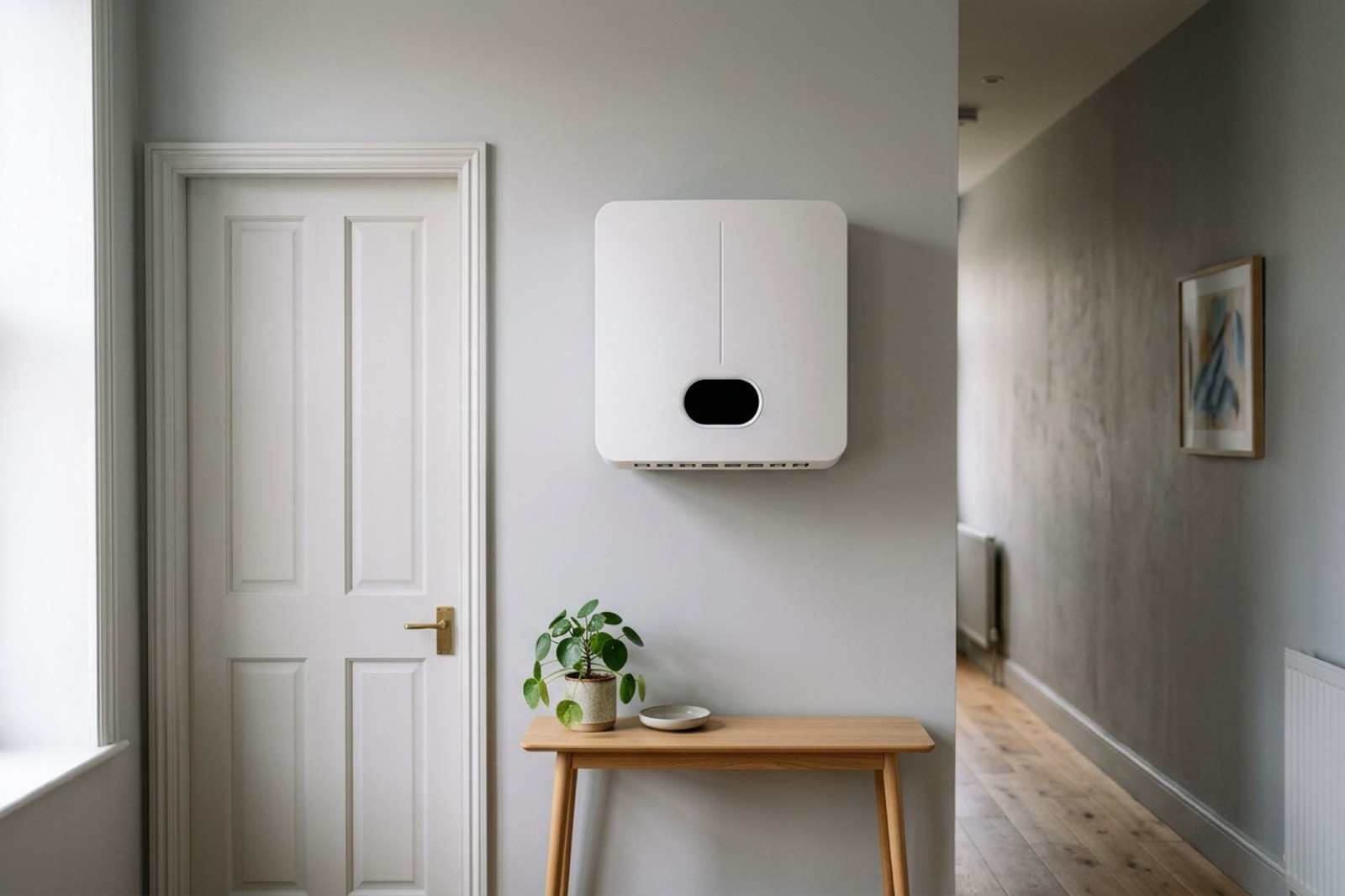
The heat pump ByEco installs is a compact, wall-mounted unit that sits inside the home, so the survey looks for a suitable wall and room inside the flat. Some systems have no outdoor unit; our guide to heat pumps without an outdoor unit explains how indoor units of that kind work.
MIS 3005-I sets general rules for any heat pump: locate it according to the manufacturer’s instructions, not next to sleeping areas or on floors that can transmit vibration, and discharge condensate safely to a suitable drain or soakaway. So ask for the datasheet and manual for the model proposed. Some indoor models take in outside air through ducts and wall vents; if the model proposed does, an outside wall and your freeholder’s permission matter.
Before you sign, MIS 3005-D requires you to be given in writing a performance estimate and the manufacturer’s datasheet for the proposed heat pump.
Step 3: the quote and the eligibility check
GOV.UK puts the order simply: confirm you are eligible, agree a quote, then the installer applies for you. Ofgem requires the installer to assess the property on site and quote with the grant as an upfront discount. The installer checks, among other things, that:
- you own the property (a flat you rent out counts) and are replacing fossil fuel heating such as oil, gas, electric or LPG;
- the flat is not social housing and has had no government funding for a heat pump or biomass boiler;
- the heat pump is not a hybrid (there is no grant for one combined with a gas boiler) and fully replaces your existing heating, with limited exceptions;
- it serves your own flat, because Ofgem says cascade systems heating multiple unrelated properties, such as flats, are not eligible; and
- the product and design meet the relevant MCS standards, and an air-to-water heat pump reaches an in situ SCOP (seasonal efficiency) of at least 2.8.
The quote, and what happens if it is more than the grant
GOV.UK says the grant is taken off the amount you pay and shown on your quotation and invoice, and Ofgem requires the full value to be deducted before you pay anything. The standard grant is £7,500 for an air source heat pump. If the quote is within it, you may have nothing left to pay; if it is more than the grant, you pay the difference. We give no price here because it depends on your flat, the system it needs and the survey; see our cost guide.
Two points for the contract. If the design changes from what you were quoted, MIS 3005-D gives you a variation to the contract and the chance to cancel without further cost; the redeveloped scheme words this differently, so check your contract. And ask what happens if the application is rejected or the voucher revoked: Ofgem says the installer’s ability to seek payment of the deducted amount then depends on the contract between you.
What you need to arrange: lease, freeholder and co-owners
This part is yours, ideally before the application; see permission for a heat pump in a flat. In short:
- Leaseholders. GOV.UK says most flats are leasehold and that you own a leasehold property for a fixed period. GOV.UK, Ofgem’s guidance and the Boiler Upgrade Scheme Regulations do not say how a leasehold flat is treated, so do not assume either way; ask how ownership will be shown.
- Your freeholder. The Leasehold Advisory Service (LEASE) says you might need your landlord’s permission even with planning permission, and lists a heat pump on the external wall among the things a lease can restrict. A ban on cutting external walls would prevent new openings, including for pipes. If written consent is needed, get it before the work starts; a landlord does not have to reply quickly.
- Co-owners and landlords. Ofgem asks the owner to confirm ownership or co-ownership with the agreement of all other owners. If you rent the flat out, you must have told any tenant about the impact (see heat pumps for landlords).
The voucher clock starts when the voucher is issued, not when the work starts, so get consent in place first.
Step 4: ByEco applies for the grant on your behalf
Once you have agreed the quote, the installer applies on Ofgem’s website, so you do not fill in the application yourself.
- ByEco submits it, with your address, the heating being replaced, the agreed quote with and without the grant, and the supporting evidence, which is the installer’s job to gather.
- Ofgem emails you to confirm consent, from boiler.upgrade.scheme.
ofgem@ notifications.service.gov.uk. Use the link within 14 days or the application expires and may be rejected. Ofgem accepts consent no other way, except an assisted digital route for people without email. - Ofgem checks who you are, which may include digital copies of ID documents; you have 14 days to answer any request for more.
- Ofgem issues the voucher to the installer and tells you. It might also phone you or visit to check the installation.
What you provide and confirm
- Your name, contact details and an email address. If Ofgem audits the application it may ask for evidence of ownership, so keep your ownership papers to hand.
- Where Ofgem needs evidence of your existing heating, photographs of the heat source showing its make and model, and a recent utility bill or fuel receipt, which you may redact.
- Confirmation of the project details, including the cost (check it matches your quote), that you will own the heating system, that you have had no other public support for this installation (for example ECO), and that you received the grant as an upfront discount.
Voucher validity
A voucher for an air source heat pump expires at the end of the day that falls three months after it is issued (regulation 15 of the Boiler Upgrade Scheme Regulations). Ofgem cannot extend it. GOV.UK words the limit differently, as 120 days from applying, so plan for the shorter.
Step 5: installation
Installation follows the design and the manufacturer’s instructions for the model. Ask in writing for the steps for the model proposed: where it is fixed, how it connects to your heating and electrical supply, how condensate is drained, and whether any opening in an outside wall is needed, because that needs the permissions described above.
We give no number of days, because no source we have read gives one for this type of unit. Ask for the expected days in writing, and how long your heating and hot water may be off. Where the work is notifiable under the Building Regulations, MIS 3005-D says the installer must make clear who notifies and ensure it is done before handover.
Step 6: commissioning, the MCS certificate, handover and the grant
MIS 3005-I requires commissioning to a documented procedure, to show the system is safe, installed to the standard and working as designed. Its example checklist asks whether the controls were demonstrated and explained to you.
At handover you should be given a handover pack with at least the commissioning forms, the maintenance requirements, the manufacturer’s manuals and warranty details, and any documents required for incentive schemes such as this one. The installer registers the installation on the MCS database and an MCS certificate is generated and sent to you for the pack; ask when to expect it, as the deadline differs between the original and redeveloped MCS rules.
Then the grant is claimed. The installer redeems the voucher using the MCS installation certificate number, and Ofgem tells you and the installer whether the claim succeeded. It pays the installer on a weekly schedule, usually within five working days of approval. The installer must not request or accept payment of the grant amount from you.
Funding and timing: why it is sensible to ask early
The scheme is funded in budgets and its rules and funding can change, so it is sensible to ask for your assessment early. The sourced facts:
- The Secretary of State sets the scheme budget, and Ofgem publishes monthly reports of the remaining annual budget.
- Ofgem cannot issue any new vouchers once the budget threshold has been met; it may then operate a queue. A voucher already issued and still valid is paid after a successful claim.
Under the current regulations, the last date on which vouchers can be issued is 31 December 2029. None of this says funding is about to run out, and we are not claiming a queue is running now. One thing is in your hands: Ofgem says queue position follows the date an application is “properly made”, and that needs your consent.
Get in touch for your free assessment (survey) and, if your flat is eligible, ByEco can start your Boiler Upgrade Scheme application while funding is available.
What to ask, and where ByEco stands
- Is my flat eligible, and how will you show I own it?
- Which exact model is proposed, is it in the MCS product directory, and can I see its manual?
- Does the quote show the £7,500 grant taken off, and what does the contract say if the application is rejected?
- Who is getting the freeholder’s permission, how many days will the work take, and when will I get the MCS certificate?
ByEco is MCS certified for air source heat pump installation (certificate IAA10330), and we apply for the £7,500 Boiler Upgrade Scheme grant on your behalf. See also heat pump installation: what to expect and the Boiler Upgrade Scheme guide.
Get in touch for your free survey with a few details about your flat, your lease and what heats it now. We will confirm what applies, explain what is left to pay if anything, and give you an itemised quote; if you are happy, we can go ahead. See also our heat pumps and grants pages.
Sources
Every figure on this page was checked against primary sources on 7 November 2026. Grant rules, planning rules and prices change — if you are reading this much later, verify before acting.
- GOV.UK — Apply for the Boiler Upgrade Scheme: how to apply
- GOV.UK — Apply for the Boiler Upgrade Scheme: check if you’re eligible
- GOV.UK — Apply for the Boiler Upgrade Scheme: what you can get
- GOV.UK — Apply for the Boiler Upgrade Scheme
- Ofgem — Boiler Upgrade Scheme: guidance for installers
- Ofgem — Boiler Upgrade Scheme guidance for installers V5.2 (PDF)
- legislation.gov.uk — Boiler Upgrade Scheme (England and Wales) Regulations 2022, regulation 14
- legislation.gov.uk — Boiler Upgrade Scheme (England and Wales) Regulations 2022, regulation 15
- MCS — MIS 3005-D The Heat Pump Design Standard, Issue 3.0
- MCS — MIS 3005-I:2025 Heat Pump Installation Standard
- MCS — Getting prepared for the redeveloped installer scheme
- GOV.UK — Leasehold property
- The Leasehold Advisory Service — Alterations and home improvements
Book your free home survey
Every home is different. The cost depends on the size of system, any radiators that need upgrading, the pipework and where the outdoor unit goes. Get in touch and we will arrange a free survey of your home and give you a clear quote. If you are happy with it, we can go ahead.