The short version
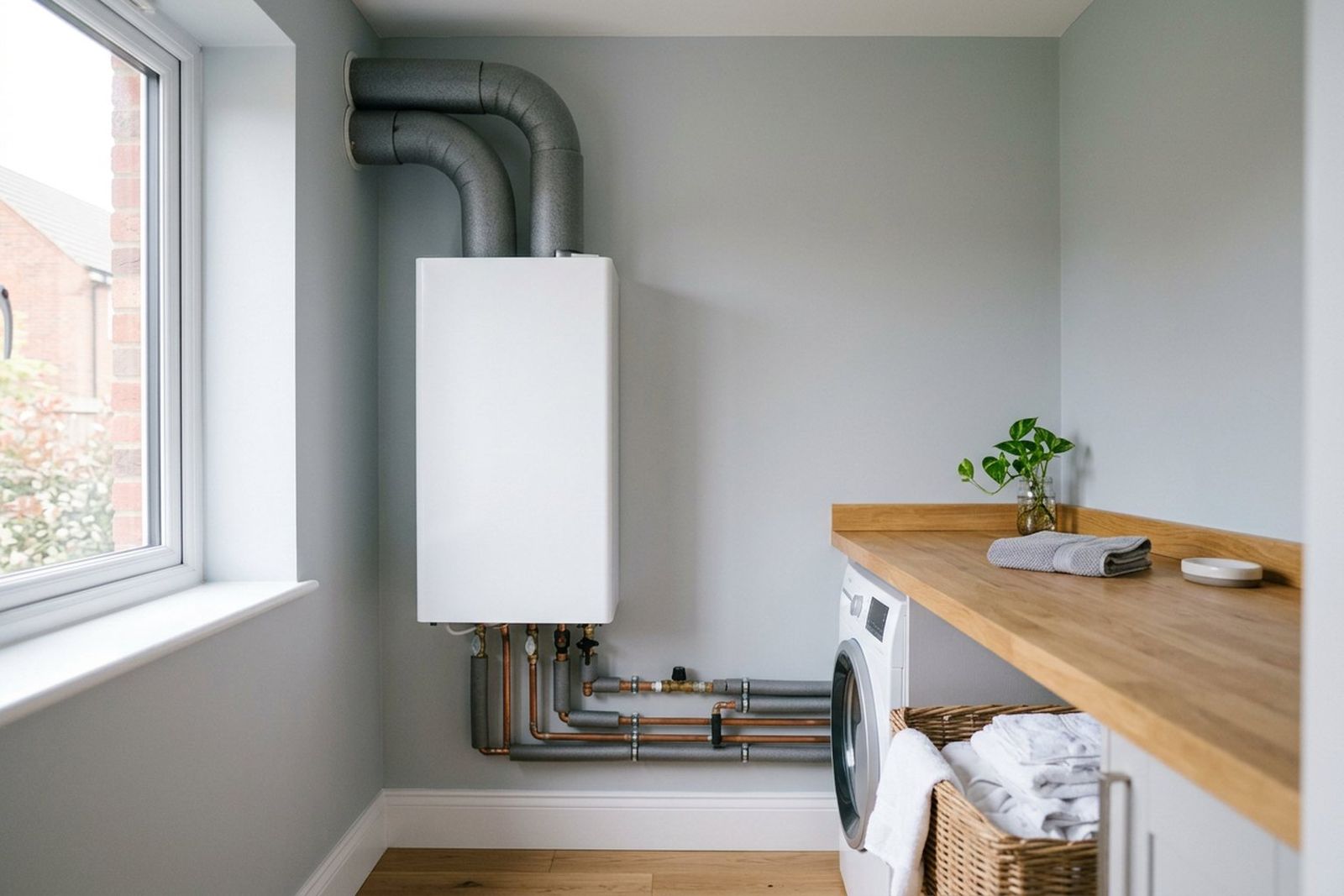
- Indoor (internal monobloc) air-to-water heat pumps exist. The unit sits inside; on the outside you see two vents.
- The models aimed at flats are small: Trianco’s Activair R290, for example, comes as a 3.2 kW wall-hung or 5 kW floor-standing unit.
- You trade an outdoor unit for two wall openings, a cupboard-sized unit indoors and duct runs that have to be kept short.
- Both Activair models are listed as certified in the MCS product directory, so you may be eligible for the £7,500 Boiler Upgrade Scheme grant if an MCS-certified installer applies and the installation meets the rules.
- In a leasehold flat you may need the freeholder’s consent to cut the outside wall, even with planning permission.
If your flat has no balcony, garden or flat roof, “a heat pump needs an outdoor unit” can sound like the end of it. It isn’t always. This guide covers how indoor units work, what manufacturers’ own documents say, and what to check before a quote. See also can you get a heat pump in a flat?
How a heat pump without an outdoor unit works
An indoor heat pump uses the same refrigeration cycle as any air source heat pump (see how an air source heat pump works): a fan pulls outside air across a heat exchanger, the refrigerant picks up its heat, a compressor raises the temperature, and the heat passes into the water for your radiators.
The difference is where it happens. Everything is in one casing indoors, and the air is ducted to and from the outside wall: one duct brings outside air in, the other sends the cooled air back out. Trianco describes its indoor unit as including “all the functionality of an outdoor unit”, with the outdoor unit “replaced by two vents”.
Two things get muddled with this. Air-to-air “through-wall” units are a different type of system: they blow warm or cool air into a room rather than heating water for radiators. And the “indoor unit” of an ordinary heat pump is the part inside, such as a cylinder or hydraulic unit, that works with an outdoor unit.
Two examples of indoor heat pumps
We name two manufacturers only to show what published figures look like, not as a recommendation.
Trianco Activair R290. Trianco says it is designed for “apartments without balconies or with limited terraces”. It comes in two versions:
| Manufacturer’s figure | Wall-hung 3.2 kW | Floor-standing 5 kW |
|---|---|---|
| Heating output (7 °C outside, 35 °C water) | 3,280 W | 4,820 W |
| Size, width × depth × height | 598 × 495 × 725 mm | 598 × 615 × 1,200 mm |
| Weight | 73–76 kg | 124 kg |
| Refrigerant | R290, 0.45 kg | R290, 0.49 kg |
| Sound pressure at 1 m | 31 dB(A) | 35 dB(A) |
| SCOP at 35 °C / 55 °C flow (MCS directory) | 4.56 / 3.38 | 4.48 / 3.36 |
| Electrical supply | Single phase | Single phase |
From Trianco’s product page and installation manuals, and the MCS product directory, October 2026. Trianco’s product page gives the wall-hung weight as 73 kg; its manual says 76 kg net.
Dimplex LI/LIK. Dimplex lists a range of indoor air-to-water heat pumps on its German website, which it says is ideal “for houses with small outdoor areas”. These are bigger machines: the LIK 8TES is 1,900 mm tall, needs a three-phase 400 V supply and has 440 × 440 mm air duct openings. We could not find it in the MCS product directory in October 2026, so do not assume a model sold elsewhere in Europe is available or grant-eligible here.
The trade-offs: output, vents, space and noise
Output
The Activair R290 units are at the small end (Trianco also lists R32 indoor models at 5 or 7 kW), and 3.2 kW or 5 kW suits a home with a low heat demand. Whether that is enough for yours comes from a room-by-room heat loss calculation, not the floor area; see what size heat pump do I need? and do I need new radiators?
Ducts and wall vents
The ducts can decide whether an indoor unit works in your home. For the wall-hung Activair, Trianco’s manual gives 250 mm spigots and a maximum combined duct length of 10 m with 250 mm ducts and two bends, falling to 5 m with 150 mm ducts; each extra 90° bend takes 1.5 m off. The floor-standing model comes set up for square ducts; if it is converted to round ducts, they must be 200 mm, no more than 5 m long, with no bends. Long runs cut the heating output, so the unit needs to sit close to an outside wall.
Condensate also has to go somewhere: the manual says to a sewer, soakaway or condensate pump, and the safety valve’s discharge pipe must be routed outside.
Space, weight and hot water
The wall-hung Activair is 725 mm tall and 598 mm wide but weighs 73–76 kg, so the wall has to carry it. Trianco’s manuals say the room should be at least 4.5 cubic metres, well ventilated, and away from gas appliances, electric heaters and other sources of ignition. For hot water, Trianco says a hot water cylinder will need to be fitted, so you need room for that as well. Other products differ; the installer should spell out how your hot water will be provided.
Noise indoors
With an outdoor unit, the noise is outside. Here the compressor and fan are in your home. Trianco publishes a sound pressure of 31 dB(A) at 1 m for the wall-hung model and 35 dB(A) for the floor-standing one. Dimplex’s page for the LIK 8TES gives sound power levels instead, which measure something different, so the two cannot be compared directly. Our guide are heat pumps noisy? explains the difference.
The MCS installation standard says heat pumps should not sit next to sleeping areas, and that internal fans and ducts should be fitted with sound attenuation where needed. Trianco says a duct attenuator can go on the outlet duct if air speed causes noise. A cupboard away from bedrooms suits it.
Is an R290 heat pump safe indoors?
R290 is propane, and Trianco’s manual is direct: in a leak, escaping refrigerant “may mix with air to form a flammable atmosphere”. The charge is small, under half a kilogram in both models. Trianco says the system starts monitoring refrigerant concentration a minute after start-up, and if it passes a set threshold it shuts down and runs the fan to vent the refrigerant outdoors.
Two practical points follow. The leak detection only works if the unit stays powered, so it should not be switched off except for servicing. And anyone working on it must be competent with R290.
The international safety standard for electric heat pumps, IEC 60335-2-40, covers appliances using flammable refrigerants up to ISO 817 group A3, which the Heat Pump Association describes as “higher flammability” and which includes R290. Ask the installer which safety standard the model you are offered meets, and what the manufacturer requires for room size, ventilation and electrical protection.
Are indoor heat pumps efficient?
The MCS product directory lists seasonal efficiency (SCOP) for both Activair models: 4.56 and 4.48 at a 35 °C flow temperature, falling to 3.38 and 3.36 at 55 °C. Dimplex gives the LIK 8TES 3.85 at 35 °C and 2.82 at 55 °C. The pattern is the same as for outdoor units: the lower the flow temperature your radiators allow, the more efficient the heat pump.
We have not found a reliable source comparing indoor and outdoor units in general, so we don’t claim either is more efficient. What you get depends on the design: the right size, low flow temperatures, short ducts and good controls.
Planning permission and the freeholder
In England, permitted development (Class G) allows one air source heat pump on a whole block of flats without a planning application, subject to conditions, but the size limit is written around the outdoor unit: the “outdoor compressor unit” on a block of flats must not exceed 0.6 cubic metres. An indoor unit has no outdoor compressor unit, so that limit does not fit it neatly. The question is the vents.
Section 55 of the Town and Country Planning Act 1990 says works to a building that do not materially affect its external appearance are not development. Whether two vents clear that bar is for the council, and the Planning Portal notes that the permitted development rights houses have for many projects do not apply to flats. Check with your council before you commit; ByEco checks this at survey. Wales has its own permitted development rules for heat pumps (updated 1 June 2026), so check with your council there too. On a listed building, works that would affect its character need listed building consent. In a conservation area, permitted development already rules out an outdoor unit on a wall or roof fronting a road, so expect the council to look closely at vents there too.
The freeholder may matter more. GOV.UK says most flats are leasehold, and the Leasehold Advisory Service says you might need the freeholder’s permission for alterations even if you already have planning permission. A lease clause such as “no cutting of external walls” would stop new openings, and the outside walls may belong to the freeholder. Get consent in writing before work starts. Landlords should see heat pumps for landlords.
Can you get the Boiler Upgrade Scheme grant for an indoor heat pump?
An indoor air-to-water heat pump is still an air source heat pump, so you may be eligible for the Boiler Upgrade Scheme grant of £7,500, which may cover part of the cost. It depends on the product and the installation, not the box’s location:
- The product. Both Activair R290 indoor models are listed as certified, air-to-water, in the MCS product directory, with certification running to 28 May 2029.
- The installer. Only an MCS-certified installer can apply, and they deduct the grant from your quote. Ofgem says applications can be rejected even where a product is on its eligibility list.
- The property. You must own it, it must not be social housing or a new build still being built, and you must be replacing fossil fuel heating, which includes electric heating.
- The design. The heat pump must be able to meet the property’s full space heating demand on its own, and have an in-situ SCOP of at least 2.8, calculated with the MCS SCOP calculator.
Since 28 April 2026 an EPC is no longer a requirement for the grant. Once an air source voucher is issued it is valid for three months, so sort out consent and planning first.
How much does an indoor heat pump cost to install?
It depends on your property, so we don’t quote a figure here. What sets the price is the size of system your home needs (from the heat loss calculation); whether radiators or pipework need upgrading; where the unit can go and how the ducts and vents reach the outside wall; how hot water will be provided; and any electrical work, such as the isolator and electrical protection the manufacturer specifies.
Get in touch and we will arrange a free survey of your home, check the wall, the duct route and the consent you will need, and give you a clear, itemised quote. If you are happy with it, we can go ahead. See also our heat pump cost guide.
What to ask, and where ByEco stands
- Is the exact model MCS certified, and what is its SCOP at the flow temperature you are designing for?
- Where will the vents go, how long are the ducts, and how many bends?
- Where will condensate and the safety valve discharge go?
- How will hot water be provided, and where does any cylinder go?
- What servicing does the warranty need? Trianco’s manual says the unit must be serviced every year by an MCS-registered heat pump engineer for the warranty to apply after the first year; see heat pump maintenance.
- Who is getting the freeholder’s consent, and has the council been asked?
ByEco has proposed indoor heat pumps to apartment customers. For flats more generally, see our notes on Manchester flats. ByEco’s MCS and TrustMark certification is in progress, so we cannot yet apply for the Boiler Upgrade Scheme for you; only an MCS-certified installer can. For what happens on the day, see what to expect from an installation, or contact us with a photo of the cupboard and the outside wall.
Sources
Every figure on this page was checked against primary sources on 19 October 2026. Grant rules, planning rules and prices change — if you are reading this much later, verify before acting.
- Trianco — Activair R290 Indoor Heat Pump, 3.2kW Wall Hung or 5kW Floor Standing (product page)
- Trianco — Activair R290 Indoor Heat Pumps brochure (January 2026, PDF)
- Trianco — High Temperature Indoor Air Source Heat Pump installation manual, wall-hung (PDF)
- Trianco — Activair R290 floor-standing installation manual (PDF)
- MCS — Product Directory (Activair Indoor 3.2kw and 5kw listings)
- Dimplex — Air/water heat pumps for indoor installation, LI/LIK series (Germany)
- Dimplex — Air-to-water heat pump LIK 8TES (Germany)
- IEC — IEC 60335-2-40:2024, safety of electrical heat pumps, air-conditioners and dehumidifiers
- Heat Pump Association — Position on installer training for flammable refrigerants (October 2025, PDF)
- MCS — MIS 3005-I:2025 Heat Pump Installation Standard, Issue 1.0
- legislation.gov.uk — General Permitted Development Order 2015, Schedule 2, Part 14 (Class G)
- legislation.gov.uk — Town and Country Planning Act 1990, section 55
- legislation.gov.uk — Planning (Listed Buildings and Conservation Areas) Act 1990, section 7
- Planning Portal — Flats and maisonettes
- Welsh Government — Planning permission: domestic heat pumps
- GOV.UK — Leasehold property
- The Leasehold Advisory Service — Alterations and home improvements (updated 22 December 2025)
- GOV.UK — Apply for the Boiler Upgrade Scheme: what you can get
- GOV.UK — Apply for the Boiler Upgrade Scheme: check if you’re eligible
- Ofgem — Boiler Upgrade Scheme: guidance for installers (V5.1, last updated 2 July 2026)
- Ofgem — Boiler Upgrade Scheme guidance for installers V5.1 (PDF)
- legislation.gov.uk — Boiler Upgrade Scheme (England and Wales) Regulations 2022, regulation 15
Book your free home survey
Every home is different. The cost depends on the size of system, any radiators that need upgrading, the pipework and where the outdoor unit goes. Get in touch and we will arrange a free survey of your home and give you a clear quote. If you are happy with it, we can go ahead.