The short version
- Service it once a year. The Energy Saving Trust says to service a heat pump annually, as you would a boiler, and MCS suggests a yearly check-up with a professional.
- No gas safety check. The annual gas safety check landlords must arrange covers gas appliances and flues. A heat pump burns no gas, so it has no flue and no gas safety check.
- F gas leak checks are a legal duty only at or above a threshold: 5 tonnes of CO2 equivalent (10 tonnes for labelled hermetically sealed units). The R32 domestic units we checked hold well under that.
- Missed services can cost you the warranty. Vaillant says its heat pump warranty becomes invalid without an annual service; Grant extends its cover to two years only if the unit is registered and serviced every twelve months.
- Your part: keep the outdoor unit clear and watch the pressure gauge and error codes.
Heat pump maintenance is lighter than people fear, but it is not nothing.
Do heat pumps need servicing?
Yes. The Energy Saving Trust’s installation guide says you should service your heat pump annually, “like you would a fossil fuel boiler or other heating system”, and its expert Q&A says to have an engineer service it according to the manufacturer’s advice, usually once a year. MCS calls regular maintenance essential.
So how often should a heat pump be serviced? Once a year, unless your manufacturer says otherwise. The work itself is modest: Grant describes its Aerona³ heat pumps as needing “only the minimum of routine servicing and maintenance”. The annual visit protects efficiency, reliability and often your warranty. For lifespan, see how long heat pumps last.
Heat pump vs gas boiler maintenance: what the law requires
The rhythm is the same — one visit a year — but the legal position is different.
For gas, the Health and Safety Executive strongly advises that all gas appliances, flues and pipework are serviced at least annually by a Gas Safe registered engineer. If you let a property, it is the law: under regulation 36 of the Gas Safety (Installation and Use) Regulations 1998, a landlord must have each gas appliance and flue it provides checked for safety within 12 months of installation and at intervals of not more than 12 months after that.
A heat pump is not a gas appliance. Those regulations define a gas appliance as one designed for use by a consumer of gas for heating, lighting, cooking and similar purposes. A heat pump runs on electricity and burns nothing, so there is no flue, no combustion to check and no gas safety certificate for it. Any gas hob or fire you keep still needs its checks. The one periodic check the law can require on a heat pump is an F gas leak check, and only above a threshold (see below).
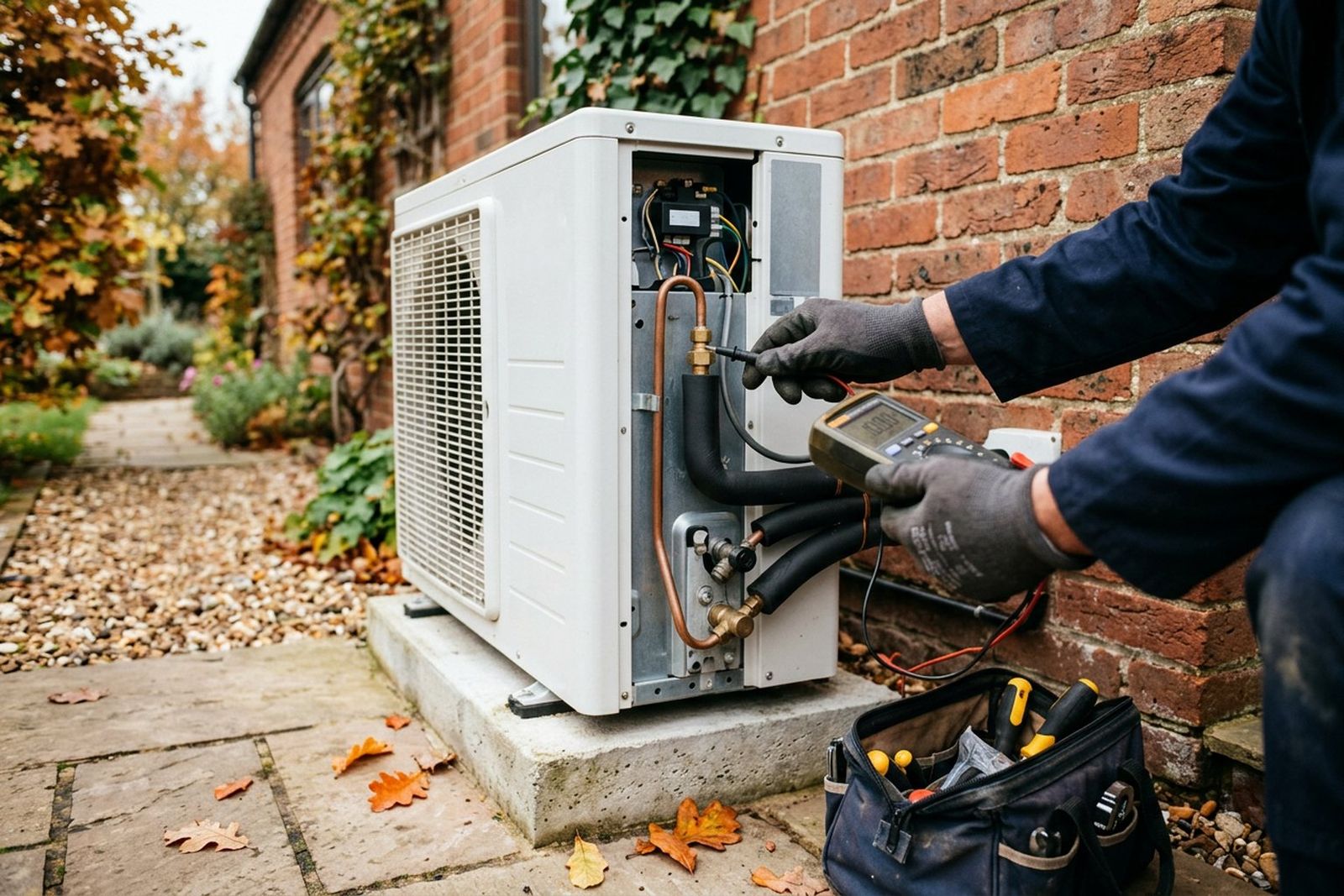
What does a heat pump annual service cover?
A service follows the manufacturer’s own schedule, so the detail varies by model. This is the typical picture:
| Area | What the engineer checks |
|---|---|
| Outdoor unit and coil | Visual condition, anything blocking airflow in or out, the evaporator coil and fan cleaned and checked, the condensate drain clear |
| Refrigerant circuit | Checked for leaks and correct pressures; any refrigerant work by a qualified engineer only |
| Electrics | Electrical connections and wiring checked for damage or scorching |
| Heating system water | System pressure topped up if needed, expansion vessel pressure, pressure relief valve, strength of the corrosion and antifreeze protection, leaks, magnetic filter cleaned |
| Pipework | Flexible hoses and pipe insulation |
| Controls | Heating and hot water settings back to what was set at commissioning; thermostat operation |
Compiled from Grant’s and Vaillant’s published service schedules and the Energy Saving Trust’s list.
Antifreeze: some systems add a thermal fluid to the heating water against freezing and corrosion; Grant recommends frost protection to at least −10°C and checks the concentration at each service. Hot water: if your system stores hot water, the service should confirm any anti-legionella setting still works — Grant describes an optional timer that periodically raises stored water to 60°C. Your installer should explain how your hot water is provided.
Ask for the visit to be recorded in the Benchmark service record, which Vaillant requires; it is the simplest proof a service happened.
Refrigerant and F gas: who can work on it, and when leak checks are law
Every heat pump has a refrigerant in a sealed circuit. Many use an F gas (a fluorinated greenhouse gas) such as R32; some newer models use propane, known as R290, which is not an F gas.
Who can work on the refrigerant
Where a heat pump contains F gas, GOV.UK says you must hold qualifications to install, service and maintain, check for leaks or recover gas from it, and that it is against the law to work with F gas without them. A category 1 certificate covers all activities; category 2 covers installing, servicing and recovering refrigerant on systems holding less than 3 kg of F gas (6 kg if hermetically sealed); category 4 covers leak checks that do not break into the circuit. Grant’s manual says any work on the refrigerant circuit must be done by an F gas registered refrigeration engineer. None of this is a homeowner job.
When a leak check is a legal requirement
Under the GB F gas regulation, equipment holding F gas equal to 5 tonnes of CO2 equivalent or more must be leak checked by a certified person — at least every 12 months up to 50 tonnes. Equipment labelled as hermetically sealed is exempt below 10 tonnes. GOV.UK says that if you use the equipment, you are responsible for getting it checked. The CO2 equivalent is the refrigerant’s weight in tonnes multiplied by its global warming potential, which GOV.UK puts at 675 for R32.
- For R32, 5 tonnes equals about 7.4 kg of refrigerant (5 ÷ 675 × 1,000).
- Grant’s Aerona³ R32 range holds 0.80 kg to 2.80 kg — about 0.5 to 1.9 tonnes CO2 equivalent, well below the threshold.
- Units on R410A reach 5 tonnes at about 2.4 kg, per GOV.UK’s table, so check the label.
The charge is on the unit’s label. Below the threshold there is no legal interval, but Grant’s and Vaillant’s annual service schedules still include a refrigerant leak check.
If your unit uses propane (R290), as Vaillant’s aroTHERM plus does, its manual sets a protective zone around it with no plug sockets, light switches, windows, doors or vents, and rules out later alterations that break that. Ask your installer before adding an outside light or socket near it.
Air source heat pump maintenance checklist: what you can do yourself
Owner jobs are few, and most come straight from manufacturer instructions:
- Keep it clear. Remove leaves, snow and debris from the air inlet and fan outlet. The Energy Saving Trust names bikes, wheelie bins and leaves. Never cover the unit or stack anything on it.
- Respect the clearances. These are set per model. For Grant’s Aerona³, for example, the minimum is 300 mm above, 600 mm in front, 600 mm to the right, 100 mm to the left and 300 mm behind (150 mm if wall-mounted). Do not let planting grow back into that space.
- Clean the casing gently. Vaillant says a damp cloth and a little solvent-free soap, with no sprays, scouring agents, detergents, solvents or chlorine-based cleaners. Leave the coil fins to the engineer.
- Glance at the pressure gauge. Ask your installer for the normal reading. Grant’s Aerona³ instructions give typical cold fill pressures of about 0.5 bar for a bungalow and 1.0 bar for a two-storey house, with a 3 bar maximum; Vaillant’s aroTHERM plus shuts down with a fault below 0.5 bar. A reading that keeps falling points to a leak.
- Note any error codes on the controller before you call anyone.
- Leave the power on in winter. Grant’s frost protection does not work if the external isolator is switched off, and Vaillant tells owners to keep its unit switched on unless separate frost protection is fitted.
- Bleed radiators with care. Releasing trapped air lowers the system pressure, which may then need topping up. If your system water contains antifreeze, topping up with tap water dilutes it, so ask your installer before refilling.
- Leave the technical settings alone. The Energy Saving Trust says you can still adjust the programmer and thermostat; see how to run a heat pump efficiently.
Vaillant’s manual is blunt about the rest: never attempt maintenance work or repairs on the product yourself.
Signs your heat pump needs attention
- New noises. MCS lists loose parts, debris in the fan and missed maintenance as causes. See are heat pumps noisy?
- Ice that does not clear. A cloud of vapour in cold weather is normally the unit defrosting, and Vaillant says you need do nothing about it. Ice that keeps building, or a unit that stays iced up, is a call to your installer. More in heat pumps in cold weather.
- Error codes or no heat. Check the power and controller first, as Grant and Vaillant advise, then call an engineer.
- Pressure that keeps dropping on the gauge.
- Bills climbing for no reason. It may be a fault or the way the system is run: the Energy Saving Trust says running a heat pump like a gas boiler can mean unexpectedly high electricity bills, poor comfort and a higher risk of equipment failure. Our guide to how much electricity a heat pump uses helps you judge what is normal.
Heat pump warranty servicing: what manufacturers and MCS require
Some manufacturers’ warranties depend on an annual service. Two examples from published terms:
- Vaillant: the heat pump should be serviced annually by Vaillant or another suitably competent, qualified engineer, following the manufacturer’s instructions; if it is not, the warranty becomes invalid. The service cost is not included.
- Grant: twelve months as standard, extended to two years if the unit is registered within 30 days of installation and serviced at twelve-monthly intervals.
Keep every service record. The fuller picture on manufacturer terms, and what else can void cover, is in our heat pump lifespan and warranty guide.
The installation has separate protection. MCS 001-1, the MCS contractor standard, requires an MCS installer to belong to a consumer code approved by the Chartered Trading Standards Institute — the Renewable Energy Consumer Code (RECC) and HIES both say they operate one — and to warrant its workmanship for at least two years, with an insurance policy covering that if the contractor stops trading. MCS installation is also what the Boiler Upgrade Scheme depends on: only an MCS-certified installer can apply. You may be eligible for £7,500 towards an air source heat pump; once the voucher is issued, the installer has three months to complete the job and claim it.
How much does heat pump servicing cost?
It varies with the make and model, whether a hot water cylinder is serviced at the same visit, whether parts are needed and travel, so we do not quote a figure. Ask for a fixed price, the checklist the engineer will follow and confirmation it goes in the Benchmark record.
If you do not have a heat pump yet, the installation cost depends on your property: the size of system it needs, set by a heat loss calculation; whether radiators or pipework need upgrading (see do I need new radiators?); where the outdoor unit goes and how long the pipe run is; how hot water will be provided; and any electrical work. Get in touch and we will arrange a free survey of your home and give you a clear, itemised quote; if you are happy with it, we can go ahead. You may be eligible for the £7,500 Boiler Upgrade Scheme grant, which only an MCS-certified installer can apply for; ByEco’s certification is in progress. More in our heat pump cost guide.
What to ask about servicing, and where ByEco stands
Before you sign for an installation, ask:
- What does the manufacturer require for this model to keep the warranty, and who registers the unit?
- Which refrigerant does it use, how much, and does it need a legal leak check?
- Who will carry out the annual service, and do they hold the right refrigerant qualifications?
- What pressure reading is normal, and what clearances or protective zone does the unit need?
ByEco installs air source heat pumps in England and Wales from our base in Manchester. Our MCS and TrustMark certification is in progress, so we cannot yet apply for the Boiler Upgrade Scheme grant for you. If you have questions about looking after a heat pump, or want to know what one would involve in your home, get in touch. See our heat pumps page and service areas.
Sources
Every figure on this page was checked against primary sources on 14 October 2026. Grant rules, planning rules and prices change — if you are reading this much later, verify before acting.
- Energy Saving Trust — Heat pump installation: a step-by-step guide
- Energy Saving Trust — Your heat pump questions answered by our experts
- MCS — Air source heat pumps: consumer guidance
- HSE — Gas safety checks: who needs them?
- HSE — Gas safety: domestic FAQs
- legislation.gov.uk — Gas Safety (Installation and Use) Regulations 1998, regulation 36
- legislation.gov.uk — Gas Safety (Installation and Use) Regulations 1998, regulation 2
- GOV.UK — Checking F gas equipment for leaks
- legislation.gov.uk — Regulation (EU) No 517/2014 (GB version), Article 4: Leak checks
- GOV.UK — Qualifications to work with F gas
- GOV.UK — Fluorinated gases (F gases)
- GOV.UK — Calculate the carbon dioxide equivalent quantity of an F gas
- Grant UK — Aerona³ R32 Installation and Servicing Instructions (DOC 0136 Rev 2.4)
- Grant UK — Aerona³ User Instructions (DOC 0112 Rev 1.1)
- Grant UK — Product guarantees
- Vaillant — Heat pump guarantee terms and conditions
- Vaillant — aroTHERM plus VWL 35/6 to 75/6 A S2 operating, installation and maintenance instructions
- MCS — MCS 001-1 The MCS Contractor Standard, Part 1, Issue 4.2
- MCS — Installation guidance for mitigating noise from air source heat pumps
- Renewable Energy Consumer Code (RECC)
- Home Insulation & Energy Systems (HIES)
- GOV.UK — Apply for the Boiler Upgrade Scheme: what you can get
- legislation.gov.uk — Boiler Upgrade Scheme (England and Wales) Regulations 2022, regulation 15
Book your free home survey
Every home is different. The cost depends on the size of system, any radiators that need upgrading, the pipework and where the outdoor unit goes. Get in touch and we will arrange a free survey of your home and give you a clear quote. If you are happy with it, we can go ahead.