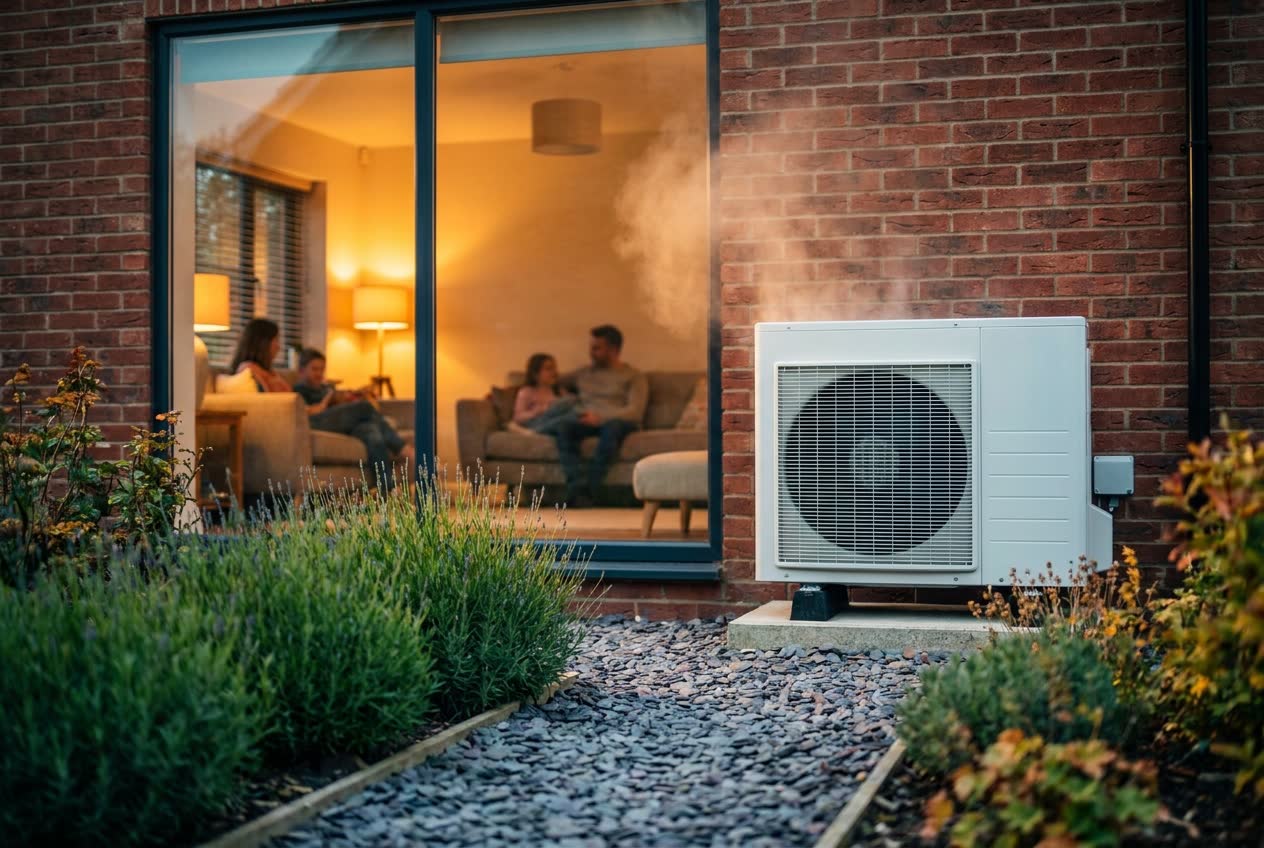
The short version
- A heat pump can work in a flat. What decides it is permission, siting and planning.
- In England, permitted development allows one air source heat pump on a whole block of flats, with an outdoor unit of no more than 0.6 cubic metres (1.5 for a house). A second unit on the block needs a planning application.
- For the noise calculation, the other flats in your block count as neighbours.
- Most flats are leasehold, and your lease may require the freeholder’s written consent even if you have planning permission.
- Flat owners can get the £7,500 Boiler Upgrade Scheme grant, but not for social housing or one system heating several unrelated flats.
“We live in a flat, so a heat pump is not for us” is sometimes right, but the reasons are usually about the building rather than the heat pump. This guide covers the rules for flats, the three ways a flat can get heat pump heating, and what to sort out first.
What decides whether a flat can have a heat pump
An air source heat pump needs an outdoor unit, pipework into the flat and equipment indoors (see how an air source heat pump works). In a flat, three things outside your control can say no:
- The freeholder or management company, if the unit or pipes touch walls, roof or grounds they own.
- The planning rules, which are tighter for a block of flats than for a house.
- Your neighbours, indirectly, through the noise calculation, which treats the flats above, below and beside you as neighbouring homes.
Sizing works as for any home, from a room-by-room heat loss calculation: see what size heat pump do I need? and do I need new radiators for a heat pump?
Planning permission for a heat pump on a flat in England
Most heat pumps in England go in under permitted development: national rules (Class G of Part 14 of the General Permitted Development Order 2015) that allow the work without a planning application. Class G covers an air source heat pump “on a dwellinghouse or a block of flats” or within its grounds (its curtilage). The Order defines a block of flats as “a building which consists wholly of flats”, and says a dwellinghouse does not include a building containing one or more flats.
So a purpose-built block, or a house wholly converted into flats, should come under the block-of-flats rules. A flat in a building that also contains a shop or office fits neither definition: the Planning Portal says a block of flats “should not also contain commercial premises”. Class G does not cover it, so expect to need a planning application, and check with your council.
An amending Order (S.I. 2025/560) changed Class G from 29 May 2025. It removed the 1 metre boundary rule and raised the size limit for houses to 1.5 cubic metres, but kept 0.6 for a block of flats. The main conditions:
| Permitted development condition (England) | House | Block of flats |
|---|---|---|
| Maximum number of air source heat pumps on the building and its grounds | 1 (2 if detached) | 1 for the whole block |
| Outdoor unit volume, including any housing | 1.5 m³ | 0.6 m³ |
| Pitched roof | Not allowed | Not allowed |
| Flat roof | At least 1 m from the edge | At least 1 m from the edge |
| Noise | Must comply with MCS 020(a) | Must comply with MCS 020(a) |
| Listed building | Not permitted development | Not permitted development |
The “one per block” rule catches flat owners out. Class G does not apply if the work would result in “more than one air source heat pump on, or within the curtilage of” a block of flats, so once one unit is on the block or its grounds, any further one needs a planning application.
Position matters too. In a conservation area or World Heritage Site, the unit cannot go on a wall or roof that fronts a highway, or nearer to a bounding highway than the building itself. Elsewhere, it cannot go on any part of a wall that fronts a highway above the level of the ground floor storey, so a unit fixed to the street-side wall of an upper-floor flat is not permitted development. The unit must also, so far as practicable, be sited to minimise its effect on the building’s appearance and the amenity of the area, and must not be used solely for cooling.
For houses, see can a terraced house have a heat pump?
The noise calculation counts the flats in your block
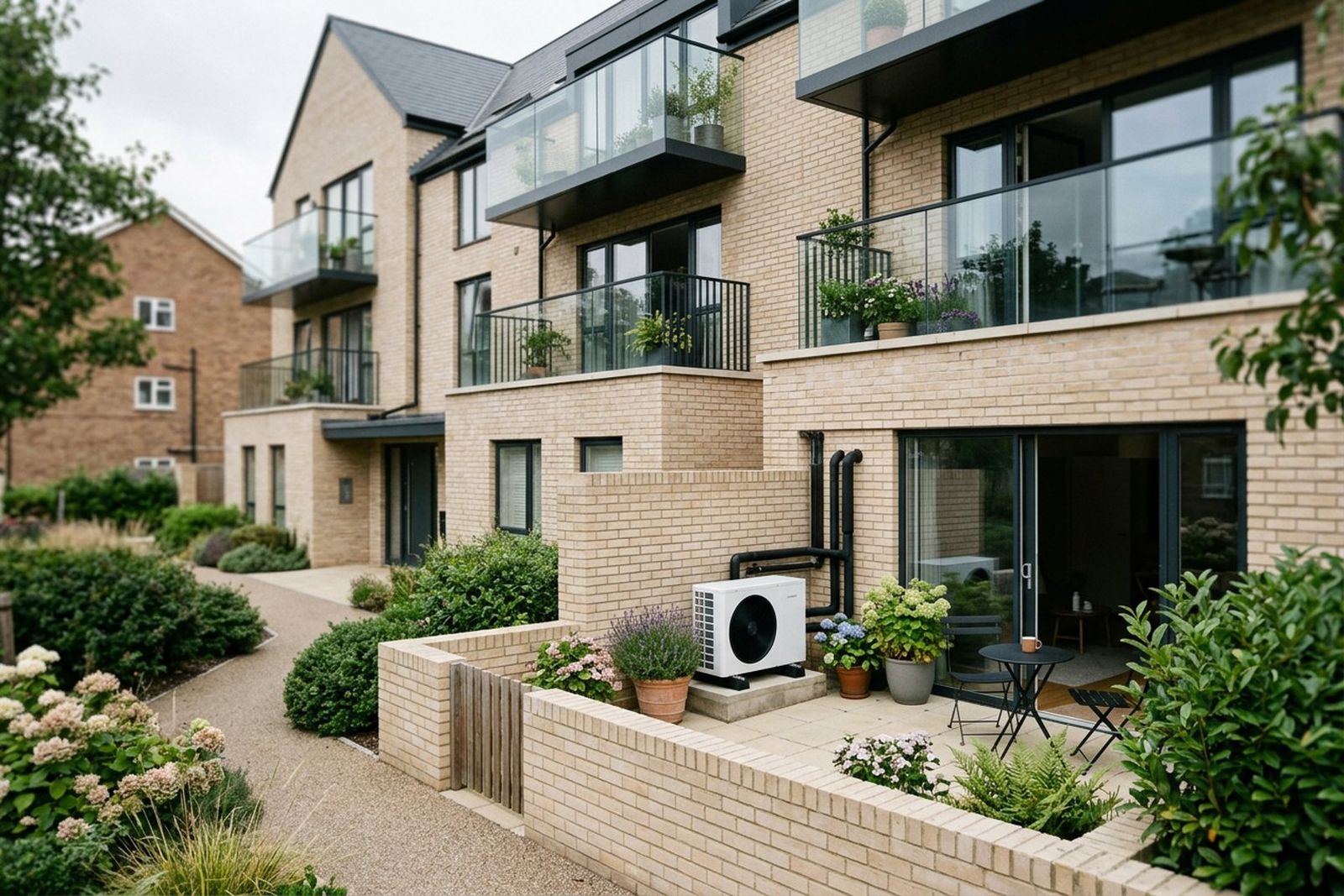
To be permitted development, the installation must comply with MCS 020(a), which checks that the heat pump meets a permitted development noise limit of 37 dB at each assessment position: a point 1 metre outside a door or window of a habitable room of a neighbouring property. For a heat pump on a block of flats, MCS 020(a) says neighbouring property “includes flats within the same block of flats” (other than your own), and that assessment positions should cover ground floor, first floor and so on. The bedroom window of the flat above or below may decide it. More in are heat pumps noisy?
Flats in Wales
Wales has its own permitted development rules for heat pumps, updated on 1 June 2026, and they differ from England’s, including on the size limit for a block of flats. In its 2025 consultation response the Welsh Government said it was not minded to allow multiple air source heat pumps on a block of flats, citing noise, siting and visual impact, and the 2026 rules keep the limit at one per block. Check with your council before you commit. The grant covers Wales on the same terms.
Heat pumps in leasehold flats: the lease and the freeholder
GOV.UK puts it plainly: “Most flats are leasehold.” Your lease sets out whether you need permission to make alterations and who is responsible for repairs, and GOV.UK warns that breaking its conditions can mean being taken to court, paying for damage, and in some cases losing the lease. This is not legal advice: it is what to check and who to ask.
The Leasehold Advisory Service (LEASE) says you might need the freeholder’s permission “even if you already have planning permission or building regulations approval”. A lease might ban alterations, allow them, allow them only with written permission, or allow them subject to conditions set out in a licence. Points that matter for a heat pump:
- Who owns the outside. LEASE notes the landlord might own the roof and the external walls (“retained premises”). For work affecting them, the landlord’s usual duty to consider a request reasonably and give reasons does not apply.
- Pipe holes. A clause such as “no cutting of external walls” would prevent new openings, including for pipes.
- Get it in writing before work starts. If the lease allows, the landlord may charge a reasonable fee for consent, and possibly a premium if the work affects parts it owns.
- Unauthorised alterations can make a flat harder to sell, remortgage or insure, says LEASE.
Ask the freeholder or managing agent first, then a solicitor or LEASE if the lease is unclear. Tenants need their landlord to lead.
Your options: your own heat pump, a shared ground loop or a heat network
Your own air source heat pump
The usual route for a flat with outside space: a ground-floor garden or terrace, a balcony, or a flat roof at least 1 metre from the edge. The MCS installation standard, MIS 3005-I, says a heat pump should not be next to sleeping areas “or on floors that can transmit vibration”, should be sited to avoid nuisance to neighbours, and must drain condensate safely to a suitable drain or soakaway (on a balcony, ask exactly where it will go).
Ask the installer to confirm the balcony or roof can carry the unit, how the pipes reach your flat, and how hot water will be provided. A ground-floor flat with its own garden is usually the simplest case; a high-rise flat with no balcony the hardest.
A shared ground loop
Each flat has its own ground source heat pump, connected to one communal loop of pipes in the ground. The grant covers them, and Ofgem says each heat pump “must serve an individual property”, up to 300 kW of heat output on the loop in total. Ground source heat pumps in the grounds of a block of flats can be permitted development under Class C.
Shared ground loops are rare: by the end of August 2026 the grant had been paid for 37 heat pumps on shared ground loops, out of 93,364 grant-funded installations of all kinds. They are a whole-building project for the freeholder or management company to lead. Ofgem counts them as a type of heat network, noting that most of a customer’s heating costs are usually paid through their electricity bill. See air source vs ground source heat pumps.
If your building is already on a heat network
Some blocks already get heat from a central plant: a communal heat network, which Ofgem describes as supplying “a single building that’s divided into separate premises”, or a district network serving two or more buildings. If your flat is on one, an individual heat pump is usually not the route: how the building is heated is a matter for the building owner and the network operator.
What about air-to-air heat pumps?
Air-to-air heat pumps blow warm air into rooms rather than heating water. They are closer to air conditioning, which ByEco does not install, so this guide sticks to heat pumps that run radiators. A heat pump paired with a boiler is a different case again: see hybrid heat pumps.
Heat pump grants for flats: the Boiler Upgrade Scheme
The Boiler Upgrade Scheme gives £7,500 towards an air source (air-to-water) or ground source heat pump, including one on a shared ground loop, in England and Wales. Flats are not excluded, but some rules bite harder for them:
- You must own the property, including a flat you rent out. GOV.UK describes a leaseholder as owning it for a fixed period; if unsure how ownership will be shown, ask the installer before they apply.
- One grant per property. An owner of several flats can apply for each legally separate one, but Ofgem says “cascade systems heating multiple unrelated properties, such as flats, are not eligible”.
- Social housing is not eligible, which Ofgem says includes some shared ownership schemes; a former council flat bought under Right to Buy and now privately owned may be eligible.
- New builds are not eligible while the developer is still building them, though GOV.UK says that if you move into a finished new build with a fossil fuel boiler you may be able to get a grant.
- Electric heating counts. GOV.UK lists electric heating alongside gas, oil and LPG as systems the grant can replace.
- Hybrids are out. A heat pump combined with a gas boiler gets no grant.
An MCS-certified installer applies and deducts the grant from your quote. An air source voucher lasts 3 months from issue, so settle consent and planning first. For prices, see heat pump costs in Manchester.
A checklist before you get quotes
- Read your lease (the alterations clause; who owns the walls, roof and balcony) and ask the freeholder or managing agent early how they handle consent.
- Ask whether the building is on a communal or district heat network.
- Check whether the building is made up wholly of flats, listed, or in a conservation area, and whether there is already an air source heat pump on the block.
- Note where a unit could go and where the nearest windows of other flats are.
- Confirm you own the flat and it is not social housing.
- Check each quote includes a heat loss calculation, the MCS 020(a) noise calculation covering your block, the unit’s volume against 0.6 cubic metres (in England), the condensate route and how hot water will be provided. See what to expect from an installation.
Where ByEco stands
ByEco installs heat pumps in flats as well as houses. ByEco’s MCS and TrustMark certification is in progress, so we cannot yet lodge a Boiler Upgrade Scheme application for you; only an MCS-certified installer can. If you own a flat in Greater Manchester, see our notes on Manchester flats and our heat pumps page, or get in touch with your lease details and a photo of where a unit might go.
Sources
Every figure on this page was checked against primary sources on 8 October 2026. Grant rules, planning rules and prices change — if you are reading this much later, verify before acting.
- legislation.gov.uk — General Permitted Development Order 2015, Schedule 2, Part 14 (Class G and interpretation), revised text
- legislation.gov.uk — General Permitted Development Order 2015, article 2 (interpretation)
- Planning Portal — Air source heat pumps: planning permission
- legislation.gov.uk — Town and Country Planning (General Permitted Development) (England) (Amendment) Order 2025 (S.I. 2025/560)
- MCS — MCS 020 a) Air Source Heat Pump Sound Calculation for Permitted Development Installations, Issue 1.1 (14 April 2025)
- MCS — MIS 3005-I:2025 Heat Pump Installation Standard, Issue 1.0
- GOV.UK — Leasehold property
- The Leasehold Advisory Service — Alterations and home improvements (updated 22 December 2025)
- GOV.UK — Apply for the Boiler Upgrade Scheme: what you can get
- GOV.UK — Apply for the Boiler Upgrade Scheme: check if you’re eligible
- Ofgem — Boiler Upgrade Scheme: guidance for installers (V5.1, last updated 2 July 2026)
- Ofgem — Boiler Upgrade Scheme guidance for installers V5.1 (PDF)
- legislation.gov.uk — Boiler Upgrade Scheme (England and Wales) Regulations 2022, regulation 15
- DESNZ — Boiler Upgrade Scheme statistics: August 2026
- Ofgem — Heat networks: who should register
- Welsh Government — Planning permission: domestic heat pumps
- Welsh Government — Changes to permitted development rights: summary of responses (2025)
- legislation.gov.uk — Town and Country Planning (General Permitted Development) (Amendment) (Wales) Order 2026
Get a figure for your house
National averages only get you so far. Send us your postcode and a little about your home, and we will come back with a realistic price and an honest view on whether a heat pump suits it.