The short version
- A heat pump may be free of charge for an eligible flat after the £7,500 Boiler Upgrade Scheme grant, subject to survey and eligibility. Whether anything is left to pay depends on the flat and the system it needs.
- GOV.UK says you are eligible if you own the property and are replacing fossil fuel heating, such as oil, gas, electric or LPG. Social housing, most new builds and hybrid systems are excluded.
- Most flats are leasehold, and your lease may require the freeholder’s written permission.
- In England, one outdoor unit of no more than 0.6 cubic metres is allowed on a whole block of flats without a planning application, and the other flats count as neighbours for the noise calculation.
- ByEco’s free survey confirms what applies to your flat. Get in touch for your free survey.
A search for a “free heat pump” for a flat may turn up plenty of promises and very few explanations. This guide sets out who GOV.UK and Ofgem say may be eligible for the grant, and the points about space, noise and permission that decide whether a flat suits a heat pump.
The short answer: when a heat pump may be free of charge for a flat
It may be, for an eligible flat. The Boiler Upgrade Scheme (BUS) is the government grant for replacing fossil fuel heating with a heat pump in England and Wales, and it pays £7,500 towards an air source heat pump. Your installer takes it off your quote before you pay. For an eligible flat, a heat pump may be free of charge after the grant, subject to survey and eligibility.
The grant is a fixed amount. If the quote is more than the grant, you pay the difference, and what the quote comes to depends on the flat, the system it needs and the survey. It is not a promise for every flat. ByEco’s free survey is how you find out.
What decides whether anything is left to pay
Four things decide it.
- The grant is taken off up front. Ofgem’s guidance says installers must deduct the full grant value from the quote before the property owner pays anything, and must not ask the owner to pay the grant amount.
- The size of system. The MCS design standard says a heat load calculation is performed on the building to size the heat pump. A smaller home with less heat loss often needs a smaller system than a large detached house, but the calculation decides, not a rule of thumb. Our guide to what size heat pump you need explains how.
- The rest of the job. Radiators and pipework, where the outdoor unit goes, how hot water will be provided and any electrical work all affect the quote.
- Eligibility. The next section sets out the rules.
For how the grant works in general, see our guide to whether you can get a free heat pump and the Boiler Upgrade Scheme guide.
Who may be eligible for the grant
GOV.UK says you are eligible for a Boiler Upgrade Scheme grant if both of these are true. You must:
- own the property you are applying for, including a business, a second home or a property you rent out to tenants; and
- be replacing fossil fuel heating systems, such as oil, gas, electric or LPG.
The scheme is open in England and Wales, and earlier energy efficiency funding does not rule you out. Ofgem’s installer guidance adds detail that matters in flats:
- Electric heating counts. Ofgem’s examples are storage heaters, electric panel radiators and electric boilers.
- The heat pump must replace the old system. Ofgem says it must fully replace the existing heating, except where supplementary heating appliances are permitted. GOV.UK says there is no grant for a hybrid system, such as a gas boiler combined with an air source heat pump.
- One grant per property. An owner of several flats may apply for each separate property.
You cannot get a grant for most new build properties, for social housing, or for a property already given government funding or support for a heat pump or biomass boiler. A new build the developer is still building is not eligible, though GOV.UK says you may be able to get a grant if you move into a finished new build with a fossil fuel boiler.
These are the scheme’s rules, not ByEco’s; the survey checks whether your flat is eligible.
Owning a flat: leasehold, landlords and shared buildings
Leasehold flats
GOV.UK says most flats are leasehold, and that you own a leasehold property for a fixed period of time. The scheme’s test is that you “own the property”. Neither GOV.UK’s eligibility page, Ofgem’s installer guidance nor the Boiler Upgrade Scheme Regulations spells out how a leasehold flat is treated, so do not assume either way. Ask the installer how ownership will be shown. Where a flat has more than one owner, Ofgem asks for the agreement of all the other owners.
Landlords and tenants
A property you rent out can be eligible, so a landlord who owns the flat may be able to apply, but a tenant cannot, because the test is ownership. Ofgem says a landlord must also confirm they have told the tenant about the impact of the installation. See heat pumps for landlords.
Former council flats and shared ownership
Social housing is not eligible. Ofgem defines it as homes owned or managed by councils, housing associations or registered social landlords, or other organisations providing housing at below market rent or through shared ownership schemes for people in housing need. A former council flat sold under Right to Buy, or a similar scheme, and now privately owned is not classed as social housing and may be eligible. If you own through a shared ownership scheme, ask the installer, because Ofgem’s definition refers to it.
Flats on a communal system
Ofgem says cascade systems heating multiple unrelated properties, such as flats, are not eligible, so one system heating several separately owned flats is not what this guide covers. It covers an air source heat pump for your own flat; see can you get a heat pump in a flat? for other options, such as shared ground loops.
Paying for it
Ofgem lists hire-purchase, conditional sale and consumer hire as ineligible, because the owner must become the legal owner of the heat pump. Be wary of any offer of a free heat pump that involves a finance or hire agreement: it may not be the grant route described here.
What a flat typically needs
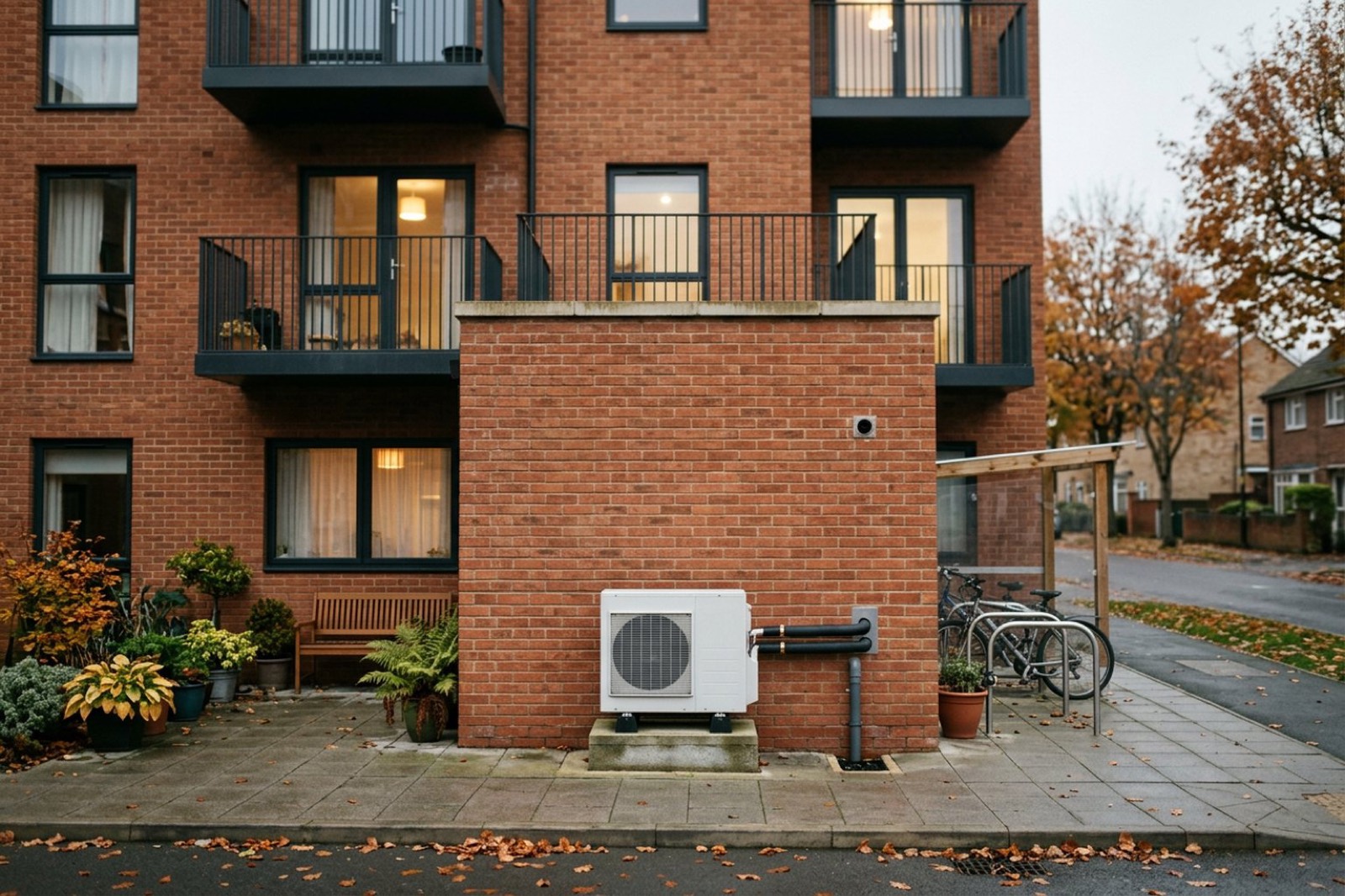
A place for the outdoor unit
An air source heat pump needs an outdoor unit, with pipework into the flat. The installer assesses the options below at the survey; where to put a heat pump outdoor unit covers siting in more detail.
| Possible position | What to check |
|---|---|
| Ground-floor patio, garden or shared ground | Who owns the land; a firm base; the noise calculation at neighbouring windows; a drain for condensate. |
| Balcony | Who owns the balcony and whether the lease allows it; the MCS installation standard says a heat pump should not be next to sleeping areas or on floors that can transmit vibration; where condensate will drain. |
| External wall | Who owns the wall; in England, a wall fronting a highway is restricted (any such wall in a conservation area; above the ground floor elsewhere); how the pipes enter the flat. |
| Flat roof | Who owns the roof; in England, at least 1 metre from the external edge of the roof to stay within permitted development. |
A ground-floor flat with its own patio is often the simplest case; a high-rise flat with no balcony or roof access is often the hardest, and the survey may find a heat pump is not practical there.
The right size of system
The MCS design standard says the heat pump is selected from a heat load calculation on the building, so there is no standard “flat size” of heat pump. A small, well-insulated flat may need a modest system; a flat with large windows or several exposed walls may need more. What is left to pay, if anything, depends on that result and the rest of the job, which is why ByEco gives a figure only after a survey.
Radiators, pipework and hot water
Some radiators may need to be larger at heat pump temperatures; see do I need new radiators?. Ask the installer to spell out how hot water will be provided.
Planning limits for a heat pump on a flat
In England, most heat pumps go in under permitted development, which means no planning application. The rule is Class G of Part 14 of the General Permitted Development Order 2015, which covers an air source heat pump on a block of flats, or within its grounds, and defines a block of flats as a building which consists wholly of flats. The main limits are:
- One heat pump for the whole block. The rule does not apply if the work would result in more than one air source heat pump on, or within the grounds of, a block of flats, so if another flat already has one, yours needs a planning application.
- 0.6 cubic metres. The outdoor unit, including any housing, must not exceed 0.6 cubic metres on a block of flats. The limit for a house is 1.5 cubic metres.
- Position. Not on a pitched roof, and on a flat roof not within 1 metre of the external edge. Not on a listed building. In a conservation area, not on a wall or roof that fronts a highway. The installation must also comply with the MCS 020(a) sound calculation (next section).
The Planning Portal says a block of flats must consist wholly of flats, for example it should not also contain commercial premises. A flat in a building with a shop or office may therefore fall outside Class G, so check with your council before assuming permitted development applies. Wales has its own rules, updated on 1 June 2026, so the England limits above may not apply there.
Noise and the MCS 020 calculation
In England, a permitted development installation must comply with the MCS 020(a) sound calculation, which checks against a noise limit of 37 dB at each assessment position: a point 1 metre outside a door or window of a habitable room of a neighbouring property. MCS 020(a) says that for a heat pump on a block of flats, neighbouring property includes the other flats in the same block, and that assessment positions should include ground floor, first floor and so on. A window of a flat above, below or beside yours may be the one that decides the result.
See are heat pumps noisy? for what the numbers mean.
Permission from the freeholder or management company
Your lease sets out whether you need permission to make alterations. The Leasehold Advisory Service (LEASE) says you might need your landlord’s permission even if you already have planning permission, and lists installing a heat pump on the external wall among the changes a lease might restrict. If your lease says you need written consent, get it in writing before the work starts.
Timing matters because an air source heat pump voucher expires three months after it is issued (GOV.UK’s eligibility page words the time limit as 120 days from applying; plan for the shorter), so sort out consent before the installer applies. What to put in your request is in do I need permission for a heat pump in a flat?
What to ask an installer
- Is my flat eligible, and how will you show I own it? Will you apply for the grant on my behalf?
- Does the quote show the £7,500 grant taken off before I pay?
- What is left to pay, if anything, and what is it for? Ask for an itemised quote.
- Where will the outdoor unit go, who owns that spot and, in England, does it stay under 0.6 cubic metres?
- Will you do the MCS 020(a) noise calculation covering the other flats in the block?
- How will hot water be provided, do radiators or pipework need changing, and will the heat pump fully replace my existing heating?
Compare at least two itemised quotes; our guide to heat pump costs in Manchester explains what drives the figure.
Where ByEco stands
ByEco installs heat pumps in flats as well as houses. ByEco is MCS certified for air source heat pump installation (certificate IAA10330), and we apply for the £7,500 Boiler Upgrade Scheme grant on your behalf.
For eligible flats, a heat pump may be free of charge after the £7,500 grant, subject to survey and eligibility. We do not quote a price until we have seen your flat. Get in touch for your free survey with a few details about your flat, your lease and where a unit might go. We will confirm what applies, explain what is left to pay if anything, and give you an itemised quote; if you are happy, we can go ahead. See also our heat pumps and grants pages.
Sources
Every figure on this page was checked against primary sources on 6 November 2026. Grant rules, planning rules and prices change — if you are reading this much later, verify before acting.
- GOV.UK — Apply for the Boiler Upgrade Scheme: check if you’re eligible
- GOV.UK — Apply for the Boiler Upgrade Scheme: what you can get
- GOV.UK — Apply for the Boiler Upgrade Scheme
- Ofgem — Boiler Upgrade Scheme: guidance for installers
- Ofgem — Boiler Upgrade Scheme guidance for installers V5.2 (PDF)
- legislation.gov.uk — Boiler Upgrade Scheme (England and Wales) Regulations 2022, regulation 5
- legislation.gov.uk — Boiler Upgrade Scheme (England and Wales) Regulations 2022, regulation 15
- legislation.gov.uk — General Permitted Development Order 2015, Schedule 2, Part 14 (Class G and interpretation)
- legislation.gov.uk — General Permitted Development Order 2015, article 2 (interpretation)
- Planning Portal — Planning permission: air source heat pump
- MCS — MCS 020 a) Air Source Heat Pump Sound Calculation for Permitted Development Installations, Issue 1.1
- MCS — MIS 3005-I:2025 Heat Pump Installation Standard
- MCS — MIS 3005-D Heat Pump Design Standard, Issue 3.0
- GOV.UK — Leasehold property
- The Leasehold Advisory Service — Alterations and home improvements
- Welsh Government — Planning permission: domestic heat pumps
Book your free home survey
Every home is different. The cost depends on the size of system, any radiators that need upgrading, the pipework and where the outdoor unit goes. Get in touch and we will arrange a free survey of your home and give you a clear quote. If you are happy with it, we can go ahead.