The short version
- A flat can need several separate permissions: planning (the council), consent under your lease (the freeholder or managing agent), building regulations (through your installer) and, for the grant, an Ofgem application made by your installer. One does not replace another.
- In England, permitted development allows one air source heat pump on a whole block of flats, with an outdoor unit of no more than 0.6 cubic metres, if it passes the MCS 020(a) noise calculation and meets the position rules.
- A listed block is not covered by that permitted development route, and on our reading neither is a flat in a building that also contains shops or offices: expect a planning application.
- The Leasehold Advisory Service says you might need the freeholder’s permission even with planning permission. Check your lease and ask your freeholder or managing agent.
- You may be eligible for £7,500 towards an air source heat pump. GOV.UK says you must own the property, and Ofgem asks the owner to confirm ownership and consent.
For a flat there is not one answer but several, from different bodies. This guide uses the legislation, GOV.UK, the Planning Portal, the Leasehold Advisory Service (LEASE), MCS and Ofgem, and says where they stop. For whether a flat suits a heat pump at all, see can you get a heat pump in a flat?
Which permissions can a flat need?
| Permission | Who decides | What it covers |
|---|---|---|
| Planning permission or permitted development | National rules; your council if you apply | The outdoor unit: number, size, position, noise (England) |
| Listed building consent | Your council | Works affecting a listed building’s character |
| Consent under your lease | Freeholder or managing agent, as your lease sets out | Alterations to your flat and to parts the landlord owns or controls |
| Building regulations | Building control, or a competent person scheme through your installer | That the work complies with the Building Regulations |
| Boiler Upgrade Scheme grant | Ofgem, on your installer’s application | The grant only. It gives you no permission to alter the building |
Planning permission for a heat pump in a flat in England
In England, an air source heat pump can go in under permitted development: national rules that remove the need for a planning application if every limit and condition is met. They are in Class G of Part 14 of Schedule 2 to the General Permitted Development Order 2015, which covers a heat pump “on a dwellinghouse or a block of flats” or within its grounds (its curtilage). Miss one limit and you apply to the council. The main limits for a block of flats:
| Limit or condition (England) | Block of flats |
|---|---|
| Air source heat pumps on the block or in its grounds | One in total |
| Outdoor unit volume, including any housing | 0.6 m³ at most |
| Noise | Must comply with MCS 020(a) |
| Roofs | Not on a pitched roof; on a flat roof, not within 1 metre of the edge |
| Listed building | Not permitted development |
| Conditions | Not used solely for cooling; sited, so far as practicable, to minimise the effect on appearance and amenity; removed when no longer needed |
A house has a higher size limit (1.5 cubic metres), and a detached house can have two units. Our guide to planning permission for a heat pump covers every Class G condition, and where to put the outdoor unit covers positions.
One heat pump for the whole block
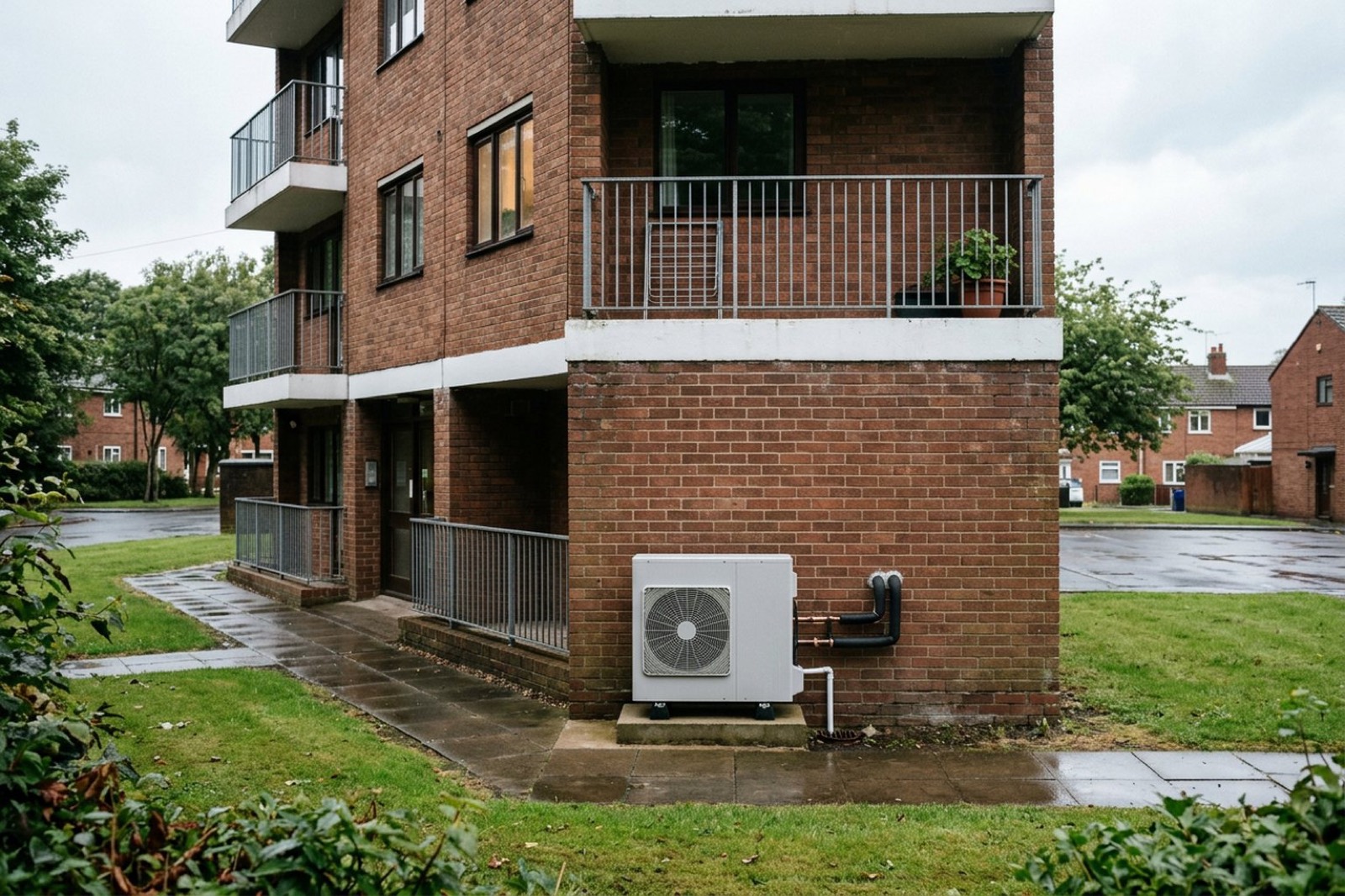
This limit catches flat owners. Class G does not apply if the work would result in “more than one air source heat pump on, or within the curtilage of” a block of flats. As we read it, if another flat or the building’s owner already has one, a second needs a planning application. Ask your managing agent whether one is fitted.
Flats above shops
The Order defines a block of flats as “a building which consists wholly of flats”, and the Planning Portal says it “should not also contain commercial premises”. A purpose-built block, or a house converted wholly into flats, should therefore come under the block rules, while a flat above a shop or office fits neither definition. That is our reading of the definitions, not a stated rule: if your building is mixed use, check with your council.
The Planning Portal warns that permitted development rights “may be removed through a planning condition, Article 4 Direction or other restriction”, so ask your council.
Listed buildings and conservation areas
Listed buildings. Class G does not apply to a heat pump on a listed block of flats or on land within its curtilage, so you need a planning application. Separately, section 7 of the Planning (Listed Buildings and Conservation Areas) Act 1990 bars works to alter a listed building “in any manner which would affect its character as a building of special architectural or historic interest” unless authorised, which is what listed building consent is for. Speak to your council’s conservation officer first.
Conservation areas. Permitted development still applies, but the unit cannot go on a wall or roof which fronts a highway, or nearer to a bounding highway than the nearest part of the block. For a flat, that may rule out a street-facing balcony.
Everywhere else. Outside a conservation area or World Heritage Site, the unit cannot go on a highway-facing wall above the ground floor storey, so a unit on the road side of an upper-floor flat is not permitted development.
Flats in Wales
Wales has its own permitted development rules for air source heat pumps, updated on 1 June 2026, so do not assume England’s limits apply. The Welsh Government’s page on domestic heat pumps is written about homes and does not mention flats, so we do not quote Welsh limits for flats. If your flat is in Wales, ask your council first, and see our planning permission guide.
The lease: does your freeholder need to agree?
GOV.UK says “Most flats are leasehold”, and that your lease tells you what conditions you have agreed to, for example whether you need permission to make alterations. Breaking them can mean court action, paying for damage and, in the end, the court taking away your lease. LEASE says that, depending on your lease, you might need the freeholder’s permission before making alterations, even if you already have planning permission or building regulations approval. This is not legal advice: it is what to check and who to ask.
- Who owns the outside. Your lease should say which parts you own and which the landlord owns or controls (“retained premises”). You cannot change the landlord’s parts without permission. LEASE lists the roof, external walls and outside space as examples, so the wall, roof or ground where a unit or pipes would go may be among them.
- What the lease says. LEASE says it might ban alterations, allow them, allow them with written permission, or allow them under a licence. If it is silent, LEASE suggests advice from a solicitor or conveyancer.
- Other clauses. LEASE gives “no cutting of external walls” as a clause that would prevent openings for pipes, and lists installing a heat pump on an external wall among the things a lease may restrict.
- Get consent in writing, before work starts. LEASE says not to rely on verbal consent, and suggests the request include a description of the work, plans or photos, contractor quotes and insurance details, proof of planning permission or building regulation compliance, and a timetable.
- The landlord’s duty. Where the lease allows alterations with consent, LEASE says the landlord must respond in writing, consent unless there is a reasonable reason to refuse, and give reasons. That does not apply to work involving parts the landlord owns or controls, or where the lease bans alterations. Any fee must be reasonable.
Check your lease and ask your freeholder or managing agent. If the lease is unclear, take advice from a solicitor or conveyancer, or from LEASE. We cannot tell you what your lease means.
If you rent, the decision sits with your landlord, who is likely to be the owner Ofgem asks to confirm ownership and consent; see heat pumps for landlords. If you bought through shared ownership, GOV.UK notes such homes are usually leasehold, and Ofgem’s ineligible social housing includes housing provided through shared ownership schemes for people in housing need, so ask an installer to check before going further.
Building regulations and MCS
The Planning Portal says installing an air source heat pump “will have to comply with the Building Regulations” and advises using an installer who belongs to the Microgeneration Certification Scheme (MCS) or the relevant competent person scheme. The MCS installation standard, MIS 3005-I, says self-certification in place of building control approval is only permitted where the work is done by a person or organisation registered with an approved competent person scheme. Ask your installer which route they use. MCS 020(a) also states that compliance “on its own does not bestow permitted development rights”. See what is MCS certification?
Noise: the other flats count as neighbours
To be permitted development in England, the installation must pass the MCS 020(a) sound calculation, which checks the heat pump against a limit of 37 dB at each assessment position: a point 1 metre outside a door or window of a habitable room of a neighbouring property. For a block of flats, MCS 020(a) says neighbouring property “includes flats within the same block of flats”, other than your own, and that positions should include ground floor, first floor and so on. A bedroom window in a neighbouring flat can decide where the unit goes.
MCS 020(a) says the installer must give you a copy of the completed calculation, and a unit with more than three reflective surfaces, for example in a small lightwell, will not meet it. The installation standard says heat pumps should not be adjacent to sleeping areas. More in heat pump noise and your neighbours and are heat pumps noisy?
The Boiler Upgrade Scheme and ownership
The Boiler Upgrade Scheme offers £7,500 towards an air source heat pump in England and Wales, and you may be eligible. GOV.UK says you must own the property you are applying for and be replacing a fossil fuel heating system such as oil, gas, electric or LPG. Your installer applies on your behalf and the grant is taken off the price. For a flat:
- What Ofgem asks the owner to confirm. Ofgem’s installer guidance (V5.1) says the owner emailed by Ofgem must confirm ownership (or co-ownership with the agreement of all other owners), consent for the installer to apply, and that the property is not social housing. The owner has 14 days to respond.
- What the sources do not say. The GOV.UK grant pages and Ofgem’s guidance do not use the words leasehold or freeholder, and do not ask for the freeholder’s consent, which is a matter for your lease. GOV.UK describes leasehold as owning a property for a fixed period, but neither source says how a leasehold flat is treated, so ask your installer before they apply.
- One system for several flats. Ofgem says cascade systems heating multiple unrelated properties, such as flats, are not eligible.
- Timing. The regulations say an air source heat pump voucher expires at the end of a three-month period beginning on the day it is issued, so it makes sense to settle lease consent and your planning route first.
What to ask an installer
- If I am in England, is the unit 0.6 cubic metres or less including any housing?
- Will you give me the MCS 020(a) calculation, and does it include the windows of other flats in the block?
- Where will the unit, pipes and condensate drain go, and who owns those parts of the building?
- What can you supply for my freeholder: plans, contractor details, insurance?
- How will the Building Regulations be met, and how will you apply for the grant given that I am a leaseholder?
- How will hot water be provided, and what happens if my freeholder refuses or asks for changes?
Have your lease to hand. More in how to compare heat pump quotes and what to expect from a heat pump survey.
Where ByEco stands
ByEco is MCS certified for air source heat pump installation (certificate IAA10330), and we apply for the £7,500 Boiler Upgrade Scheme grant on your behalf. Get in touch for your free survey and we will look at your flat, the possible positions and which permissions are likely to apply. For eligible flats, a heat pump may be free of charge after the £7,500 Boiler Upgrade Scheme grant, subject to survey and eligibility; see our guide to heat pumps for eligible flats. Our notes on Manchester flats and heat pumps page are a good start, or contact us with your lease details and a photo of where the unit might go.
Sources
Every figure on this page was checked against primary sources on 6 November 2026. Grant rules, planning rules and prices change — if you are reading this much later, verify before acting.
- legislation.gov.uk — General Permitted Development Order 2015, Schedule 2, Part 14 (Class G and interpretation), revised text
- legislation.gov.uk — General Permitted Development Order 2015, article 2 (interpretation)
- legislation.gov.uk — Planning (Listed Buildings and Conservation Areas) Act 1990, section 7
- Planning Portal — Planning permission: air source heat pump
- Planning Portal — Heat pumps: building regulations
- Welsh Government — Planning permission: domestic heat pumps
- MCS — MCS 020 a) Air Source Heat Pump Sound Calculation for Permitted Development Installations, Issue 1.1
- MCS — MIS 3005-I:2025 Heat Pump Installation Standard, Issue 1.0
- GOV.UK — Leasehold property
- GOV.UK — Leasehold property: leaseholder rights and responsibilities
- The Leasehold Advisory Service — Alterations and home improvements (updated 22 December 2025)
- GOV.UK — Apply for the Boiler Upgrade Scheme: what you can get
- GOV.UK — Apply for the Boiler Upgrade Scheme: check if you’re eligible
- GOV.UK — Apply for the Boiler Upgrade Scheme: how to apply
- Ofgem — Boiler Upgrade Scheme guidance for installers V5.1 (PDF)
- legislation.gov.uk — Boiler Upgrade Scheme (England and Wales) Regulations 2022, regulation 14
- legislation.gov.uk — Boiler Upgrade Scheme (England and Wales) Regulations 2022, regulation 15
Book your free home survey
Every home is different. The cost depends on the size of system, any radiators that need upgrading, the pipework and where the outdoor unit goes. Get in touch and we will arrange a free survey of your home and give you a clear quote. If you are happy with it, we can go ahead.