Free heat pump for 1 and 2 bedroom flats.*
Own a 1 or 2 bedroom flat heated by gas, oil, LPG or electricity? The heat pump we fit in flats — a compact indoor air-to-water unit, installed entirely inside your flat — is 100% covered by the Boiler Upgrade Scheme grant, so you pay nothing. Every one of the 192 flats we’ve had installed so far paid nothing. Book your free, no-obligation assessment.
*Terms and conditions apply. You must own the flat (landlords included); social housing and shared ownership aren’t eligible. It must replace gas, oil, LPG or electric heating, and the flat must not have had government heat pump funding before. Ofgem must approve the Boiler Upgrade Scheme grant, and our assessment and the installer’s heat loss survey must confirm the unit suits your flat. Any lease or freeholder consent must be in place. Installation is by our partner MCS certified installer, and the offer is subject to grant funding being available.
The short version
- The free survey is a visit to your flat, a heat loss calculation and a written, itemised quote. Whether the grant covers the whole price of a heat pump for an eligible flat is confirmed in that quote, subject to survey and eligibility.
- The offer box says ByEco’s assessment and the installer’s heat loss survey must confirm the unit suits your flat.
- The MCS heat pump design standard asks for a heat load calculation, and says the customer must be given room heat losses and other design details in writing before installation starts.
- Ofgem asks the installer to carry out an on-site assessment. Ofgem issues the voucher, and its regulations say it must refuse one where it is not satisfied the conditions are met.
- The Boiler Upgrade Scheme is not permanent: its final voucher issue date is 31 December 2029, and Ofgem cannot issue new vouchers once the budget threshold is met.
If you own a flat and are thinking about a heat pump, the first step is a visit, not a commitment. This article walks through that visit: what the assessment and the installer’s heat loss survey are for, what the visitor looks at, what to have ready, what you get afterwards and what the visit cannot do. It does not repeat the later stages in full. For the steps after the quote, see the step-by-step guide to a heat pump in a flat, and for a room-by-room explanation of any heat pump survey, see what happens in a heat pump survey.
What happens at the free survey of a flat?
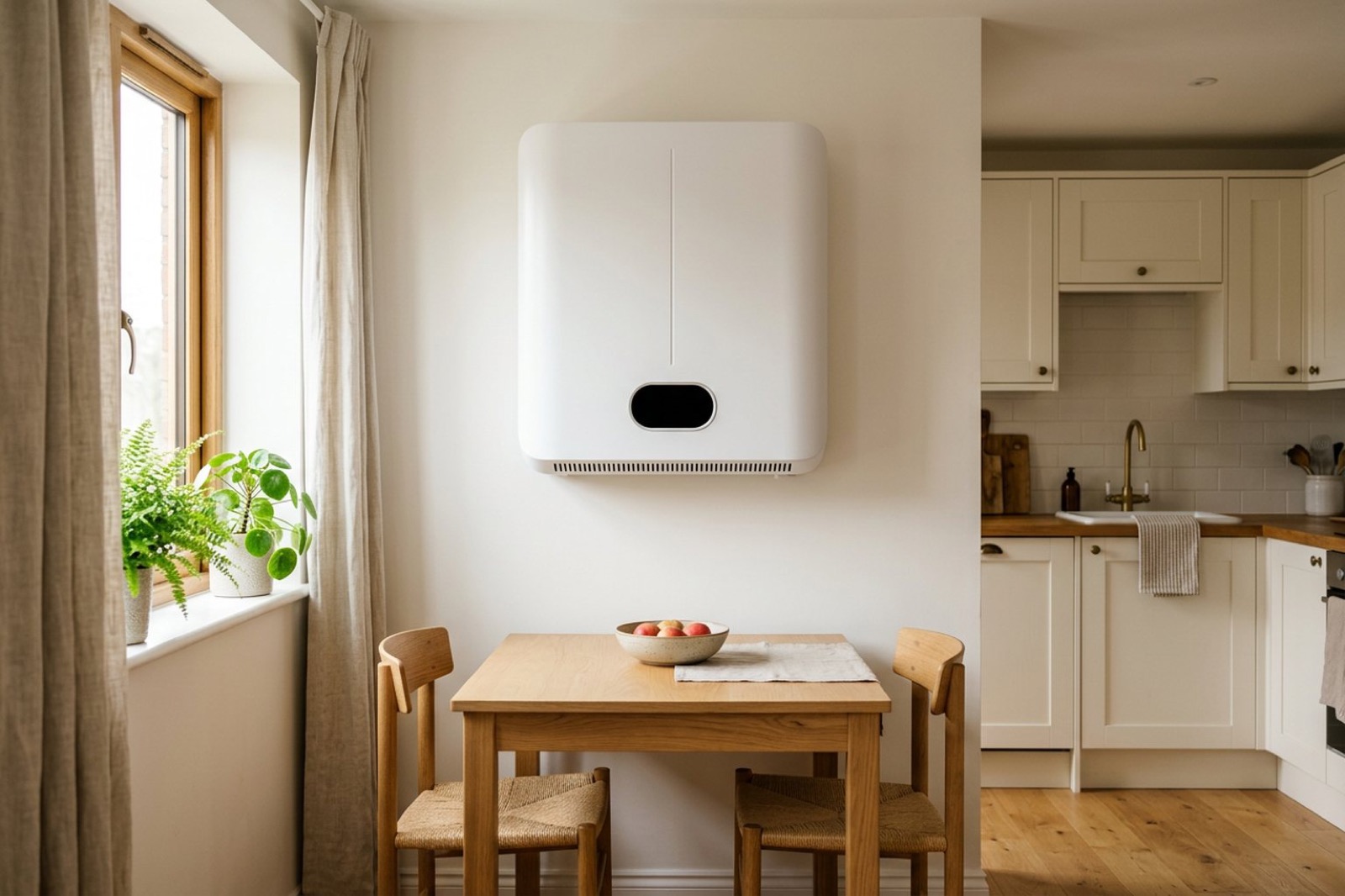
According to ByEco’s brochure, the process starts with a free home survey: we visit your property, measure each room and look at the walls, windows, radiators, pipework, electrics and where a unit or vents could go. A room-by-room heat loss calculation then sets the kW size you need and whether any radiators should change, and the brochure says the quote that follows is itemised and in writing.
Three things are worth knowing before the visit. First, the survey is how ByEco finds out whether a heat pump suits your flat, and it is free. Second, a heat pump may be free of charge for an eligible flat, subject to survey and eligibility, but the survey cannot promise that. Third, the visit is a chance to ask your questions about the flat, its heating and its lease. See which homes may get a free heat pump.
What the assessment and the heat loss survey decide
The offer box at the top of this page is ByEco’s offer. It says that “our assessment and the installer’s heat loss survey must confirm the unit suits your flat”. In other words, the offer depends on what the visit finds.
The technical rules come from MIS 3005-D, the MCS design standard for heat pumps. For a heat pump system (other than air to air) that is to supply 100% of the space heating load, it says a heat load calculation “should be performed on the building”, using internal temperatures not less than those in its Table 1 and the external temperatures in its Table 2 (column A or B, according to the contractor’s assessment of the building location). It also says a heat pump “shall be selected that will provide at least 100% of the heat load” from that calculation. We are not quoting the temperatures here; ask your installer which were used.
The same standard sets out what the customer must be given. It says that “prior to the installation commencing, the customer shall be provided in writing with” a list that includes:
- all specific room heat losses (in W/m²), where the standard notes that specific heat loss is the total heat loss divided by floor area;
- the calculated daily hot water demand;
- the type and dimensions of the emitters (radiators or similar) to be used;
- the design emitter temperature, based on the worst performing room; and
- the design flow temperature of the water leaving the heat pump, before any blending valves.
The list continues beyond these items, and MIS 3005-D also says that where there is a change to the agreed design or estimated performance from that given before the detailed design, the customer must be given an updated performance estimate, a variation to contract and “the opportunity to cancel the contract without further cost, obligation or liability”. Ask for the heat loss figures in writing, as the standard describes.
Radiators are part of the same calculation. The MCS heat emitter guide (MCS 021) is a flow chart and table for matching a radiator or underfloor system to a room’s heat loss, and it says the process “should be repeated for all of the heated rooms in the dwelling”. It says more stars are given when lower heat emitter temperatures are used, and that it can be used for systems with existing radiators or to design a new heat emitter system. See whether you need new radiators.
What the visitor looks at
ByEco’s brochure lists the walls, windows, radiators, pipework, electrics and where a unit or vents could go. Taking each in turn:
- The existing heating. For a retrofit where a valid EPC is not available, Ofgem says it will request evidence of the heating system being replaced. Ofgem says that evidence, where available, would typically include a recent utility bill or fuel receipt and photographs of the existing heating system, and that the photographs must clearly show the heat source, the make and model of the heating system (for example the nameplate on a boiler) and the location of the heating source. Expect photographs of your boiler, electric heaters or other heat source to be needed, possibly at the visit. Ofgem’s guidance says the installer, not the property owner, gathers and uploads the evidence.
- The electrics. MIS 3005-D says the MCS contractor “shall ensure that the electricity supply is adequate for the size of heat pump specified”. ByEco’s brochure lists the electrics among the things looked at, and the standard’s duty applies whoever installs. See heat pumps and your electricity supply.
- Where the unit and its openings could go. ByEco’s brochure says an indoor unit needs two circular openings through the external wall, one for the air inlet and one for the air outlet, and that final opening sizes, positions and the terminal type are confirmed on site and set out in your quote and drawings. See heat pumps without an outdoor unit.
- The lease and the building. The offer box says any lease or freeholder consent must be in place. ByEco’s brochure adds that the wall openings can still need permission from the council or the freeholder, so ByEco checks this for your building at the survey. We found no Boiler Upgrade Scheme source, in GOV.UK’s pages, Ofgem’s guidance or pages for installers and property owners, or the regulations, that states freeholder consent as a condition of the grant, so this is a separate question from the grant. See heat pumps and a leasehold flat and permission for a heat pump in a flat.
- Access. This is our practical suggestion, not a scheme rule: if the route from the front door to the wall where a unit could go is narrow, shared or controlled by a managing agent, say so at the start, because it affects the plan.
What to have ready
The scheme rules are Ofgem’s, not ours. These are practical suggestions, labelled as such:
- A recent bill or receipt. Ofgem says a utility bill (for gas or electric heating) or a fuel receipt (for LPG, coal or oil) must be dated within the last 3 months (from the date the voucher application is submitted) and show the installation address. If you have a recent one to hand, show it.
- Leave the heating where it is. Because Ofgem says its evidence would typically include photographs of the existing system, it is sensible not to remove or disconnect it before it has been photographed.
- Your lease and the freeholder’s or managing agent’s details. Bring them, and note whether the lease covers work to external walls.
- Your consumer unit. Make sure the visitor can reach it.
- Your questions. Hot water, radiators, disruption to neighbours and what is in the quote are all fair questions. Our application checklist lists more of what to have ready.
What you get afterwards
ByEco’s brochure says the next step is a clear, itemised quote covering the unit, the hot water arrangement, radiator changes and electrical work, all in writing. If you are happy with it, the brochure says ByEco goes ahead; if not, there is no obligation.
Ofgem’s guidance fits with this: before applying, the installer must provide the property owner with a quote for the installation that includes the grant as an upfront discount. GOV.UK says the value of the grant will be taken off the amount you pay for installation and shown on your quotation and invoice.
Whether the grant covers the whole price for your flat, and whether anything is left to pay, is confirmed in that quote. GOV.UK lists £7,500 towards an air-to-water heat pump and describes the grant as covering part of the cost of replacing fossil fuel heating systems. ByEco’s offer for eligible 1 and 2 bedroom flats is described in the offer box at the top of this page, and the quote is where it is applied to your flat. For the detail, read our Boiler Upgrade Scheme guide.
What the assessment does not do
- It does not confirm eligibility. Ofgem issues the boiler upgrade voucher, and regulation 15(7) of the Boiler Upgrade Scheme regulations says it must refuse one where it is not satisfied that the conditions are met. Our guide on whether your flat is eligible covers the tests.
- It does not replace Ofgem’s consent step. Ofgem says property owners must give consent via the validation link in its email within 14 days of being contacted, or the application will expire and may be rejected.
- It does not fix the price. That is the written quote.
- It does not commit you. According to ByEco’s brochure there is no obligation to go ahead.
Where a point depends on your flat, such as shared ownership or a shared heating system, tell the visitor at the start.
Why it is sensible to ask early
The Boiler Upgrade Scheme is not permanent. The sources say:
- Final date. The regulations say Ofgem must refuse to issue a voucher after 31 December 2029.
- Budget. Ofgem cannot issue new vouchers once the budget threshold is met. If the available budget runs out, Ofgem may operate a queue, ordered by when an application is deemed properly made. Separately, the Secretary of State may introduce a cap on the number of vouchers issued each quarter.
- Voucher validity. An air-to-water voucher expires three months after it is issued, and an expired voucher cannot be extended. GOV.UK words the limit differently, as 120 days from applying, so plan around whichever limit comes first.
Ofgem’s BUS monthly scheme update, with statistics to 31 October 2026 and last updated on 11 November 2026, lists £62,665,000 as the remaining budget for Year 5 (1 April 2026 to 31 March 2027). Ofgem’s footnote says that figure includes all undetermined applications and vouchers issued yet to be redeemed, and is a dynamic value. It is a snapshot, so check the latest report. We are not forecasting when funds might be used.
So asking for your free survey sooner means your application can be made while funding is available, if your flat is eligible. Rules and funding can change.
Where ByEco stands
Call 0161 710 4510 or use the contact page and tell us the flat’s area, what heats it now and who owns it. The survey is free, and it is how we find out whether a heat pump suits your flat. See also our heat pumps and grants pages, or get in touch for your free survey.
Worth asking at the visit: which rooms have the highest heat loss, which radiators would change and are they in the quote, how will hot water be provided, where would the openings go, and what the contract says if the application is rejected.
Sources
Every figure on this page was checked against primary sources on 13 November 2026. Grant rules, planning rules and prices change — if you are reading this much later, verify before acting.
- GOV.UK — Apply for the Boiler Upgrade Scheme: overview
- GOV.UK — Apply for the Boiler Upgrade Scheme: what you can get
- GOV.UK — Apply for the Boiler Upgrade Scheme: check if you’re eligible
- GOV.UK — Apply for the Boiler Upgrade Scheme: how to apply
- Ofgem — Boiler Upgrade Scheme: guidance for installers
- Ofgem — Boiler Upgrade Scheme guidance for installers V5.2 (PDF)
- Ofgem — BUS monthly scheme update
- legislation.gov.uk — Boiler Upgrade Scheme (England and Wales) Regulations 2022, regulation 15
- MCS — MIS 3005-D The Heat Pump Design Standard, Issue 3.0
- MCS — MCS 021 Heat Emitter Guide for Domestic Heat Pumps, Issue 2.1
Book your free home survey
Every home is different. The cost depends on the size of system, any radiators that need upgrading, the pipework and where the outdoor unit goes. Get in touch and we will arrange a free survey of your home and give you a clear quote. If you are happy with it, we can go ahead.