The short version
- Some heat pumps can cool, but most are not set up for it. Most air-to-water heat pumps in UK homes are fitted for heating and hot water only.
- Cooling needs the right emitters. A reversible heat pump makes chilled water, but ordinary radiators are not designed to cool; active cooling needs fan coils, or underfloor pipes with careful control.
- Air-to-air units cool readily; air-to-water units cool only where suitable emitters are fitted. The £7,500 grant is written for air-to-water heat pumps.
- Condensation is the catch. Cool a surface below the dew point and water forms on it, so cooling has to be designed around that.
- If summer comfort matters to you, raise it early so the system can be planned with it in mind.
Some heat pumps can cool your home, but most air-to-water heat pumps fitted in UK homes are set up for heating and hot water only. A reversible heat pump can run its refrigerant cycle in reverse to make chilled water, yet whether that actually cools your rooms depends on your emitters: standard radiators are not designed to cool. This guide explains what can and cannot cool, the two main types of heat pump, the condensation problem, and what to do if cooling matters to you.
Can a heat pump cool your home?
Sometimes. A heat pump moves heat; a reversible one can move it either way, so in summer it can take heat out of your home instead of putting it in. The limit is not usually the heat pump but what it is connected to. As Daikin puts it, “heat pumps can be used for cooling, but this depends on the type of emitters you have.”
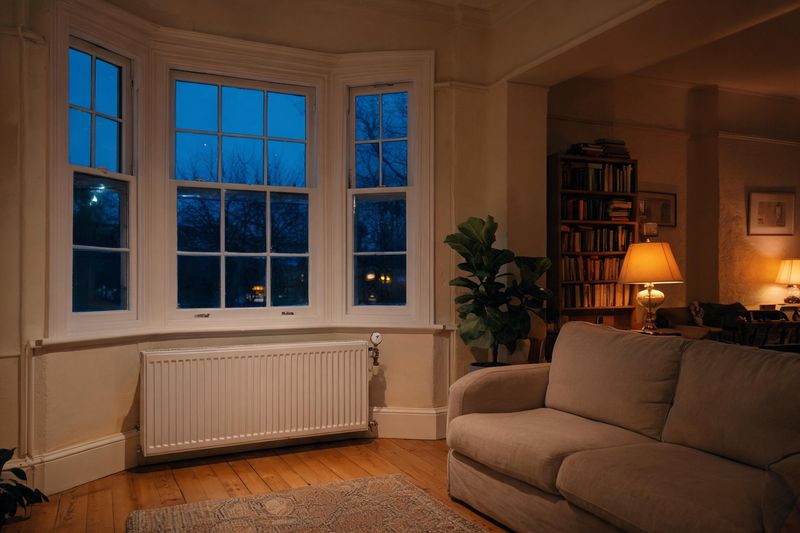
An ordinary radiator is designed to give out heat by sitting hotter than the room. Run cold water through it and it does little useful cooling: it has no fan to move air, and its cold surface simply gathers condensation. That is why active cooling from an air-to-water heat pump needs different emitters — fan coils, or underfloor pipework run with care. If your rooms have radiators, see do I need new radiators for a heat pump? and heat pumps and underfloor heating for how emitters are chosen.
Air-to-air and air-to-water heat pumps
There are two broad types, and the difference decides how easily each can cool.
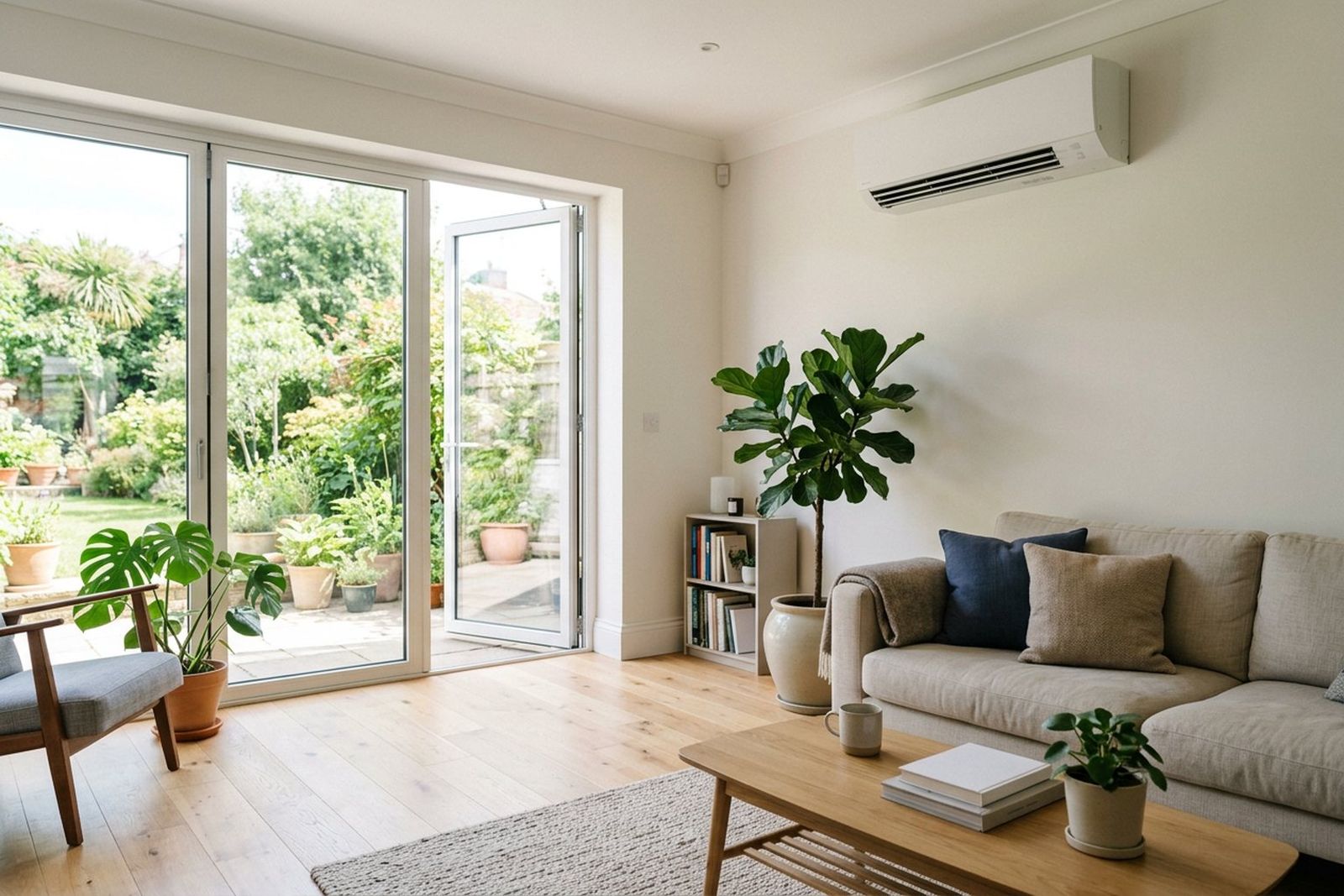
Air-to-air heat pumps work much like an air-conditioning unit: they blow air through indoor fan units, warm in winter and cool in summer. MCS notes that these “use fans to circulate warm air around your home, and can also offer cooling”, but that they “don’t provide hot water”.
Air-to-water heat pumps heat water for radiators or underfloor heating and, in most homes, the hot water cylinder. MCS calls air-to-water “the most common option in the UK”. An air-to-water unit can cool only where emitters that are made to cool are fitted. The £7,500 Boiler Upgrade Scheme grant is written for air source (air-to-water) heat pumps, so it is the type most UK homeowners end up discussing. For how the two compare in day-to-day use, see our notes on heat pump installations.
What a reversible heat pump does in cooling mode
In heating, a heat pump takes low-grade heat from the outdoor air, raises its temperature with an electric compressor and passes it into your water — the cycle set out in how an air source heat pump works. A reversible model has a valve that turns the cycle around: it draws heat out of the water (and so out of your rooms) and rejects it outside, sending chilled water back round the system.
You can see this in a real product. Trianco’s indoor Activair R290, for example, has a cooling mode as well as a heating mode; its own figures give a cooling output with the water leaving the unit at 7 °C. Daikin describes the same idea for its air-to-water range, where cooling is delivered when the heat pump is “combined with heat pump convectors or underfloor heating”. Not every heat pump is reversible, though, and many sold in the UK are configured for heating and hot water only, so cooling is not something to assume — ask whether a given model can do it and whether it has been enabled.
The condensation problem
Cooling brings a complication heating does not. Air holds moisture, and when a surface drops below the air’s dew point, that moisture condenses on it — the same reason a cold drink sweats on a warm day. Chilled water is cold: the Activair’s cooling mode, for instance, sends water out at 7 °C, well below a typical summer dew point indoors. Trianco’s own manual warns installers to keep clearance around the unit “to avoid condensation resulting from the unit’s low surface temperature”.
Fan coils handle this by design. They blow room air across a cold coil and are built with a drip tray and a condensate drain to carry the water away, much as a fridge or an air-conditioner does. Underfloor cooling is different: there is no drain under your floor, so the water must never be cold enough to take the floor below the dew point, or the surface would get wet. In practice that means the controls hold the flow temperature up. One underfloor manufacturer, Rehau, describes controls that “manage the output cooling function so that the dewpoint is not reached and the risk of condensation is eliminated”. Underfloor cooling is therefore gentle cooling, and it only works with the right controls.
Do UK homes need cooling?
Historically, not much. British summers have been mild enough that most homes manage without any cooling, and the heat pump’s job here is overwhelmingly heating and hot water. That picture is shifting, though. An Arup analysis for the Climate Change Committee, reported by CIBSE Journal, found that already “55% of UK buildings fail the criterion in CIBSE’s TM59 guidance for assessing whether bedrooms are comfortable overnight during heatwaves”, and that “nine in 10 existing UK homes will be at risk of overheating” if global temperatures reach 2 °C above pre-industrial levels.
Before reaching for active cooling, much of the comfort comes from the fabric: a well-insulated home with good shading on sun-facing windows, and night-time ventilation, stays noticeably cooler in a heatwave. The same insulation that keeps winter heat in helps keep summer heat out. Active cooling from a heat pump is an addition to that, not a replacement for it.
Does cooling cost more to run?
Cooling uses electricity in the same way heating does: the compressor and fans run on mains power, so the more you cool and the colder you cool, the more electricity you use. We will not put a figure on it here, because it depends entirely on your home, how much you run it and the tariff you are on; our guide to how much electricity a heat pump uses explains what drives the number. The main point to hold on to is that in a UK home the heat pump earns its keep in winter: heating and hot water are the big jobs, and cooling, where it is fitted at all, is a summer extra.
Cooling and the Boiler Upgrade Scheme grant
The Boiler Upgrade Scheme offers £7,500 towards an air source heat pump — an air-to-water heat pump — in England and Wales. It is a grant for the heating system. You may be eligible for it, and it may cover a good part of the cost, if the product is MCS certified, an MCS-certified installer applies on your behalf and the installation meets the rules. Whether a heat pump can also cool does not change that: what matters for the grant is that it is a qualifying air-to-water heat pump, properly installed.
One honest caveat: the grant does not exist to fund air conditioning, and adding cooling emitters is extra work on top of the heating design. Treat cooling as a feature to weigh on its own merits, not as something the grant pays for. ByEco’s MCS and TrustMark certification is in progress, so we cannot yet apply for the grant on your behalf; only an MCS-certified installer can.
What to do if cooling matters to you
Raise it early. The things that make cooling possible — a reversible heat pump, fan coils or carefully controlled underfloor pipes, and controls that watch the dew point — are far cheaper to build in at the design stage than to retrofit later. If you know summer comfort is a priority, say so before the emitters are chosen, and ask any installer plainly whether the system they propose can cool, through which emitters, and how condensation is managed.
ByEco’s own role is the heating side. We survey your home, calculate the heat loss room by room and design an air-to-water heating system around it; the size of heat pump and the emitters follow from that calculation, not from floor area alone, as our guide to what size heat pump you need explains. What a system costs depends on your property: the size it needs, whether radiators or pipework have to be upgraded, where the outdoor unit goes and how far the pipe run is, how hot water is provided and any electrical work. Rather than quote a figure blind, we would rather look. Get in touch and we will arrange a free survey of your home and give you a clear, itemised quote; if you are happy with it, we can go ahead. See also our heat pump cost guide and what to expect from an installation.
Sources
Every figure on this page was checked against primary sources on 24 October 2026. Grant rules, planning rules and prices change — if you are reading this much later, verify before acting.
- GOV.UK — Apply for the Boiler Upgrade Scheme: what you can get
- MCS — Air source heat pump (consumer guide): air-to-air and air-to-water
- Daikin UK — Low temperature air-to-water heat pumps (cooling and emitters)
- Daikin — Warm water and cool air: heating, cooling and hot water from one heat pump
- Trianco — Activair R290 Indoor Heat Pump (product page)
- Trianco — Activair R290 Indoor Heat Pumps brochure (January 2026, PDF)
- Trianco — Activair R290 wall-hung installation manual (PDF)
- Trianco — Activair R290 floor-standing installation manual (PDF)
- Heating & Ventilating Review — Underfloor cooling: a cool alternative to air con (Rehau)
- CIBSE Journal — Nine out of 10 UK homes will overheat at 2°C warming (Arup for the Climate Change Committee, 27 October 2022)
Book your free home survey
Every home is different. The cost depends on the size of system, any radiators that need upgrading, the pipework and where the outdoor unit goes. Get in touch and we will arrange a free survey of your home and give you a clear quote. If you are happy with it, we can go ahead.