The short version
- COP (coefficient of performance) = heat out ÷ electricity in, at one test condition. As arithmetic, a COP of 3 means 3 kWh of heat for every 1 kWh of electricity at that moment.
- SCOP (seasonal COP) is a lab-based average over a standard heating season and an “average” European climate, set out in the Ecodesign rules. It is quoted at a stated water temperature, usually 35°C or 55°C.
- SPF (seasonal performance factor) is what an installed system really achieves over a year. In the government-funded Electrification of Heat trial, the median whole-system SPF of air source heat pumps was 2.78.
- The lower the design flow temperature, the higher the SCOP. A SCOP figure means little unless you know which temperature it was quoted at.
- For the Boiler Upgrade Scheme, an air source (air-to-water) heat pump must have a SCOP of at least 2.8, worked out by the MCS method. You may be eligible for £7,500.
Heat pump brochures, labels and quotes are full of efficiency figures, and they are easy to mix up. This guide explains what each one measures, where it comes from and how to use it when you compare quotes. If you want the basics of how the technology moves heat first, read how an air source heat pump works.
COP, SCOP and SPF in one minute
All three figures are the same kind of ratio: units of heat delivered for each unit of electricity used. What differs is when and where they are measured.
| Figure | What it measures | Where it comes from |
|---|---|---|
| COP | Heat out ÷ electricity in at one set of conditions | Lab test at standard rating conditions, or any measured period |
| SCOP | The ratio averaged over a standard heating season | Lab test data and a set calculation under “average” climate conditions |
| SPF | Heat delivered ÷ electricity used over a real year | Measured in an installed system, or estimated by your installer |
A simple piece of arithmetic shows how to read them. If a system uses 1 kWh of electricity and delivers 3 kWh of heat, the ratio is 3. MCS describes an SPF of 3 the same way: the system “would have delivered 3 kWh of heat energy for every 1 kWh of electrical energy it consumed” over a standard year. You will sometimes see this written as a percentage: the Electrification of Heat report notes that an SPF of 2.90 means an electrical efficiency of 290%. That is a worked example of the maths, not a promise about any particular heat pump.
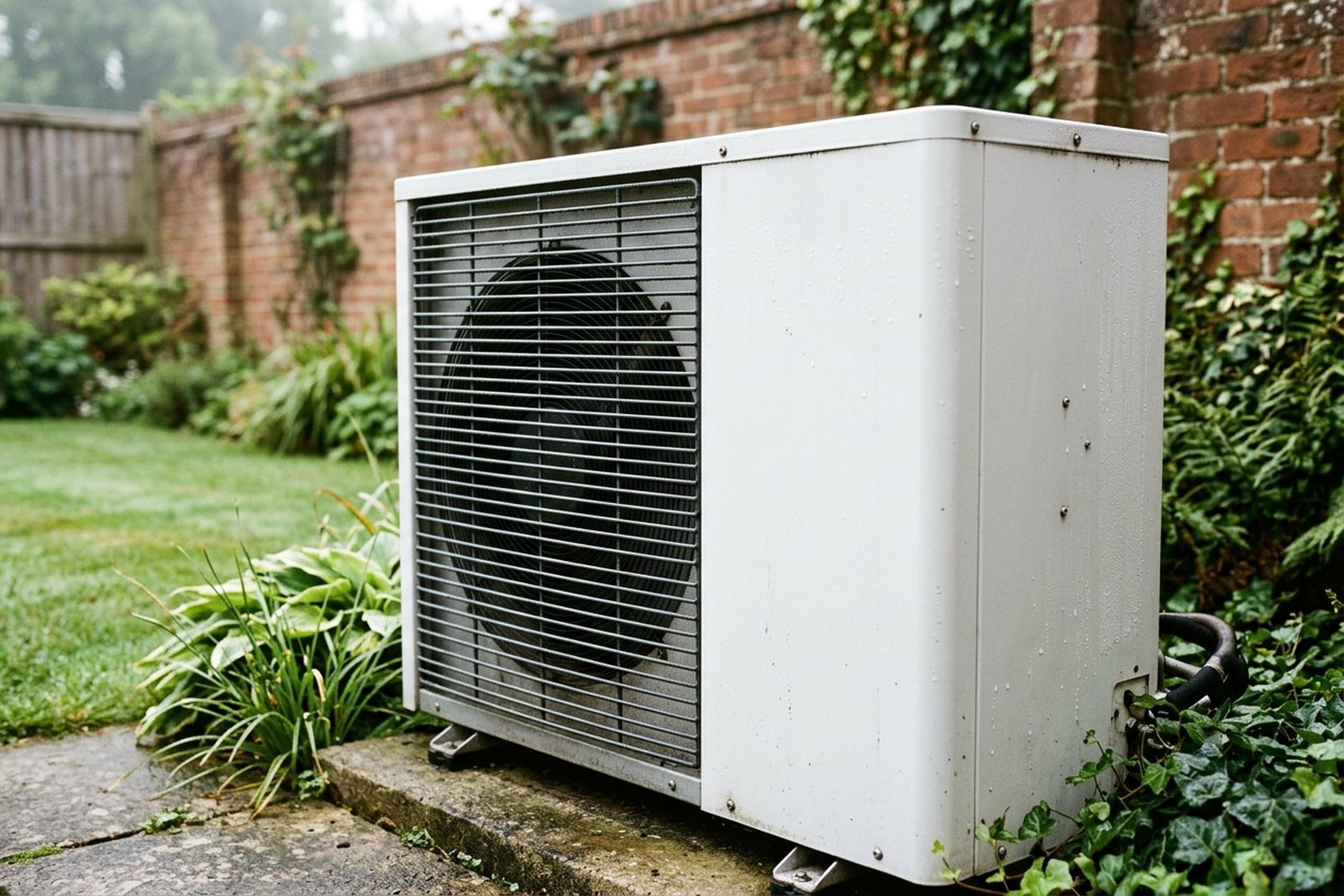
What is COP?
The coefficient of performance is a snapshot. The GB version of the Ecodesign Regulation for space heaters (813/2013) defines the “rated” COP as the declared heating capacity divided by the energy input, for heating provided at standard rating conditions. For an air-to-water heat pump those conditions are outdoor air at +7°C and water leaving the heat pump at 55°C, or 35°C for a low-temperature heat pump.
Outside the lab, “COP” is used loosely. The Electrification of Heat report says a COP “can be taken over any time interval and any system boundary”. That is why a single COP figure on a brochure, measured on a mild day with warm water, can look much higher than the same unit manages on a cold January morning. In the trial, the measured COP rose as the outdoor temperature rose towards 10°C. See do heat pumps work in cold weather? and our guide to the defrost cycle for what happens in winter.
What is SCOP, and how is it measured?
SCOP is meant to smooth out the snapshot problem. The Ecodesign Regulation defines it as the overall coefficient of performance “representative of the designated heating season”, calculated as the reference annual heating demand divided by the annual energy consumption. In practice it is built up like this:
- A standard climate. “Average climate conditions” are defined as the temperature conditions characteristic of Strasbourg. The regulation sets out a reference heating season of 4,910 hours, split into one-degree “bins” of outdoor temperature, with a reference design temperature of −10°C.
- A stated water temperature. A low-temperature application means the heat pump delivers its declared capacity at a water outlet temperature of 35°C; a medium-temperature application means 55°C.
- A test standard. MCS’s SCOP calculator (MCS 026) takes its test conditions from EN 14825:2013 and calculates SCOP under the average climate defined by Regulation 813/2013.
You may also see ηs (seasonal space heating energy efficiency), often shown as a percentage. The regulation calculates it as the SCOP divided by a conversion coefficient of 2.5, corrected for things such as temperature controls. As rough arithmetic before those corrections, a SCOP of 3.0 corresponds to about 120%. Since 26 September 2017, a heat pump placed on the market in Great Britain must have an ηs of at least 110%, or 125% for a low-temperature heat pump.
The energy label (Regulation 811/2013) turns ηs into a letter class. For a heat pump space heater (other than a low-temperature heat pump) it shows a class for medium- and low-temperature application, printed as “55 °C” and “35 °C”. The 35°C classes use a stricter scale, so the same letter does not mean the same efficiency at both temperatures.
Why flow temperature changes the number
A heat pump works harder to make hotter water, so its efficiency falls as the flow temperature rises. You can see this in the MCS product directory, which lists SCOP against flow temperature for certified heat pumps. One air-to-water model listed when we checked on 28 October 2026 showed:
| Flow temperature | Listed SCOP |
|---|---|
| 35°C | 4.23 |
| 45°C | 4.07 |
| 50°C | 3.86 |
| 55°C | 3.65 |
That is one product, shown only to illustrate the pattern; other models differ. The point is that a SCOP quoted at 35°C cannot be compared with one quoted at 55°C. The field trial found the same direction in real homes: median efficiency was clearly higher when systems produced 35°C water than 55°C. Our guide to heat pump flow temperature sets out those trial results.
This is why the MCS design standard ties the figure to your house. MIS 3005-D says the installer must be given, in writing, the design flow temperature and “the installation’s SCoP/SPER (as taken from the MCS website) based on the above design flow temperature”. The design flow temperature in turn depends on your heat loss and your radiators; see what size heat pump do I need? and do I need new radiators for a heat pump?
SPF: what heat pumps achieve in real homes
SPF is the measured result. The Electrification of Heat demonstration project, funded by the Department for Energy Security and Net Zero and written by Energy Systems Catapult (December 2024), monitored heat pumps in real homes. It defines SPF as the ratio of the total heat supplied to the home to the electricity used by the heat pump and other devices of the heating system, taken over one year.
SPF is reported at different “boundaries”, which is the detail people most often miss:
- SPFH2 covers the heat pump unit itself. Across 428 air source heat pumps the median was 2.93.
- SPFH4 is the whole system, including back-up and immersion heaters and the circulation pumps. The median was 2.78, with the middle half of homes between 2.55 and 3.05.
The trial also compared real results with the SCOP each system was designed to. Using the same boundary (SPFH2), the measured figure was lower than the “as designed” SCOP in 92% of the 483 homes compared, and across all 483 it averaged 0.66 below the design figure. The report suggests the design method, based on lab test data, does not capture what happens during installation and operation, and it also found a few systems that matched or beat their design figure. So a SCOP is a fair way to compare products, but it is not a forecast of your own SPF. For what an SPF means for electricity use, see how much electricity does a heat pump use?
The MCS performance estimate in your quote
An MCS certified installer must give you a heat pump system performance estimate under MCS 031. MCS says it is a requirement “that this estimate is provided to the customer at the quoting stage”, using a standard method so that estimates from different MCS certified installers can be compared. The format set out in MCS 031 (Issue 4.0) includes:
- the proposed heat pump capacity and type of heat emitters;
- the proposed flow temperature;
- the estimated seasonal performance factor; and
- a high and low estimate of the electricity the system will use in kWh.
Two details are worth knowing. Where existing radiators are kept, MCS 031 uses a default flow temperature of 60°C unless a room-by-room heat loss calculation justifies a lower one. And MCS itself says that heat demand, and therefore performance, is “difficult to predict with certainty”, so treat the estimate as a guide. MCS has since published updated versions of the calculation tool, so the layout you see may differ slightly.
What is a good SCOP for an air source heat pump?
There is no single “good” number, because it depends on the flow temperature your home needs. There is a floor, though. The Boiler Upgrade Scheme Regulations say an air-to-water or ground source heat pump must have “a seasonal coefficient of performance of at least 2.8”. Ofgem’s installer guidance says this in situ SCOP is calculated with the MCS SCOP calculator (MCS 026) and that Ofgem will check it against the MCS installation certificate. GOV.UK puts it more simply: the system must meet minimum efficiency levels, and your installer can advise you on these. Note that Ofgem’s list of eligible products does not consider SCOP, so a product being on that list is not enough on its own.
When you compare quotes, compare like with like:
- Same temperature basis. Ask for the SCOP at your design flow temperature, not the 35°C headline.
- Check the listing. Look the model up in the MCS product directory and read across to that flow temperature.
- Read the performance estimate. Compare the SPF, the flow temperature and the radiator assumptions between quotes.
- Look at the design, not just the box. A lower design flow temperature, set by a proper heat loss calculation and suitable radiators, can matter as much as the choice of unit. Our guide to running a heat pump efficiently covers the settings afterwards.
What to ask an installer, and where ByEco stands
- What design flow temperature have you used, and why?
- What is the SCOP at that temperature, from the MCS product directory?
- Can I see the MCS performance estimate, including the SPF and the high and low electricity figures?
- Which radiators stay and which change?
- How will hot water be provided?
- Does the system meet the Boiler Upgrade Scheme minimum SCOP?
ByEco installs air source heat pumps for homeowners in England and Wales. ByEco is MCS certified for air source heat pump installation (certificate IAA10330), and we apply for the £7,500 Boiler Upgrade Scheme grant on your behalf. We design from a room-by-room heat loss survey and show you the performance estimate, with the flow temperature it is based on, before you decide. The cost depends on your property, including the size of system, any radiator or pipework changes, where the outdoor unit goes, hot water and electrical work, so we do not quote a typical price. Please get in touch for a free survey and a clear, itemised quote, and go ahead only if you are happy. You may be eligible for the £7,500 grant, which may cover part of the cost; see the Boiler Upgrade Scheme explained, our grants page and what affects the cost.
Sources
Every figure on this page was checked against primary sources on 28 October 2026. Grant rules, planning rules and prices change — if you are reading this much later, verify before acting.
- Energy Systems Catapult for DESNZ — Electrification of Heat Demonstration Project: Heat Pump Performance Data Analysis Report (December 2024, PDF)
- legislation.gov.uk — Commission Regulation (EU) No 813/2013 (GB version), Annex I definitions
- legislation.gov.uk — Regulation 813/2013, Annex II ecodesign requirements
- legislation.gov.uk — Regulation 813/2013, Annex III measurements and calculations
- legislation.gov.uk — Commission Delegated Regulation (EU) No 811/2013 (GB version), Annex II energy efficiency classes
- legislation.gov.uk — Regulation 811/2013, Annex III the labels
- legislation.gov.uk — Boiler Upgrade Scheme (England and Wales) Regulations 2022, regulation 9
- Ofgem — Boiler Upgrade Scheme guidance for installers V5.1 (PDF)
- MCS — SCOP and SSHEE Calculator (MCS 026)
- MCS — MCS 031 Heat Pump Pre-sale information and performance calculation, Issue 4.0 (PDF)
- MCS — An installer guide to the updated heat pump performance estimate standard and tool (MCS 031)
- MCS — MIS 3005-D:2025 Heat Pump Design Standard, Issue 2.0 (PDF)
- MCS — Product Directory
- GOV.UK — Apply for the Boiler Upgrade Scheme: what you can get
- GOV.UK — Apply for the Boiler Upgrade Scheme: how to apply
Book your free home survey
Every home is different. The cost depends on the size of system, any radiators that need upgrading, the pipework and where the outdoor unit goes. Get in touch and we will arrange a free survey of your home and give you a clear quote. If you are happy with it, we can go ahead.