The short version
- Steam is normal. A plume of water vapour from the outdoor unit in cold weather is almost always the defrost cycle at work. Vaillant’s manual for the aroTHERM plus tells owners that if you see a cloud of vapour on the unit “you do not have to do anything”.
- Frost is expected. The outdoor coil runs colder than the air, so in damp weather below about 5°C moisture condenses on its fins and freezes. The heat pump detects this and thaws it automatically at intervals.
- A defrost is short. The unit briefly warms the coil — on many models by reversing so warm refrigerant flows outward — to melt the frost, which runs off as water. Heating pauses for a few minutes, then carries on.
- It uses little energy. A government field trial found that, averaged over a year, 3.55% of the heat a heat pump provided went on defrosting.
- When to worry: a unit frozen solid for a long time, ice building faster than it clears, or constant defrosting with error codes or no heat. Then call your installer.
“Why is my heat pump steaming?” and “why is my heat pump icing up?” are among the most common worries in a first winter with one. The short answer is that both are usually normal. This guide explains what the heat pump defrost cycle is, why frost forms, what the unit does to clear it, how often it happens and how much energy it uses, where the meltwater goes, and how to tell ordinary defrosting apart from a genuine fault. It is about the defrost itself; for how well heat pumps heat in the cold generally, see do heat pumps work in cold weather?
Is the steam from my heat pump normal?
Yes, in almost all cases. What looks like smoke or steam is really a plume of water vapour, given off as the unit warms up to shed frost and the melted frost evaporates into cold air. It is the same effect as your breath on a frosty morning. The installation and operating manual for one named range, the Vaillant aroTHERM plus, puts it plainly: “If you observe a cloud of vapour on the product, you do not have to do anything. This effect may arise during the thawing process.”
So heat pump steam is normal, especially in cold, damp spells and first thing on a frosty morning. You may also notice the fan slow or stop, the usual hum change, and a little water appear underneath. None of that is a sign of a problem on its own. The rest of this guide explains why it happens.
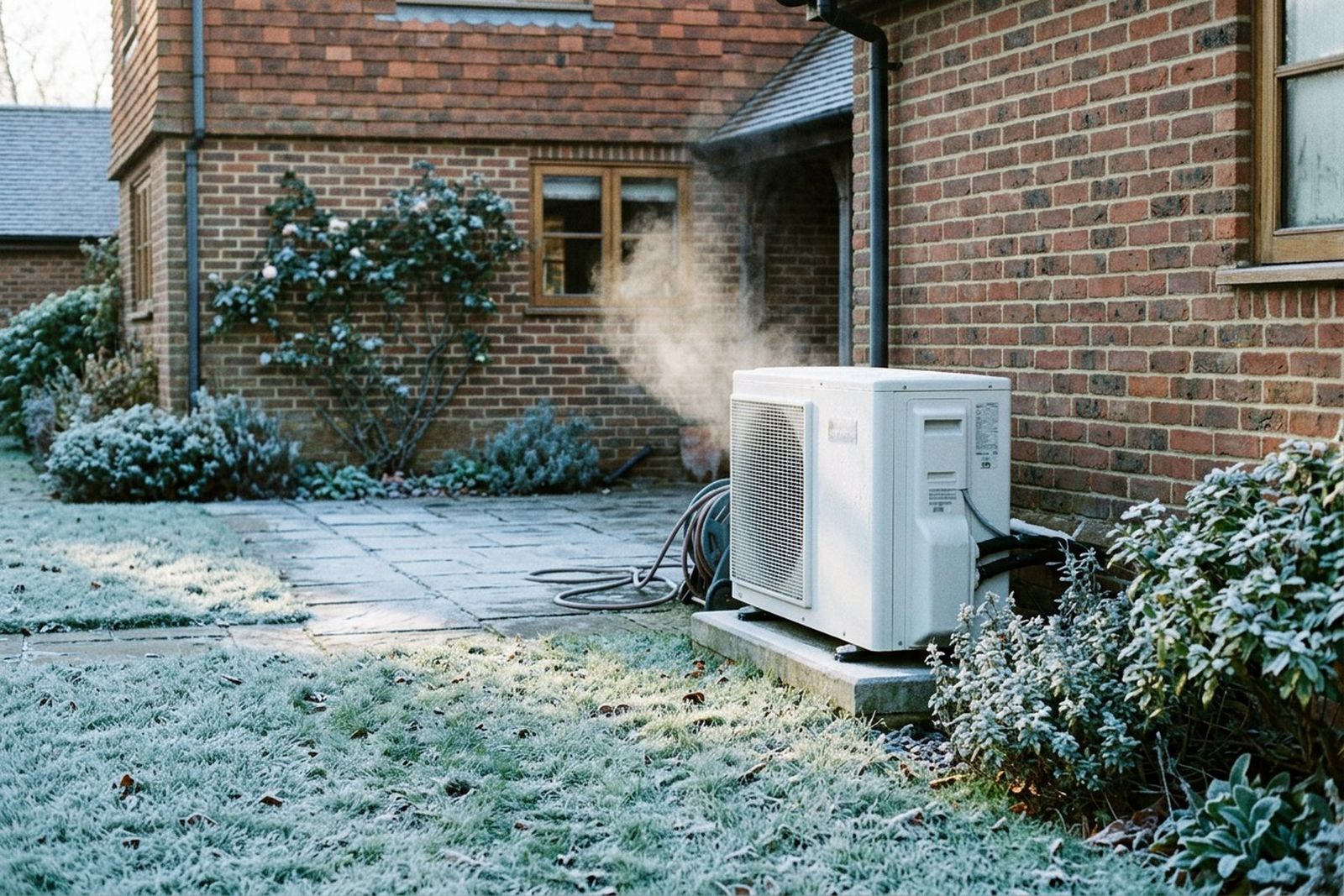
Why frost forms on an air source heat pump
An air source heat pump pulls heat out of the outside air. To do that, the refrigerant in the outdoor coil — the evaporator — is deliberately kept colder than the air around it, so heat flows into it even on a cold day; a compressor then raises that heat to a useful temperature for your radiators. Our guide to how an air source heat pump works walks through each step.
Because the coil surface sits below the air temperature, it often sits below freezing in winter. When the air is also damp, moisture condenses on the metal fins and turns to frost — exactly as it does on a cold car windscreen overnight. Vaillant’s manual describes the same thing: “At outdoor temperatures below 5 °C, condensation on the fins of the evaporator may freeze and frost may form.” Left alone, that frost would build up and block the airflow the unit needs, so it has to be cleared. As the Energy Saving Trust’s installer toolkit puts it, “domestic heat pump systems must carry out a defrost cycle at times to prevent ice build-up on the external heat exchanger (evaporator)”.
What happens during a defrost cycle
When the unit senses frost, it runs a defrost mode to warm the coil and melt it. A government study for the former Department of Energy & Climate Change noted that defrosting can be done in three ways: “reverse cycling the hot gas refrigerant”, electrically, or by reverse flow of heat from the heating system — and that drawing heat back from the heating system was the method most often used in the field trial. In practice many modern air source units use the reversing approach: as Vaillant’s manual describes it, “the thawing occurs by reversing the refrigeration circuit while the heat pump is operating”, and “the heat energy that is required for this is taken from the heating installation”.
Whichever method a particular model uses, the practical effect is the same:
- Heating pauses for a few minutes while the coil is warmed. The system is briefly taking heat back out of your heating water rather than putting it in, so radiators can cool a little.
- The frost melts and runs off the unit as water (condensate).
- A vapour plume can rise as that warmth and moisture meet cold air.
- Normal heating resumes automatically once the coil is clear.
This is why a short dip in radiator temperature during a cold snap is not a fault. The MCS heat pump design standard, which MCS-certified installers work to, expects a system to cope: an air source heat pump system “should be able to maintain the internal design temperatures across multiple defrost cycles”. Having enough water volume in the heating circuit is part of how that is achieved, which is one reason a buffer tank or volumiser is sometimes fitted.
How often it happens, and how much energy it uses
There is no fixed timetable. How often a heat pump defrosts depends on the weather — chiefly temperature and humidity — so you will see more defrosts in cold, damp conditions and almost none in dry or mild weather. The government study found defrost is “most frequent at ambient temperatures of 5–7°C”, the clammy range where there is both enough moisture in the air and enough chill to freeze it, rather than only in the hardest frost. Any installer or forum figure quoting an exact “every X minutes” should be treated with caution: it varies with the model, the weather and the siting.
The energy cost is modest. The same study reported that, on average across the field trial, “3.5 kWh/day of defrost was used in the coldest month”, and that “on average over the year 3.55% of the heat provided by the heat pump was used for defrost”. In other words defrosting accounts for only a small share of a heat pump’s yearly output. It is also already baked into the efficiency figures you see quoted for UK heat pumps: the government-funded Electrification of Heat trial confirms that “energy used to defrost ASHPs is accounted for within the calculations”, so the real-world performance figures in our cold-weather guide already include it.
Where the meltwater goes: the condensate drain
The water from a defrost — and the condensation that forms on the coil in normal running — has to drain away cleanly. If it pools and refreezes under the unit, it can build a pad of ice and, worse, ice over a path and become a slip hazard. So the outdoor unit sits above a condensate drain that carries the water to a safe soakaway or gully.
Manufacturer guidance is specific about this. Grant’s Aerona³ manual says to “use 40 mm waste pipe to form a condensate disposal system” running “to a suitable gulley or soakaway”, and warns that “it is essential that the condensate is able to drain away and not allowed to run onto any adjacent paths or driveways where, in winter, this will result in icing and a potential hazard”. Vaillant allows the condensate to be “guided into a sewer, pump sump or soakaway via a downpipe, gully, balcony run-off or roof run-off”, but insists that “any condensate that accumulates is discharged frost-free”, with a gravel bed and, where needed, electric trace heating to keep the discharge from freezing. Good drainage is one of the quiet details that separates a tidy install from a troublesome one, and it is set at the survey.
What is normal, and what is a fault
Nearly everything you notice in winter is ordinary defrost behaviour. The table below sorts the common sights.
| Normal | Worth a call to your installer |
|---|---|
| Periodic short defrosts in cold, damp weather | Constant defrosting that never seems to stop |
| A plume of vapour during or after a defrost | The unit frozen solid for a long time |
| A little water, or light surface frost, under the unit | Ice building faster than it clears, or a thick pad of ice under or over the unit |
| A brief dip in radiator warmth, then recovery | Error or warning codes on the controller, or no heat at all |
Never defrost the unit yourself. Do not chip at the ice, pour hot water over the coil or open the casing. If the heat pump stays iced up, keeps defrosting, shows error codes or stops heating, leave it alone, note any codes on the controller, and contact your installer. Our heat pump maintenance guide covers what to check and when to call.
A heat pump that defrosts far more than the weather seems to justify, or that struggles to clear ice, can be a sign of something treatable — poor airflow, a blocked or frozen condensate drain, or a siting problem — rather than a failing unit. It is worth reporting rather than living with, because a small fix early avoids a mid-winter breakdown.
Good siting, and where ByEco stands
A well-sited unit defrosts cleanly and rarely gives trouble. The things that help are practical: clear airflow all round, so the unit is not boxed into a tight corner or smothered by a fence; a spot out of a frost pocket where cold, damp air collects; the unit raised on feet or a bracket above the ground so meltwater and any snow fall away; and a proper condensate drain to a soakaway or gully, kept clear of paths. These are exactly the points an installer should weigh up on site — ByEco looks at airflow, siting and drainage as part of the home survey, alongside the cold-weather sizing and noise checks (see are heat pumps noisy?).
Because the right answer depends on your property, there is no standard price and we do not quote one here. What the job costs depends on the size of system your home needs, whether any radiators or pipework have to change, where the outdoor unit goes and how far the pipe run is, how hot water is provided and any electrical work; our heat pump cost guide explains what drives it. You may be eligible for the £7,500 Boiler Upgrade Scheme grant towards an air source heat pump in England and Wales; an installer applies for it and takes it off your quote, and it can only be claimed through an MCS-certified installer — see our Boiler Upgrade Scheme guide.
ByEco is based in Manchester and installs air source heat pumps for homeowners across England and Wales, mostly around Greater Manchester (see heat pump installation in Manchester). ByEco’s MCS and TrustMark certification is in progress. For a free home survey and a clear, itemised quote, with no obligation to go ahead, get in touch; you can also read more about our heat pump installations.
Sources
Every figure on this page was checked against primary sources on 25 October 2026. Grant rules, planning rules and prices change — if you are reading this much later, verify before acting.
- Vaillant — aroTHERM plus VWL 35/6 to 75/6 A S2 installation and operating instructions (0020330791_03): 3.13 Thawing mode, 4.2 condensate discharge, 7.1 troubleshooting
- Kiwa GASTEC at CRE for DECC — Investigation of the interaction between hot water cylinders, buffer tanks and heat pumps, contract 30047 (January 2013), 5.3.2 Defrost
- GOV.UK (Department of Energy & Climate Change) — Investigation of the interaction between hot water cylinders, buffer tanks and heat pumps (publication page, 14 May 2013)
- Grant UK — Aerona³ R32 Air Source Heat Pump Installation and Servicing Instructions (DOC 0136 Rev 2.4, February 2024), 3.5.3 Condensate disposal
- MCS — MIS 3005-D The Heat Pump Design Standard, Issue 3.0 (5 December 2025)
- Energy Systems Catapult for DESNZ — Electrification of Heat: Heat Pump Performance Data Analysis Report (December 2024)
- Energy Saving Trust Green Heat toolkit — Heat pump system design: system volume and frost protection
- GOV.UK — Apply for the Boiler Upgrade Scheme: what you can get
Book your free home survey
Every home is different. The cost depends on the size of system, any radiators that need upgrading, the pipework and where the outdoor unit goes. Get in touch and we will arrange a free survey of your home and give you a clear quote. If you are happy with it, we can go ahead.