The short version
- Not always. A buffer tank or volumiser is sometimes needed and sometimes not; it depends on the system design and how much water the radiators and pipework already hold.
- A buffer tank is a vessel of water in the heating circuit that adds volume and hydraulically separates the heat pump side from the radiator side. A volumiser just adds water volume in series, on a single circuit, with no separation.
- Enough water volume helps. It gives the defrost cycle a reserve of heat, keeps enough flow through the heat pump and reduces how often the compressor stops and starts.
- Design matters. A government study found a poorly configured four-pipe buffer can raise the return temperature to the heat pump and needs a second pump, which can cost efficiency.
- Many modern systems minimise or avoid buffers. Heat pump radiators are usually larger, so the circuit often holds enough water on its own; where it falls short, a volumiser on the return is often the lighter-touch fix.
“Do I need a buffer tank?” is one of the most argued-over questions in heat pump design, and the honest answer is that it depends on your system. This guide explains what a buffer tank and a volumiser actually are, why water volume matters to a heat pump, how a buffer differs from a volumiser and a low loss header, and when you are unlikely to need one. It is about the heating side of your system; how your hot water is provided is a separate question (see heat pumps and hot water).
What is a buffer tank, and what is a volumiser?
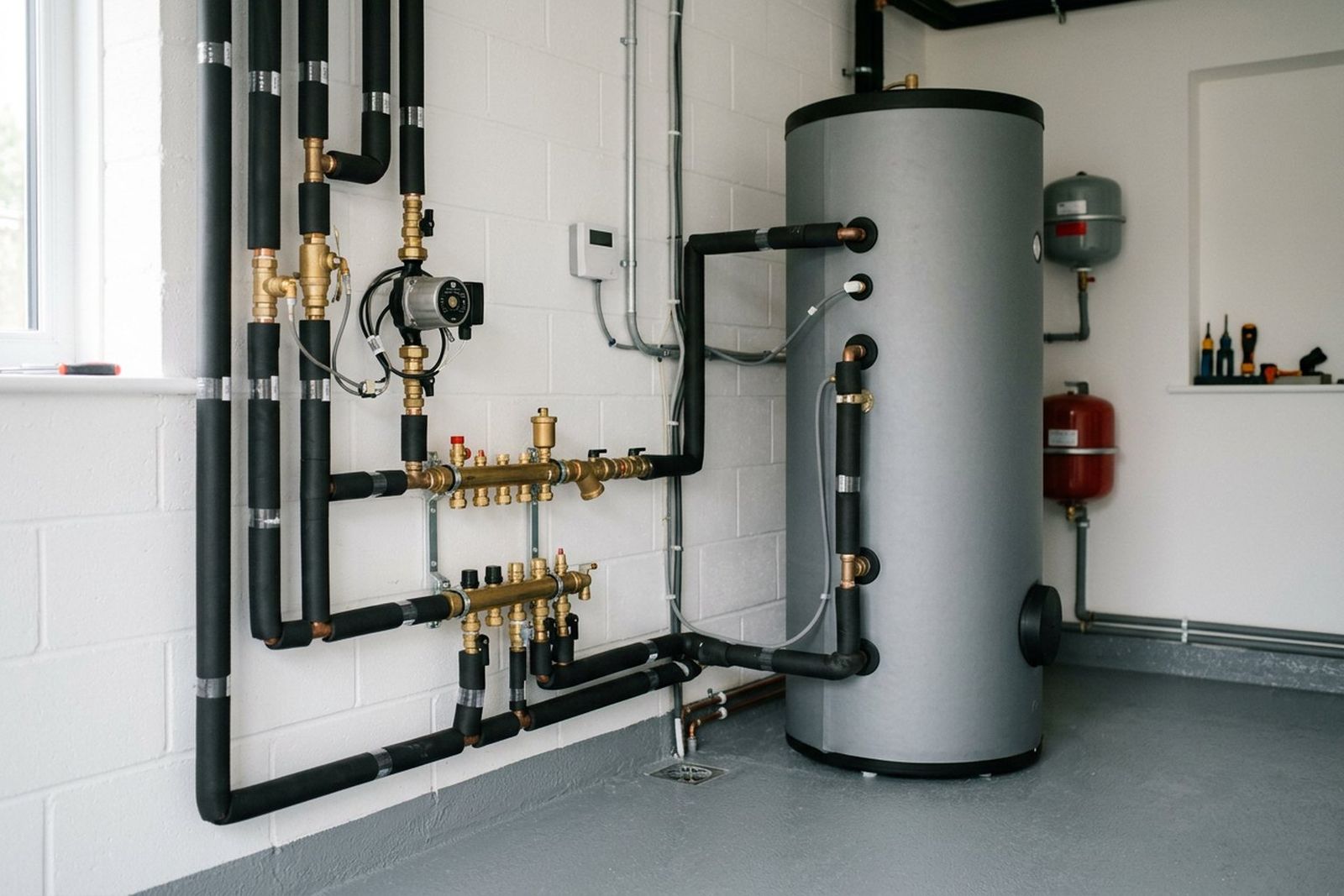
Both are tanks of water plumbed into your heating circuit, and both add to the total volume of water the heat pump can draw on. The difference is how they are connected.
A volumiser is the simpler of the two. As Grant UK’s installation manual for its Aerona³ air source heat pump puts it, a volumiser “is simply a vessel used to increase the volume of the system”, with “only two connections, one inlet and one outlet”. Because it has one way in and one way out, it sits in series on a single circuit: all the water still flows through it on its way round, and it does not split the system into two loops.
A buffer tank usually has four connections (often called a four-port or four-pipe buffer): a flow and return on the heat pump side, and a separate flow and return on the heating side. That creates hydraulic separation — two loops that can run at different flow rates, joined through the tank. The heat pump keeps a steady flow through itself, while the radiator circuit can run at its own rate. A low loss header does a similar separating job in a much smaller fitting; Grant’s combined volumiser and low loss header, for example, “provides an extra 11.5 litres to the system volume” and “also gives hydraulic separation of the primary circuit of the heat pump from the secondary system circuit”.
Why extra water volume matters for a heat pump
A heat pump likes a decent volume of water moving through it. There are three everyday reasons, and they are the real point behind buffers and volumisers.
- Defrost. In cold, damp weather an air source heat pump periodically reverses to melt frost off its outdoor coil, drawing heat back out of your heating water to do it (see do heat pumps work in cold weather?). Enough water volume gives that defrost a reserve of stored heat to draw on, so rooms stay comfortable. MCS’s heat pump design standard, MIS 3005-D, requires that an air source system “should be able to maintain the internal design temperatures across multiple defrost cycles”. Defrost is a normal, modest overhead: a government field trial found that, on average over the year, 3.55% of the heat a heat pump provided went on defrosting.
- Less stop-start cycling. If the circuit holds too little water, the heat pump heats it quickly, satisfies the thermostat, stops, and soon restarts — “short cycling”, which is hard on the compressor and wastes energy. The same government study found the main reason to fit a buffer tank “is to decrease short cycling of the heat pump”, and suggested designing for a minimum run time of more than 10 minutes for an air source heat pump.
- Keeping the flow up. The heat pump needs a minimum flow rate through it to work properly. Grant’s manual warns that “an excessively low flow rate may cause problems including reduced capacity and poor circulation”, and that the flow has to be enough to give about an 8°C difference between the water leaving and returning. Thermostatic radiator valves that close off rooms can cut the volume and flow the heat pump sees, which is one trigger for adding a vessel.
Buffer tank vs volumiser vs low loss header
The three are often lumped together, but they are not interchangeable, and the differences matter for efficiency.
| Component | Hydraulic separation? | What it mainly does |
|---|---|---|
| Volumiser | No — in series on one circuit | Adds water volume only |
| Low loss header | Yes, in a small fitting | Separates the two circuits, adds a little volume |
| Buffer tank (four-port) | Yes, a full second circuit | Separates the circuits and adds volume |
Hydraulic separation can be genuinely useful — it lets the heat pump run a steady, high flow through itself while the radiators run slower. But separation has a catch. A four-port buffer adds a second circuit with its own pump, and if the two sides are not carefully matched and commissioned, hot flow water and cooler return water can mix inside the tank. That mixing lowers the temperature reaching your radiators, so the heat pump has to run hotter to compensate — and a heat pump’s efficiency falls as its flow temperature rises.
The government-commissioned study tested this directly. It found that, compared with a simpler two-pipe arrangement, “the temperature of the 4 pipe buffer tank tends to drift up (especially in times of low demand) relative to what it would have been on a two pipe system”, and flagged “the additional electrical demand of the second circulating pump in a 4 pipe system”. Its conclusion was that where a vessel is needed, putting it on the return as a two-pipe tank “should hold the return temperature down, which should improve the efficiency of the heat pump”. In other words, a badly designed buffer can cost you efficiency, while a volumiser or a two-pipe tank on the return avoids most of that risk. This is why the design detail matters more than the label on the tank.
When you probably don’t need a buffer tank
Plenty of modern systems need no buffer at all. Because a heat pump runs cooler than a boiler, its radiators are usually larger (see do I need new radiators for a heat pump?), and larger radiators and their pipework hold more water. The government study noted that this “radiator volume is often large enough to not require a buffer tank”.
Two things have also changed since older systems. First, most heat pumps sold today are inverter-driven, meaning they can turn their output down rather than only switching on and off. The study found buffer tanks “are less relevant with inverter driven heat pumps, where the heat pump can modulate … because cycling is less of an issue”, and that they matter more with older fixed-speed units. Second, where a system does fall a little short on volume, the study recommended supplementing it “by a two pipe buffer tank placed in the return pipe to the heat pump” — effectively a volumiser — rather than defaulting to a four-port buffer.
The practical test an installer uses is simple: take the heat pump manufacturer’s minimum system volume, add up what your radiators, underfloor circuits and pipework already hold, and see whether you clear it. MIS 3005-D expects equipment to be installed “in accordance with its manufacturer’s instructions”, so the manufacturer’s figure is the one that counts. Some heat pumps need a vessel as standard — Grant, for instance, requires a volumiser on every Aerona³ R32 install “except when the heat pump is connected to a … combined volumiser/low loss header, buffer or thermal store” — while others allow a direct connection if the volume is there.
Space, siting and the hot water cylinder
A buffer tank, volumiser or low loss header is a physical object that has to go somewhere — usually indoors, near the heat pump’s indoor pipework, in a utility room, airing cupboard or plant space. A four-port buffer can be sizeable; a low loss header or a small volumiser is much more compact. Where it goes, and whether the space suits it, is one of the things a surveyor checks (see what happens during a heat pump installation).
It is worth being clear that a buffer tank and a volumiser are heating-side components. They are not the same thing as a domestic hot water cylinder, which stores water for your taps and showers; they heat nothing for washing. Occasionally the two are confused because both are tanks, and some products combine functions, but they do different jobs. Whether and how your hot water is stored is a separate design question for your installer to spell out — our guide to heat pumps and hot water covers it.
The survey and design decide — and where ByEco stands
There is no honest way to say from a web page whether your home needs a buffer tank, a volumiser or neither. It falls out of the heat loss survey and the system design: the size of heat pump your home needs (see what size heat pump do I need?), how much water your emitters and pipework already hold, the manufacturer’s minimum volume, and whether the design calls for hydraulic separation. Under MIS 3005-D, before the work starts you should be given the design in writing, including the emitters to be used and “the design flow temperature of the water leaving the heat pump”; if a buffer or volumiser is part of that design, ask why, where it goes and how it has been sized to protect efficiency. For how the running flow temperature affects your bills day to day, see running a heat pump efficiently.
Because it all turns on your property, there is no standard price and we do not quote one here. The cost depends on the size of system your home needs, whether any radiators or pipework have to change, where the outdoor unit goes and how far the pipe run is, how hot water is provided and any electrical work; a buffer or volumiser, where one is needed, is a small part of that. Our heat pump cost guide explains what drives it. You may be eligible for the £7,500 Boiler Upgrade Scheme grant towards an air source heat pump in England and Wales; an installer applies for it and takes it off your quote, and it can only be claimed through an MCS-certified installer — see our Boiler Upgrade Scheme guide.
ByEco is based in Manchester and installs air source heat pumps for homeowners across England and Wales, mostly around Greater Manchester (see heat pump installation in Manchester). We design each system around a room-by-room heat loss survey, so any decision on a buffer tank or volumiser is made on the numbers, not fitted by habit. ByEco’s MCS and TrustMark certification is in progress. For a free home survey and a clear, itemised quote, with no obligation to go ahead, get in touch; you can also read more about our heat pump installations.
Sources
Every figure on this page was checked against primary sources on 24 October 2026. Grant rules, planning rules and prices change — if you are reading this much later, verify before acting.
- MCS — MIS 3005-D The Heat Pump Design Standard, Issue 3.0 (5 December 2025)
- GOV.UK (Department of Energy & Climate Change) — Investigation of the interaction between hot water cylinders, buffer tanks and heat pumps (publication page, 14 May 2013)
- Kiwa GASTEC at CRE for DECC — Investigation of the interaction between hot water cylinders, buffer tanks and heat pumps, contract 30047 (January 2013)
- Grant UK — Aerona³ R32 Air Source Heat Pump Installation and Servicing Instructions (DOC 0136 Rev 2.4, February 2024)
- Grant UK — The case for the low loss header (blog)
- Energy Systems Catapult for DESNZ — Electrification of Heat: Heat Pump Performance Data Analysis Report (December 2024)
- GOV.UK — Apply for the Boiler Upgrade Scheme: what you can get
Book your free home survey
Every home is different. The cost depends on the size of system, any radiators that need upgrading, the pipework and where the outdoor unit goes. Get in touch and we will arrange a free survey of your home and give you a clear quote. If you are happy with it, we can go ahead.