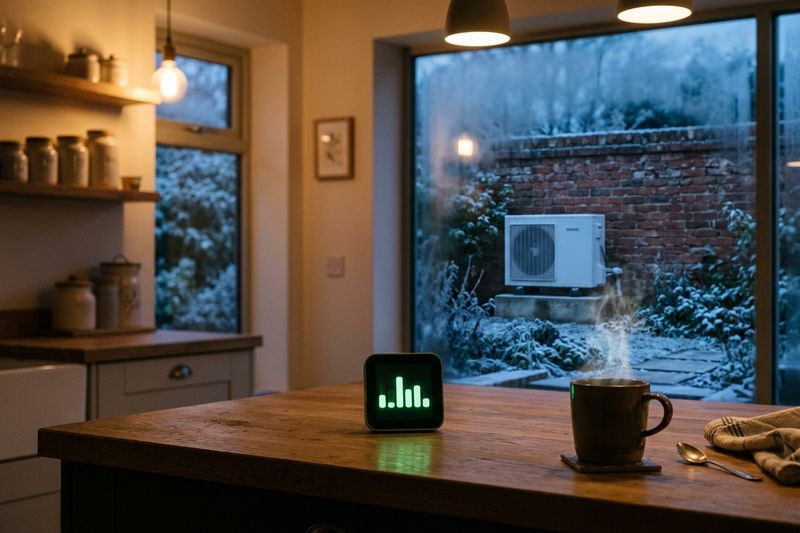
The short version
- Yes. MCS’s installation standard covers heat pump systems supplying buildings with “space heating and/or domestic hot water”, and Ofgem requires a grant-funded heat pump to cover “the full space heating and hot water heating demand”, alone or with supplementary appliances.
- Temperature. Where a heat pump works with a hot water cylinder, MCS requires it to be “capable of a flow temperature of at least 55 °C at design conditions”.
- Legionella. MCS requires a “means to prevent bacterial growth” and leaves the frequency of any pasteurisation to a risk assessment. HSE’s 60 °C storage guidance sits under duties aimed at dutyholders, landlords among them.
- Sizing. MCS puts daily hot water demand at 45 litres × N, N being the greater of bedrooms + 1 or known occupants — 180 litres a day for a three-bedroom house.
- Efficiency and cost. Hotter water is less efficient, and what an installation costs depends on your property — book a free survey and we will itemise it.
The temperature, the bacterial controls and the demand calculation are all written down in standards you can read.
Do heat pumps give hot water?
Yes, and the paperwork takes it for granted. MCS’s installation standard MIS 3005-I covers “microgeneration heat pump systems supplying permanent buildings with space heating and/or domestic hot water”, and Ofgem’s Boiler Upgrade Scheme guidance requires a grant-funded heat pump to be “capable of providing the full space heating and hot water heating demand to a property”, on its own or with supplementary heating appliances.
The field data agrees: in the government-funded Electrification of Heat project, which monitored 742 heat pump systems, a sensor on the control valve recorded “whether the heat pump is in space heating or hot water mode” on the full heat pump installations. For the mechanics first, see how an air source heat pump works.
How a heat pump heats your hot water
A heat pump makes warm water, not flame. On a call for hot water, a three-port diverter valve routes the flow to a coil instead of the heating circuit, as Trianco’s Activair manuals show.
Because the water arriving is cooler than a boiler’s, the heat exchanger has to be bigger. MCS notes that hot water heat exchangers for heat pump systems “tend to require a greater surface area compared to traditional combustion-based heat sources (i.e. boilers) because the flow temperature is typically lower”, and accepts a cylinder labelled to the Hot Water Association’s HWA 002:2020 specification. Where an existing cylinder is kept, MCS sets conditions: insulation on it and its pipes upgraded to at least new-installation level, a duty of care over its mechanical integrity — scale, corrosion, the extra thermal stress of being driven by a heat pump — and a size that complies with the manufacturer’s requirements.
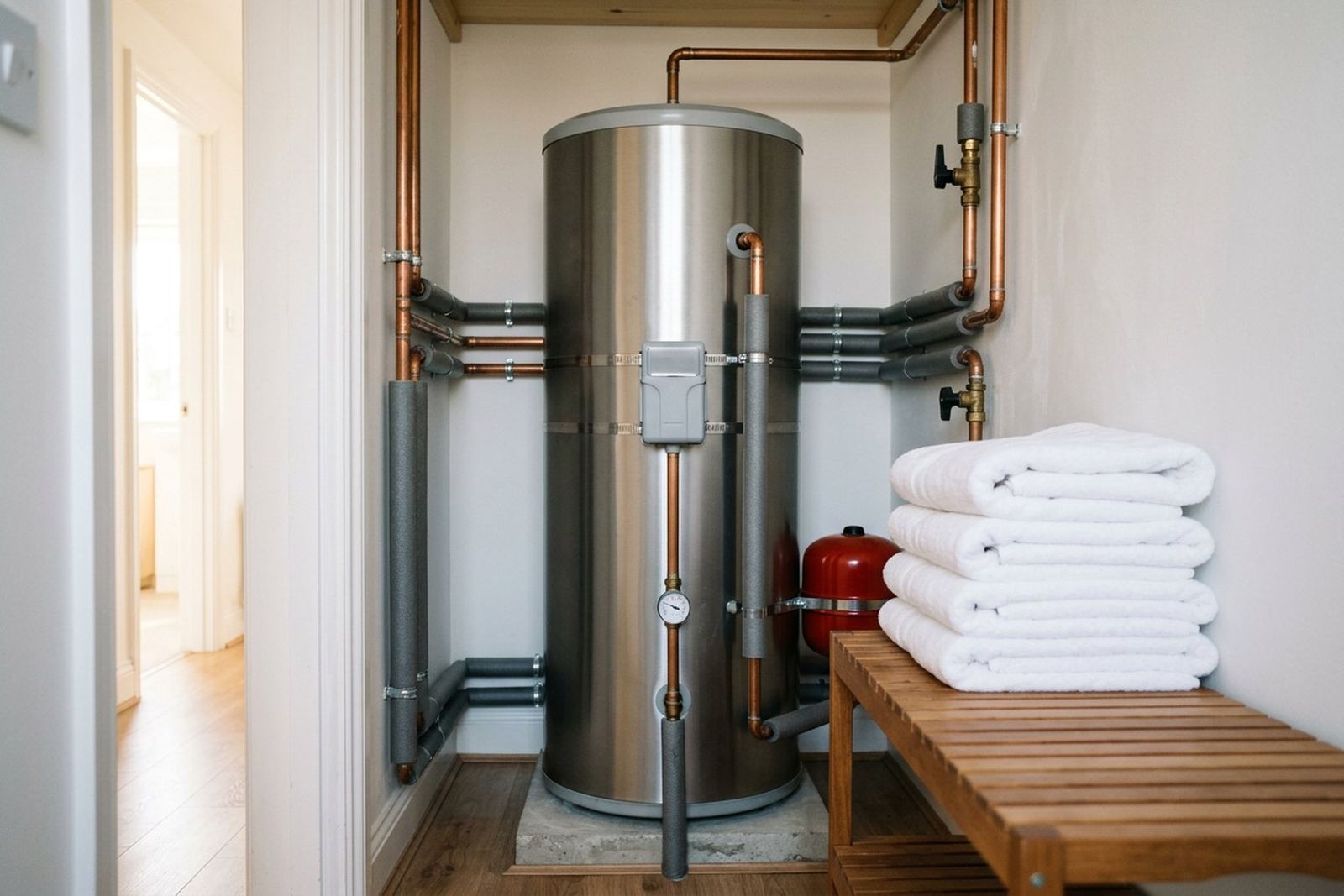
Heat pump hot water temperature: what the standard and the manuals say
Two numbers matter. The design floor: MIS 3005-D clause 5.6.6 says that when installing a hot water cylinder to work with a heat pump, “the heat pump shall be capable of a flow temperature of at least 55 °C at design conditions” — the coldest outside temperature at which it meets the heat demand unaided.
The ceiling the hardware allows: Trianco’s Activair R290 floor-standing unit is listed with an “Operating water Temperature 4 ~ 65°C”; the wall-hung version in the same range is listed at 5 ~ 60 °C.
MCS pushes designs down rather than up. Clause 5.5.5: where a design proposes a flow temperature above 55 °C, “an alternative design using a flow temperature of 55 °C or lower should also be provided”, with the efficiency differences explained so you can choose. The Electrification of Heat report says the same from the data — systems “should be designed and set up to operate at low flow temperatures for as much of the time as possible, regardless of their maximum temperature”. Better-matched radiators usually buy you that; see do I need new radiators for a heat pump.
What that means at the tap, the shower and the bath
The temperature a system reaches is not what arrives at your tap, because hot water is blended with cold on the way. In England and Wales, Approved Document G requirement G3(4) says the hot water supply to any fixed bath must be designed so “that the temperature of the water that can be delivered to that bath does not exceed 48 °C”, by an in-line blending valve with a maximum temperature stop — a requirement that applies when a dwelling is erected or formed by a material change of use. Where stored water can exceed 80 °C, the guidance says a tempering valve should keep the temperature reaching the distribution system to 60 °C or below.
HSE adds that where vulnerable people can reach baths or showers and the scalding risk is significant, a Type 3 thermostatic mixing valve “must be fitted to prevent water being discharged at more than 44 °C”. MCS assumes blending too: you must be given “the design flow temperature of the water leaving the heat pump and before any blending valves”. Comparing a stored temperature with a boiler’s flow temperature is not comparing two shower temperatures.
Heat pump legionella cycle: duty, guidance and standard
Three different kinds of rule are in play.
| What it is | Who it binds | What it says |
|---|---|---|
| Legal duty | Dutyholders: employers, those in control of premises, landlords | HSE’s Approved Code of Practice L8 is aimed at “dutyholders, including employers, those in control of premises”. For rented homes, section 3(2) of the Health and Safety at Work Act and COSHH apply. |
| Technical guidance | Nobody on its own — it shows how to meet the duty | L8’s technical detail “is published separately in HSG274”. HSE advises that hot water “should be stored at least at 60 °C and distributed so that it reaches a temperature of 50 °C … within 1 minute at the outlets”. |
| Certification standard | MCS-certified installers | MIS 3005-D 5.6.8: hot water systems “shall incorporate a means to prevent bacterial growth (including legionella bacteria)”; where that is periodic pasteurisation, “a bacterial risk assessment can help determine how frequent” it should be. |
So MCS requires a means of control, not a timetable. In homes, HSE says the risks “are generally considered to be low owing to regular water usage and turnover”. In a rented home the duty bites: HSE lists “setting the temperature of the hot water cylinder (calorifier) to ensure water is stored at 60 °C” among simple control measures for landlords, says the law does not require a legionella test certificate, and notes inspectors “do not proactively inspect domestic premises” — though a landlord whose tenant caught the disease at home could be prosecuted. See heat pumps for landlords.
In practice the function arrives fitted. Trianco’s Activair commissioning instructions set a disinfection temperature of 60 °C on the wall-hung unit (60–70 °C on the floor-standing one) for 60 minutes every 7 days — which is where the familiar weekly cycle comes from. Whatever an installer sets is recorded: the MIS 3005-I commissioning checklist has fields for “Legionella cycle temp” and “Legionella freq (days)”, so ask for that sheet at handover.
Heat pump reheat time and how hot water demand is sized
MCS does not leave capacity to judgement. Clause 5.6.2 sets daily demand as Vd,average = 45 × N, where N is the greater of bedrooms plus one, or known occupants. A three-bedroom house comes out at 45 × 4 = 180 litres a day. That figure, with the heat pump’s capacity, is what MCS sizes any cylinder from; it points to its guidance document MGD 007 and accepts that “the size of cylinder may be limited by the available space”.
Reheat is a negotiated number: “the desired domestic hot water cylinder reheat time shall be agreed with the customer”, and you must be given the calculated daily hot water demand and “the specification of any new domestic hot water cylinder and its recovery rate”. How long a reheat takes depends on the model, the cylinder and the coil, so ask for the recovery rate for the pairing you are quoted. Timing is yours afterwards: hot water needs the higher flow temperature, so place the cycle where it suits your day and your tariff — see how to run a heat pump efficiently and what size heat pump do I need.
Heat pump shower pressure: stored and instantaneous hot water
Pressure is a plumbing question, not a heat pump one, and Approved Document G defines the options plainly. An unvented (closed) system is “a vessel fed with cold water from a supply pipe or dedicated storage cistern (without a vent pipe)”; a vented (open) one is “a vessel fed with cold water from a dedicated storage cistern”. An instantaneous water heater, which HSE gives as “combi boilers and electric showers”, heats small volumes as they are drawn and involves “no water storage”.
Neither arrangement is the villain. Where the cold feed comes from sets the pressure at your outlets, which is why a survey looks at your incoming mains too. Unvented systems carry a compliance trail too: installing one is notifiable building work unless the installer is on a competent person scheme, which issues you a building regulations certificate of compliance.
Is heating water with a heat pump efficient?
Less efficient than space heating, yes, because efficiency falls as the water gets hotter. The Electrification of Heat trial measured it: across all monitored heat pumps the median half-hourly coefficient of performance of the heat pump unit itself was 3.50 at a 35 °C flow temperature, 2.38 at 55 °C and 2.02 above 65 °C. Trianco’s test conditions for the Activair R290 floor-standing unit show the same shape: at 7 °C outside it gives 4,820 W from 1,080 W of electricity at 35 °C out, and 4,910 W from 1,720 W at 55 °C — roughly 4.5 units of heat per unit of electricity against 2.9.
So hot water is costed separately: where MCS’s performance estimation method applies, the water heating load is divided by the efficiency “when the heat pump is operating at the flow temperature … while providing water heating service”. It also sits inside the trial’s whole-system result — a median seasonal performance factor of 2.78 across 428 air source heat pumps, interquartile range 2.55 to 3.05, counting the hot water those systems made and the electricity their immersion and back-up heaters used. See how much electricity a heat pump uses.
What the grant and the standards say about hot water
Ofgem’s installer guidance, paragraph 3.89: “The BUS-funded heat pump must have sufficient kilowatt thermal capacity to meet the full space heating demands of a property on its own. The combined system … must be capable of providing the full space heating and hot water demand for the property.” So the heat pump alone has to cover space heating; hot water may be met by the heat pump plus supplementary appliances, as long as those are neither fossil-fuelled nor biomass boilers. The guidance defines the term too: “hot water heating demand refers to water for personal use within the property”.
You may be eligible for £7,500 towards an air source heat pump in England and Wales. An MCS-certified installer applies on your behalf and the value comes off what you pay, and an air source voucher expires three months from the day it is issued. ByEco’s MCS and TrustMark certification is in progress, so we cannot yet apply for the grant for you. More in the Boiler Upgrade Scheme explained and on our grants and rebates page.
Cost, the survey, and where ByEco stands
We do not publish a single installed price, because the number depends on your building: the system size your heat loss calls for, whether radiators or pipework need upgrading, where the outdoor unit goes and how long the pipe run is, the hot water arrangement, and any electrical work. See heat pump costs in Manchester and what to expect from a heat pump installation.
Worth asking before you sign:
- What is the calculated daily hot water demand here, and what size and recovery rate follow from it?
- What reheat time are we agreeing, and at what temperature?
- What is the design flow temperature before any blending valves, and what will the outlets be limited to?
- How is bacterial growth controlled — at what temperature, how often, on what risk assessment?
ByEco installs air source heat pumps for homeowners in England and Wales, from Manchester. Book a free home survey and we will measure the heat loss, work out the hot water demand and give you an itemised quote; if you are happy with it, we go ahead. Get in touch, or see our heat pumps page and service areas.
Sources
Every figure on this page was checked against primary sources on 20 October 2026. Grant rules, planning rules and prices change — if you are reading this much later, verify before acting.
- MCS — MIS 3005-D The Heat Pump Design Standard, Issue 3.0
- MCS — MIS 3005-I The Heat Pump Installation Standard, Issue 1.0 (2025)
- MCS — Standards and Tools Library
- Ofgem — Boiler Upgrade Scheme: Installer Guidance V5.1
- Ofgem — Boiler Upgrade Scheme guidance for installers
- HSE — Legionnaires’ disease: hot and cold water systems
- HSE — Legionella and landlords’ responsibilities
- HSE — L8: The control of legionella bacteria in water systems (ACOP, 4th edition)
- GOV.UK — Approved Document G: sanitation, hot water safety and water efficiency
- HM Government — Approved Document G, 2015 edition with 2024 amendments
- Energy Systems Catapult / DESNZ — Electrification of Heat: Heat Pump Performance Data Analysis
- Trianco — Activair R290 floor-standing heat pump installation manual
- Trianco — Activair wall-hung heat pump installation manual
- GOV.UK — Apply for the Boiler Upgrade Scheme: what you can get
- legislation.gov.uk — Boiler Upgrade Scheme (England and Wales) Regulations 2022, reg 15
Book your free home survey
Every home is different. The cost depends on the size of system, any radiators that need upgrading, the pipework and where the outdoor unit goes. Get in touch and we will arrange a free survey of your home and give you a clear quote. If you are happy with it, we can go ahead.