The short version
- For a heat pump on its own, the Energy Saving Trust suggests a dedicated heat pump tariff or a dynamic tariff, and a heat pump tariff without a peak rate if possible.
- Heat pumps tend to run for long periods at low output, so a single cheap overnight window helps much less than it does for an electric car. Hot water is the easiest thing to move into cheap hours.
- Smart time-of-use tariffs need a smart meter. Economy 7 does not usually suit a heat pump, which often runs through the dearer daytime rate.
- Ofgem’s price cap covers standard variable tariffs, not fixed ones: 26.32p per kWh and 54.83p a day for electricity from 1 October to 31 December 2026 (GB average, Direct Debit, no VAT).
- There has been no VAT on household electricity since 1 October 2026. At the Budget the Government announced it will extend this until July 2027; the law still gave 31 March 2027 when we checked.
With a heat pump, electricity becomes your heating fuel, so the tariff matters more than before. Here is how each type works with a heat pump’s running pattern, and how to check one against your own use.
Which electricity tariff suits a heat pump?
It depends on what else you have and how flexible your home can be. For a home with a heat pump but no solar panels or battery, the Energy Saving Trust’s tariff guide says to look for a dynamic tariff or a heat pump tariff. If you choose a heat pump tariff, it says to pick one without a peak rate if possible, because you will often have to carry on running the heat pump during that expensive period to keep your home warm.
The tariff can make a real difference. In research published in August 2026, which used measured data from 546 homes to model around 1.1 million combinations of technology and tariff, the Energy Saving Trust found that most heat pumps on a standard flat-rate tariff cost the same or even more to run than an efficient gas boiler, while those on a dedicated heat pump tariff tended to have significantly better running costs. Its earlier caution still applies: time-of-use tariffs charge more than standard tariffs at some times of day, so you could still be better off on a standard tariff if you cannot shift your use. Heat pump tariffs are mostly only available to homes that have one, so check you are eligible.
The main types of electricity tariff
Ofgem describes three main types of tariff: fixed rate, standard variable and multi-rate. Smart time-of-use tariffs add several more.
| Tariff type | How it works | With a heat pump |
|---|---|---|
| Standard variable (price cap) | One unit rate all day; can go up or down, within the price cap | Simple; the same rate at the evening peak as at night |
| Fixed | Price set for a period; not covered by the price cap | Certainty; check the rate and any exit fee |
| Economy 7 | One cheaper period at night, dearer electricity in the day | Usually a poor fit: heat pumps often run through the day |
| Static smart time-of-use | Set peak, off-peak and sometimes shoulder rates, with prices usually fixed well in advance | Can work if you move hot water and some heating into the cheaper hours |
| Dynamic | A different price every half-hour, based on wholesale prices | Suggested by the Energy Saving Trust; suits controls that respond to price |
| Heat pump tariff | One or more cheaper periods, sometimes a peak period too; mostly for homes with a heat pump | Designed for this load; without a battery, look for no peak rate |
| EV tariff | One period of very cheap electricity in the early hours | Most heat pump use falls outside the cheap window |
The price cap limits the unit rate and standing charge together, not your bill: the more you use, the more you pay. Ofgem says it protects people on standard variable tariffs, not those who agreed a fixed tariff. Ofgem sets it every three months, and the next period starts on 1 January 2027.
Why a heat pump is not an electric car
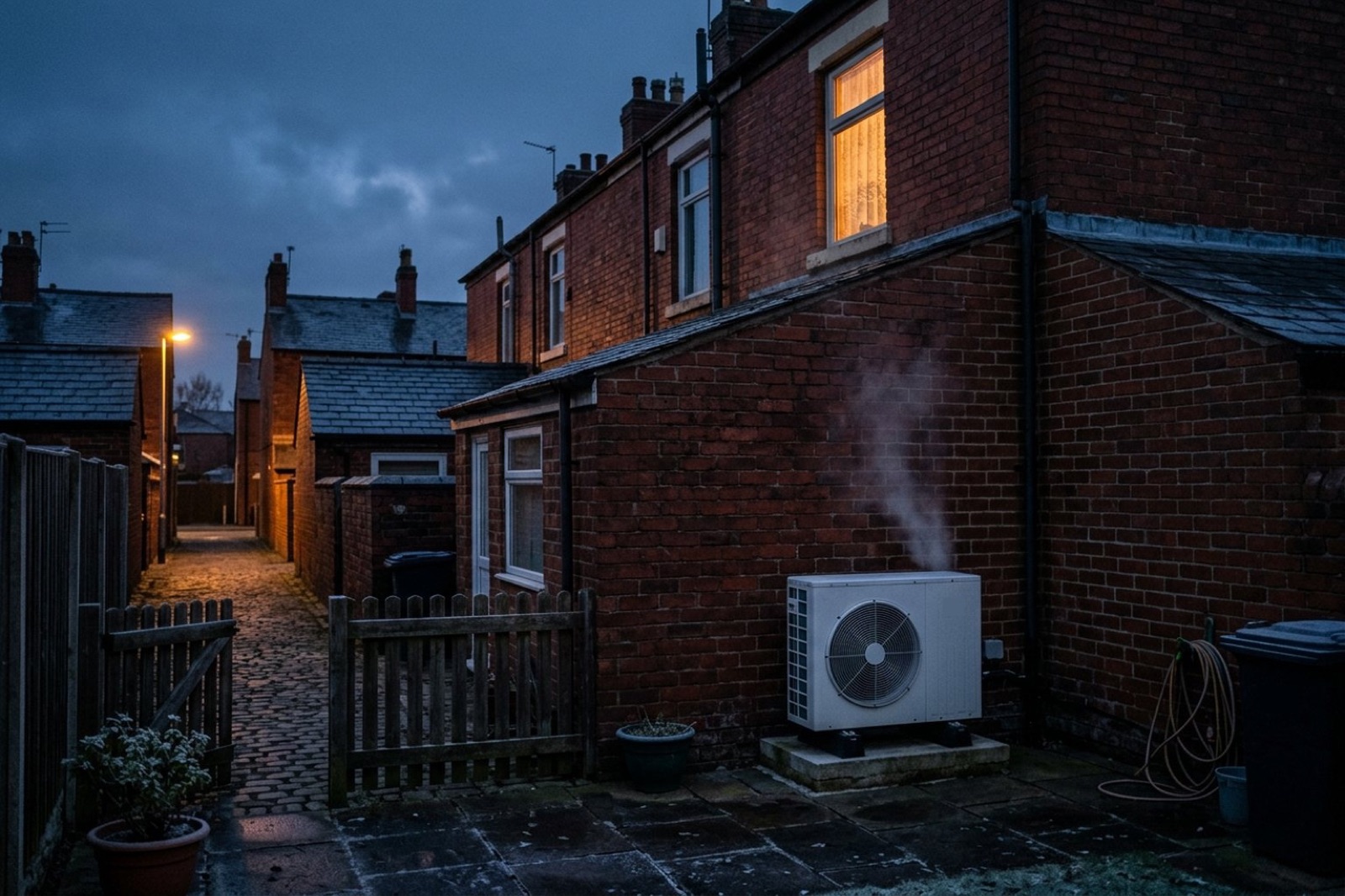
An electric car can take most of its charge in a few cheap hours overnight. A heat pump works differently. It usually keeps the house warm by running for long periods at a modest output, and in cold weather it may run for much of the day. The Energy Saving Trust puts it plainly: Economy 7 meters do not work well with heat pumps, because heat pumps often run throughout the day during the more expensive peak rate.
So a tariff built around one overnight window rarely suits a heat pump. If you have both, the Energy Saving Trust says to look at a heat pump tariff instead of an EV tariff, because you will not be able to use much of the EV tariff’s cheap electricity to run the heat pump.
A heat pump uses a lot of electricity in winter, so small differences per kWh add up. See how much electricity a heat pump uses and heat pump vs gas boiler running costs.
Shifting hot water and heating into cheaper hours
A time-of-use tariff only pays off if you can move use into the cheaper hours. There are two levers.
- Hot water. If your system heats a hot water cylinder, this is the easiest load to move. The Energy Saving Trust advises setting the water heating programme for the lowest-priced hours on a time-of-use tariff, and running the periodic sterilisation cycle, which heats the cylinder above 60°C, in those hours too. On a standard tariff without solar panels, it suggests the middle of the afternoon, when the outside air is generally warmest.
- Space heating. The Energy Saving Trust says you may be able to set the water heating, “and maybe even the space heating”, to use cheaper electricity. In practice that means warming the house a little before a peak so the heat pump can ease off during it. That depends on how well your home holds heat, and it should not mean boiler-style bursts of on and off.
How hot water is provided varies between installations, so ask your installer to spell out how yours will work. Your system may already have settings designed for certain tariff types. Our guides to heat pumps and hot water and running a heat pump efficiently cover the settings in more detail.
Do you need a smart meter?
For a smart time-of-use tariff, yes. The Energy Saving Trust says you need a smart meter to sign up, and that its readings every 30 minutes are what let suppliers offer tariffs that adapt to demand. Ofgem lists access to more flexible tariffs among the benefits. If you do not have one, ask your supplier before you switch.
Standing charges and VAT
The electricity standing charge
The standing charge is a fee you pay every day, even on a day you use no energy. Under the cap for 1 October to 31 December 2026 the average electricity standing charge is 54.83p a day, about £200 a year; yours depends on your region and how you pay. It varies between tariffs, so compare it as well as the unit rate.
The gas standing charge
If you keep a gas meter for a hob or anything else, you also keep paying the gas standing charge: 29.68p a day on average under the same cap. At the Budget on 28 October 2026 the Government said it would ask Ofgem to remove gas standing charges in 2027 or as soon as possible after, with those costs moved onto the unit rate instead. That is a plan, not yet in force, and it covers gas, not electricity. See what happens to your gas supply after a heat pump.
VAT on electricity
There has been no VAT on household electricity in Great Britain since 1 October 2026. VAT had been charged at 5% on the electricity you used and on the standing charge, and the Government says that applies to fixed tariffs too. Gas is still charged at 5%.
The cut was due to end on 31 March 2027, and Ofgem’s price cap page still says so. At the Budget the Government announced an extension until July 2027, and HMRC’s VAT notice now says the government has announced an end date of 30 June 2027. When we checked on 2 November 2026, the order that sets the zero rate still gave 31 March 2027, so treat the later date as announced until the law is changed.
VAT on installing a heat pump is separate: HMRC’s Notice 708/6 says installing an air source heat pump in a home is zero-rated until 31 March 2027, then reverts to 5%.
How to compare tariffs on your own numbers
Ofgem says to compare tariffs, and that the right option may be with your current supplier. Two simple sums help:
- Each 1p per kWh is worth roughly your annual kWh in pence. A home whose heat pump uses 3,000 kWh a year (an example figure, not a forecast) would pay about £30 a year more or less for every 1p per kWh difference in its average rate.
- A standing charge 10p a day higher costs £36.50 a year. At 3,000 kWh, that is about the same as paying 1.2p per kWh more.
Hypothetical example, to show the method. For a time-of-use tariff, the question is whether the cheap hours outweigh the dear ones. These prices are illustrative round numbers, not real tariff prices, and the results are not typical savings or a forecast for your home. Suppose a tariff is 10p per kWh cheaper than your current flat rate in its off-peak hours and 15p per kWh dearer in its peak window. If you can move 1,000 kWh a year into the off-peak hours, you gain £100. If 300 kWh of heating still falls in the peak, you lose £45. You come out about £55 a year ahead, before any difference in standing charge. If you could move only 300 kWh, the gain would be £30 and you would be £15 a year worse off.
Half-hourly smart meter readings, or your heat pump’s own energy data, show when it actually runs. Use a full year if you can, as most of the electricity is used in the coldest months.
If you also have solar panels or a battery
The Energy Saving Trust’s guide suggests that with solar panels, you pair a good export rate with a dynamic or heat pump import tariff from the same company, probably avoiding a peak rate. With a battery, a heat pump tariff that includes a peak rate can work, because the battery runs the heat pump through the expensive period. See heat pumps and solar panels.
What to ask a supplier, and where ByEco stands
Before you switch, ask the supplier:
- Is this tariff only for homes with a heat pump, and what proof do you need?
- What are the peak, off-peak and any shoulder hours, and do they change by season or day of the week?
- Are the rates fixed for a period or variable, and how will I be told of changes?
- What is the standing charge, and is there an exit fee or minimum term? (Ofgem says leaving a fixed tariff early may mean an exit fee.)
- Do I need a smart meter, and can my heat pump or its controls work with the tariff?
ByEco installs air source heat pumps in England and Wales. We are MCS certified for air source heat pump installation (certificate IAA10330), and we apply for the £7,500 Boiler Upgrade Scheme grant on your behalf. You may be eligible for that grant if you own your home and are replacing fossil fuel heating; see the Boiler Upgrade Scheme explained. At handover we show you how to set the heating and hot water schedules, so you can match them to your tariff.
What a heat pump costs to install depends on your property: the size of system its heat loss calls for, whether radiators or pipework need upgrading, where the outdoor unit goes and how long the pipe run is, how hot water will be provided, and any electrical work. See our heat pump cost guide, or get in touch for a free survey and an itemised quote. If you are happy with it, we go ahead.
Sources
Every figure on this page was checked against primary sources on 2 November 2026. Grant rules, planning rules and prices change — if you are reading this much later, verify before acting.
- Energy Saving Trust — Which energy tariffs are best for renewable technology combinations? (last updated 19 October 2026)
- Energy Saving Trust — We looked at over a million heat pump, technology and tariff combinations (12 August 2026)
- Energy Saving Trust — Smart time of use tariffs: all you need to know (last updated 19 October 2026)
- Energy Saving Trust — Your heat pump questions answered (last updated 27 May 2026)
- Ofgem — Energy price cap unit rates and standing charges, 1 October to 31 December 2026
- Ofgem — Energy price cap and standing charges explained
- Ofgem — How your electricity or gas bill is calculated
- Ofgem — Switch your home energy supplier
- Ofgem — Get help with your smart meter
- GOV.UK — What the Autumn Budget 2026 means for your energy bills (28 October 2026)
- GOV.UK — Chancellor abolishes standing charges on gas bills to make payments fairer (28 October 2026)
- GOV.UK — Breathing space on your energy bill
- HMRC — Fuel and power (VAT Notice 701/19), updated 28 October 2026
- legislation.gov.uk — The Value Added Tax (Supplies of Domestic Electricity) Order 2026 (SI 2026/987)
- HMRC — Energy-saving materials and heating equipment (VAT Notice 708/6)
- GOV.UK — Apply for the Boiler Upgrade Scheme: what you can get
Book your free home survey
Every home is different. The cost depends on the size of system, any radiators that need upgrading, the pipework and where the outdoor unit goes. Get in touch and we will arrange a free survey of your home and give you a clear quote. If you are happy with it, we can go ahead.