The short version
- The installer manuals we read use R32 or R290 (propane); R410A is a third, listed in GOV.UK and EPA tables (we opened no heat pump manual that uses it). The type and weight of refrigerant are on the unit’s label.
- GOV.UK’s global warming potential (GWP) figures are 2,088 for R410A and 675 for R32. Propane, which is not an HFC (so we read it as outside the F gas rules), has a GWP of 3 per the US EPA and one manufacturer’s manual.
- R32 is classed A2L (lower flammability) and R290 A3 (higher flammability). The R290 manuals we read set a zone around the unit kept clear of windows, vents and similar openings.
- The refrigerant sits in a sealed circuit. Work on it is for qualified people only: never a homeowner job.
- GOV.UK sets a legal leak-check duty at 5 tonnes of CO2 equivalent (10 tonnes for hermetically sealed units). The R32 units we checked hold less than that; the label shows yours.
Refrigerant is the one part of a heat pump most owners never see, yet it affects climate impact, where the outdoor unit can go and who may service it. Everything below comes from GOV.UK, the US EPA, the Energy Saving Trust, the MCS installation standard or an installer manual we have read.
What does the refrigerant do in a heat pump?
It carries heat from the outside air to your heating system. The Energy Saving Trust describes the heat exchanger or evaporator as taking the heat from the air, the compressor as moving the refrigerant around and compressing the gas “to the temperature needed for the heat distribution circuit”, and the condenser as giving up heat to the central heating system.
In plain terms, the refrigerant is made cold enough to pull heat out of outdoor air, then squeezed until it is hot enough to warm your heating water. It circulates in its own closed loop; your heating is a separate water circuit that the refrigerant only reaches through a heat exchanger. For the full cycle, see how an air source heat pump works.
Which refrigerants do heat pumps use?
R32, R290 and R410A are the three in our sources. Which one a heat pump has depends on the model, so the label and manual are the guide. The table uses GOV.UK for F gas GWPs, the US EPA for propane and the safety classes, and manuals for the example charges.
| Refrigerant | What it is | GWP | Safety class | Example charge in a manual we read |
|---|---|---|---|---|
| R410A | HFC mixture (an F gas) | 2,088 | A1 (no flame propagation) | Not from a model manual; GOV.UK says 2.4 kg equals 5 tonnes CO2 equivalent |
| R32 | HFC-32 (an F gas) | 675 | A2L (lower flammability) | 0.80 to 2.80 kg across Grant’s Aerona³ R32 range |
| R290 | Propane, a hydrocarbon | 3 | A3 (higher flammability) | 0.60 to 0.90 kg across Vaillant’s aroTHERM plus VWL 35/6 to 75/6 range |
GWP is relative to carbon dioxide, which is 1. The EPA lists R410A at 2,090; we use GOV.UK’s 2,088. None of our sources says which IPCC assessment report its GWPs come from, so treat the R290 figure (EPA, Vaillant) as indicative beside GOV.UK’s two.
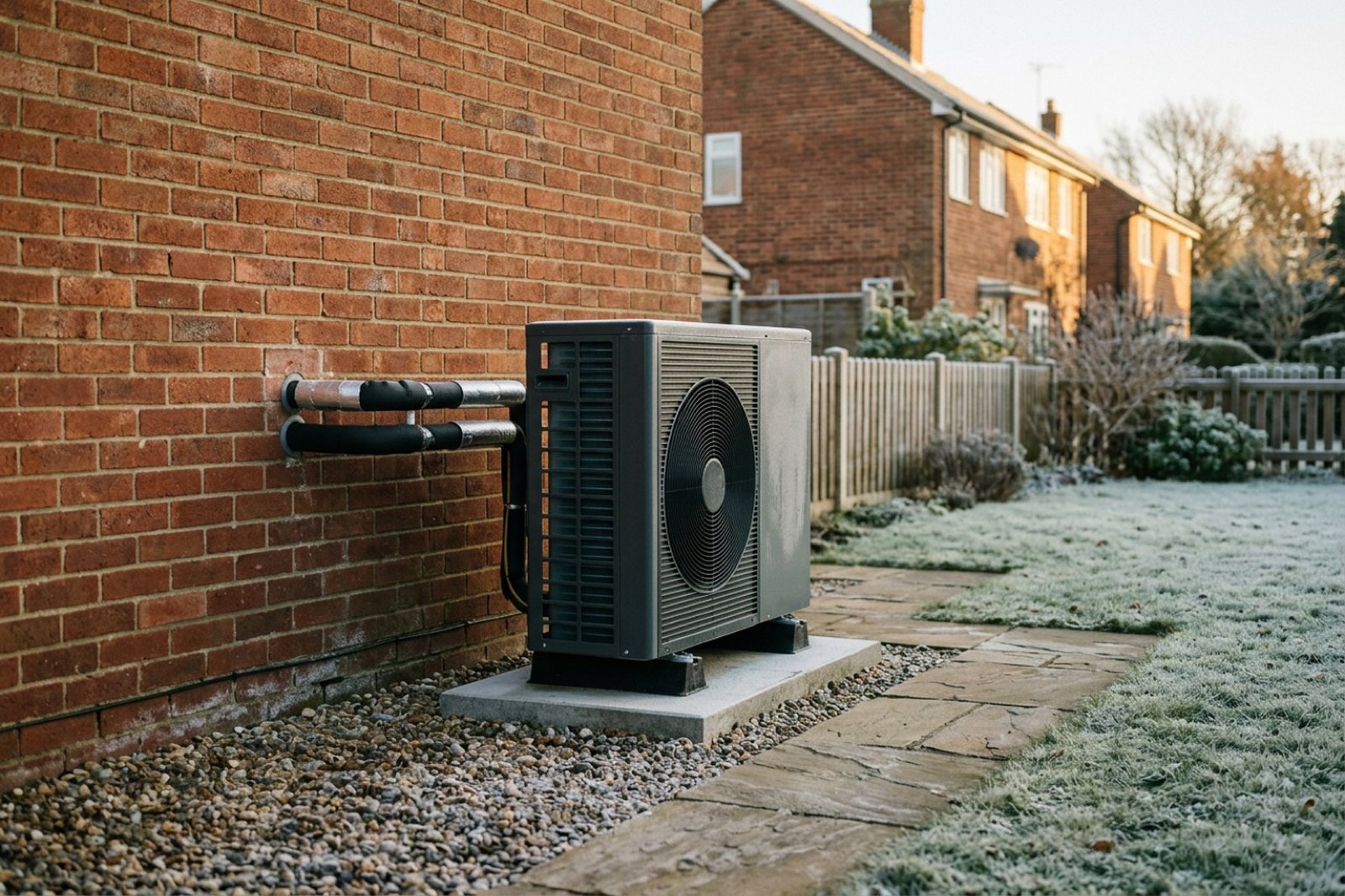
We cannot say which type is better for every home, and found no source on how common each is. R290 has the lowest GWP and, in the manuals we read, the most detailed siting rules.
What is GWP, and are the rules changing?
GOV.UK describes carbon dioxide equivalent as “a measure of how much a gas contributes to global warming, relative to carbon dioxide”. You calculate it by multiplying the mass of the gas in tonnes by its GWP. A higher GWP matters if the gas escapes, which is why sealed circuits and leak checks matter.
On the rules, GOV.UK says the UK is “phasing down HFCs by 79% by 2030” against average use in 2009 to 2012, and that it covers mixtures. R32 and R410A are both HFCs, so both are inside it. GOV.UK tells users of HFC equipment to ask suppliers about alternatives, and manufacturers to use lower-GWP gases. As we read it, that limits supply of the gas rather than banning your heat pump.
GOV.UK also keeps a list of F gas bans in new products. Its air conditioning and heat pump table covers cars, movable air conditioning and, from 2025, single split systems under 3 kg with a GWP above 750. It lists air-to-water single split systems as an exception to that last ban, an exception GOV.UK says it added on 27 August 2026. We found no entry banning R32 or R410A in air-to-water heat pumps. Caution: the legislation.gov.uk text of the underlying regulation (Annex III of Regulation 517/2014) states that ban without mentioning the exception, so we rely on GOV.UK’s wording. These are Great Britain rules and can change; we found no date after which a given refrigerant becomes unavailable, so ask what your installer would use to service your unit in future.
Are heat pump refrigerants flammable?
R32 and R290 are, to different degrees. The US EPA reproduces the ASHRAE Standard 34 safety classification: the letter (A) shows lower toxicity, and the number shows flammability. Class 1 means no flame propagation; class 2L is lower flammability, with a maximum burning velocity under 10 cm/s; class 3 is higher flammability. The EPA lists R410A as A1, HFC-32 (R32) as A2L and R-290 (propane) as A3.
That is the reason for the extra rules, not a reason to rule these units out. The EPA says refrigerants can bring risks including toxicity and flammability, and that “system design, engineering controls, and other techniques mitigate this risk”. Grant’s R32 manual warns against installing where flammable gas could leak around the unit, such as from an LPG cylinder, and says leaked refrigerant exposed to fire may produce poisonous gas. We have not found a source that puts a number on the risk of a refrigerant fire, so we do not.
What flammability means for where the unit goes
For R290, quite a lot. Vaillant’s manual says propane is denser than air, so a leak “may collect near the ground”. It defines a protective zone with no windows, doors, cellar entrances or ventilation openings, no ignition sources such as plug sockets, light switches or lamps, and no extension of the zone to adjacent buildings or public traffic areas. It adds that you may not make later structural alterations that break those rules. Ecogenica’s manual gives a safety zone of 250 mm at the back, 1500 mm at the front and 250 mm each side, and says there must be no depressions or excavations in it.
These distances are examples, not a standard. For R32, Grant describes its published clearances as minimums for commissioning, servicing and airflow, so they are not like-for-like with an R290 safety zone. Our guide to where to put a heat pump outdoor unit sets the manuals side by side.
- Tight plots. A zone that must stay clear of openings and not reach adjacent buildings or public areas can be harder to meet on a narrow plot. See heat pumps in terraced houses. Ask the surveyor to check it against the manual for the model quoted.
- Later changes. If you have an R290 unit, ask before adding an outside socket or light, a door or a drain near it. That is our reading of the manuals, not a rule we can quote for your model.
Is the refrigerant sealed in, and can it leak?
Grant’s manual says: “The refrigerant is hermetically sealed within the heat pump.” The Energy Saving Trust says a heat pump “in many cases is a monobloc unit and is precharged with the refrigerant gas”. Split systems differ: the Energy Saving Trust says refrigerant, not system water, is piped between the units and that “a registered F-gas engineer is required to fit this pipework and charge the system”, and the MCS installation standard, MIS 3005-I, has a commissioning line for split systems only, recording that the system was evacuated and charged by an F gas registered operative.
Sealed does not mean it can never leak. One manual points out that its refrigerant is “colourless and odourless, making leaks hard to detect”. Grant says the refrigerant must never be vented, and Vaillant tells engineers to use a gas sniffer before opening the unit. If you suspect a leak, call your installer or the manufacturer and do not open the unit; that advice is ours, not a quotation.
Who is allowed to handle refrigerant?
For equipment holding F gas, GOV.UK says it is against the law to work with it without the correct qualifications, and you can receive a civil penalty. Individuals need a certificate to install new systems, service and maintain them, check for leaks, recover gas and decommission. GOV.UK lists four categories: category 1 for all activities, category 2 for installing, maintaining, servicing and recovering refrigerant from systems under 3 kg of F gas (6 kg if hermetically sealed), category 3 for recovery only, and category 4 for leak checks that do not break into the circuit. It names City and Guilds, BESA and LCL Awards as the accredited organisations.
GOV.UK’s company page adds that a business servicing stationary air conditioning and heat pump equipment for others must be certified by an approved body, and names Refcom Certification, F-Gas Register (Quidos) and Bureau Veritas. That page was last updated in 2019, so ask the company for evidence rather than relying on a list.
There is a wrinkle. The Energy Saving Trust says that because a monobloc is often precharged there is “no requirement for F-Gas trained engineers” to install it, while GOV.UK lists installing new systems among the activities that need qualifications. We have not found a source that reconciles the two, so ask your installer which applies to your model.
Propane is not an HFC, PFC or sulphur hexafluoride, so we read it as outside the F gas qualification rules. It is not outside any rules: Vaillant says anyone opening the unit needs knowledge of R290’s particular risks, and that work on the refrigerant circuit needs specialist knowledge of flammable refrigerants, the right tools and protective equipment. We did not find a named UK qualification for propane heat pumps in the sources we opened, so ask the installer what theirs is.
Annual checks and leak checks
Our heat pump maintenance guide covers servicing. For refrigerant, GOV.UK’s leak-check page (last updated 2019) says that if you use a stationary heat pump containing F gas you are responsible for getting it checked for leaks, with frequency depending on the amount of gas and its GWP. The legal duty starts at 5 tonnes CO2 equivalent, with checks at least every 12 months from 5 to under 50 tonnes. For hermetically sealed units GOV.UK sets no maximum period below 10 tonnes. If a leak is found it must be repaired as soon as possible and the test repeated within a month.
- For R32, 5 tonnes is about 7.4 kg (5 ÷ 675 × 1,000) and 10 tonnes about 14.8 kg.
- Grant’s 0.80 to 2.80 kg R32 range is about 0.5 to 1.9 tonnes CO2 equivalent, below both thresholds.
- For R410A, GOV.UK’s table gives 2.4 kg as 5 tonnes; 10 tonnes is about 4.8 kg (10 ÷ 2,088 × 1,000). Check the label.
Below the threshold GOV.UK sets no interval, but manufacturers include a refrigerant check in their servicing: Grant’s maintenance list includes confirming there are no refrigerant leaks, and Vaillant’s manual has a section on checking the circuit for tightness. Because propane is not an F gas, we read GOV.UK’s leak-check rules as not applying to it, so the manufacturer’s schedule is what matters.
What to ask an installer, and where ByEco stands
- Which refrigerant does this model use, and how many kilograms? MIS 3005-I’s commissioning checklist has a line for refrigerant and charge.
- What are its GWP and safety class (A1, A2L or A3) and where is that shown in the manual?
- Does the proposed position meet the manual’s safety zone or clearances, and will you show me?
- Who handles any refrigerant work, and what F gas certificates or company certification do they hold?
- Does the annual service include a refrigerant leak check, and what should I avoid fitting near the unit?
We are MCS certified for air source heat pump installation (certificate IAA10330), and we apply for the £7,500 Boiler Upgrade Scheme grant on your behalf. You may be eligible for it: see our grant guide. Cost depends on the property, so get in touch for a free survey and an itemised quote, and ask which refrigerant the model uses and where the unit could go. If you are happy with the quote, we go ahead. See our air source heat pump service, our guide to comparing quotes or book a free survey.
Sources
Every figure on this page was checked against primary sources on 5 November 2026. Grant rules, planning rules and prices change — if you are reading this much later, verify before acting.
- GOV.UK — Qualifications to work with F gas
- GOV.UK — Company certification to work with F gas
- GOV.UK — Checking F gas equipment for leaks
- GOV.UK — Calculate the carbon dioxide equivalent quantity of an F gas
- GOV.UK — Fluorinated gases (F gases): GWP tables and HFC phase-down
- legislation.gov.uk — Regulation (EU) 517/2014, Annex III (retained GB version)
- GOV.UK — Bans on F gas in new products and equipment: current and future
- US EPA — Substitutes in residential and light commercial air conditioning and heat pumps (SNAP)
- US EPA — Refrigerant safety (ASHRAE Standard 34 classification)
- Energy Saving Trust — Heat pump installer toolkit: what is a heat pump?
- Energy Saving Trust — Heat pump installer toolkit: gas boiler and heat pump differences
- Energy Saving Trust — Heat pump installer toolkit: pipework insulation (split systems)
- MCS — MIS 3005-I:2025 Heat Pump Installation Standard (commissioning checklist)
- Grant UK — Aerona³ R32 installer manual (doc 0136, rev 2.4, February 2024)
- Grant UK — Aerona³ user instructions (doc 0112, rev 1.1, January 2023)
- Vaillant — aroTHERM plus VWL 35/6 to 75/6 A S2 installation and operation manual (R290)
- Ecogenica — Outback installer manual (PDF dated 31 July 2026): R290 safety zone
Book your free home survey
Every home is different. The cost depends on the size of system, any radiators that need upgrading, the pipework and where the outdoor unit goes. Get in touch and we will arrange a free survey of your home and give you a clear quote. If you are happy with it, we can go ahead.