The short version
- Both are big, long-running loads. SP Electricity North West says an electric car and a heat pump can each use as much electricity as a domestic power shower, but for much longer.
- What matters is your main fuse and the maximum demand of the whole home, including existing equipment. Your installers work that out; do not guess from the size of either device.
- Manchester’s network operator is SP Electricity North West. The ENA’s combined flow chart says an installation with both a charger and a heat pump follows the apply route, before connecting, not a notification afterwards.
- Home chargers sold by businesses since 30 June 2022 must have smart features, including default off-peak charging hours you can change. These rules cover the charger, not your fuse.
- Tell your heat pump installer about the charger, and your charger installer about the heat pump, at the survey.
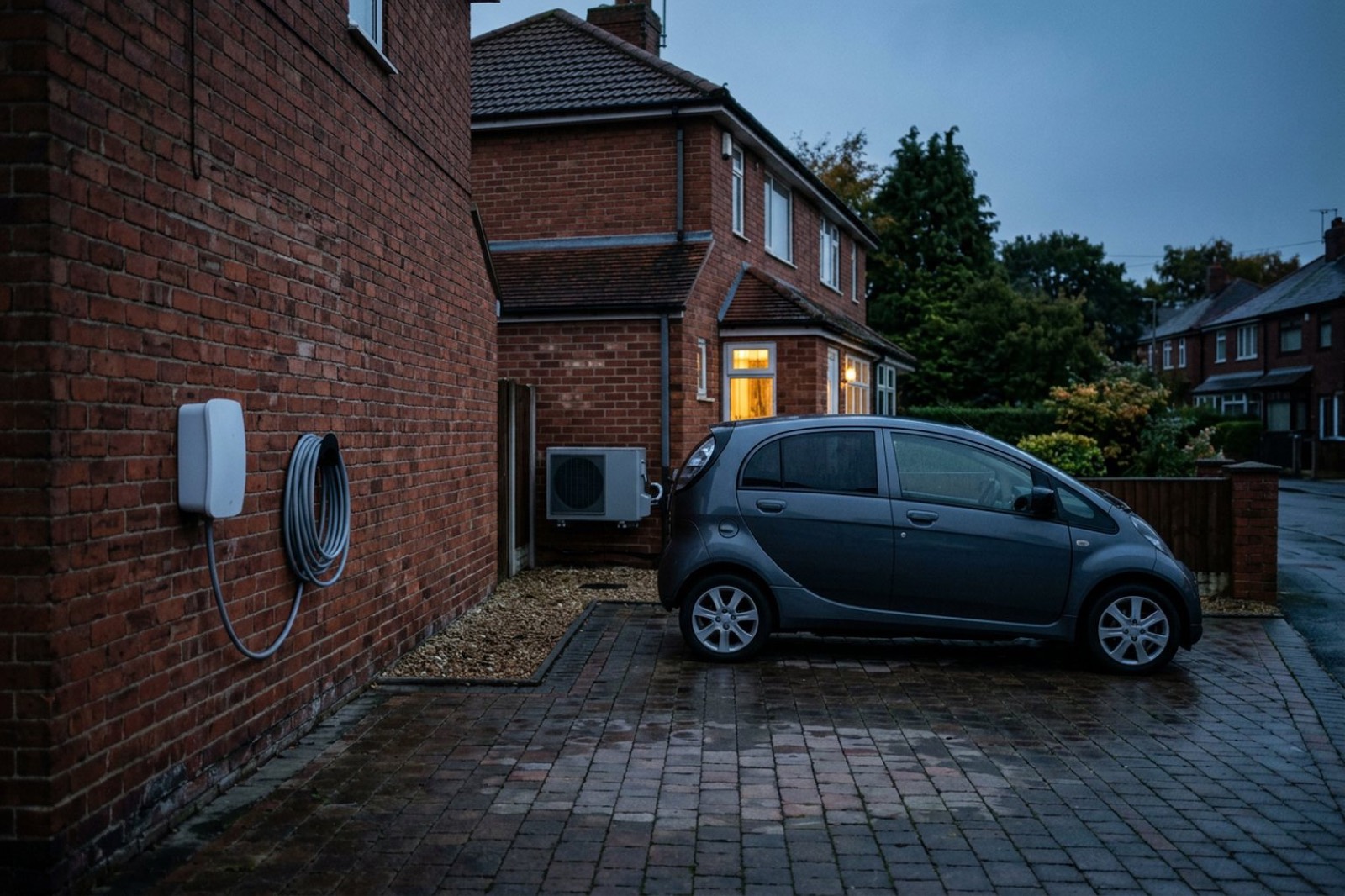
If you are planning an electric car and a heat pump, or already have one of them, the sensible question is not “will they fit?” but “will my supply cope when they run together, and who needs to be told?” For the supply side in more depth, see whether you need an electricity supply upgrade.
Why a heat pump and a car charger need planning together
SP Electricity North West, the network operator for Greater Manchester, says on its heat pump page that heat pumps can use as much electricity as a domestic power shower, but for much longer. Its electric vehicle page says the same about cars. That is why networks want to know about both.
The Energy Networks Association (ENA), which represents the network operators, says overloading a connection happens when several high-demand appliances are used at the same time, and that an electric car is likely to be the largest single draw. So the risk is overlap, and how much your home can take is a calculation for your installers.
It is not a one-off calculation either. If you fit the heat pump first and the charger later, the second installer must count the heat pump as existing load. Tell the first installer what is coming.
What decides whether your supply can take both
Your home’s supply ends at the cut-out, the unit that houses the main fuse. The national connection form used for both heat pumps and car chargers asks for a load survey, which it says should cover the existing maximum demand of the whole premises, the new equipment and any import or load limiting devices. It also asks for details of existing car chargers, electric heating, battery storage, solar panels and other large loads. Four things are looked at:
| What is looked at | Why it matters for a heat pump plus a charger |
|---|---|
| Main fuse (cut-out) rating | It sets the ceiling. If it is unknown, the network operator can confirm it, and nobody should open the cut-out unless authorised. |
| Maximum demand of the whole home | The ENA defines this as a figure that assumes not every load runs at once. |
| Looped supply | The ENA says this is where more than one service cable ends in a cut-out, so other homes are connected through it. It rules out the simple notification route. See our supply guide. |
| Any load limiting | A device that caps the demand can reduce what has to be planned for, but it must be declared and allowed for in the calculation. |
MCS’s heat pump design standard says the installer must make sure the electricity supply is adequate for the size of heat pump specified. Approved Document P, the electrical safety part of the Building Regulations in England, says the existing installation should be checked so that the equipment, including the distributor’s, can carry the additional loads arising from new work. The same thinking applies to adding a charger. The form warns that reinforcement costs may be charged to the customer; whether that applies depends on your property.
Telling your network operator
If you live in Cumbria, Lancashire, Greater Manchester or parts of Derbyshire and Cheshire, your network operator is SP Electricity North West, which still uses the name Electricity North West on some pages. Anywhere else in England and Wales it will be a different company. The ENA says digits 9 and 10 of the full 21-digit supply number (MPAN) on your bill are the distributor ID, which identifies the operator, and the operator will be on the paperwork your installer completes.
Heat pumps and car chargers use the same national form, which the ENA now calls its legacy form because installers can also apply through an online platform, ENA Connect Direct. The form has two routes:
- Connect and notify. If every criterion is met, the installer connects the equipment and tells the operator within 28 days. The first criterion is that only one additional piece of equipment, a car charger or a heat pump, is being connected.
- Apply to connect. If any criterion cannot be met, the application goes in before the equipment is connected.
For a heat pump and a charger together, the ENA’s combined flow chart (version 1.3) says the operator will need to consider the power quality implications, so the apply route should be followed. The form agrees: tick more than one type of equipment and “this must be an application”. So fitting both in one project is an application, even if each would have been a simple notification alone. That is not a barrier to doing both, but build the time into your plans. Other criteria include a known cut-out rating, no safety concerns with the operator’s equipment, a metered supply, not a looped service, and maximum demand below the cut-out rating. For ordinary whole-current metering, maximum demand must also stay below 13.8kVA per phase (60A) unless the load is limited.
Load limiting needs care. The ENA’s FAQ and flow chart say that where a home’s existing demand is already above 60A, network operators will permit connect and notify for a new charger or heat pump, provided the existing connection has no issues and the new device is installed with a curtailment scheme that keeps the home’s overall demand to 60A or less whenever it is running. It adds that a limiting device must “fail safe”. SP Electricity North West’s own charger page, however, lists “employing a load management scheme to manage the import, or export (applicable to sites with V2G)” among the questions where a yes means you apply to connect. The two sources do not say how they fit together, so ask your installer which route they are using and why.
Who sends it? Usually the installer: the operator’s page says it is general practice, and the Energy Saving Trust says the installer usually registers a charger for you. Ask for confirmation that it has been done.
Smart chargers and load management
The Electric Vehicles (Smart Charge Points) Regulations 2021 apply to chargers for cars and vans that are sold for private use in Great Britain, whether at home or at work. They exclude public and rapid chargers and chargers sold before 30 June 2022. The security requirements started on 30 December 2022. Businesses must not sell or advertise a covered charger unless it meets them. A charger must:
- be able to send and receive information and to respond to signals by raising or lowering the rate of charging or changing when it charges, so that it can take part in demand-side response;
- come with pre-set default charging hours outside peak hours, which the regulations define as 8am to 11am and 4pm to 10pm on weekdays, unless it is sold with a demand-side response agreement. You can accept, change or remove them when you first use it and afterwards, and you can override them;
- use a random delay of up to 600 seconds when charging starts or its rate changes, which you can cancel;
- keep charging if its internet connection drops, and keep its smart features if you change electricity supplier;
- measure the electricity it uses, and show you the figures.
Two practical points follow. First, the regulations do not cover a private individual selling a second-hand charger, so ask for the statement of compliance on a new unit. Second, the rules are about the charger as a product. They do not mention heat pumps, fuses or whole-home demand, so a smart charger does not automatically protect your fuse while the heat pump is running. The government has also consulted on new energy smart appliance regulations that would bring in these rules with amendments, so check what applies when you buy.
The fuse job belongs to load limiting, which is separate. The ENA says load limiting can allow a charger to be installed without upgrading your home, by briefly pausing and restarting the charger, which it says has minimal impact on an overnight charging session. Ask your installers whether it is included, and whether it is declared on the network operator’s form.
Tariffs: one cheap window or two?
The Energy Saving Trust says EV tariffs give one period of very cheap electricity in the early hours of the morning. That suits a car that can charge overnight. It suits a heat pump less well, and the Trust’s advice for homes with both is to look at a heat pump tariff instead, because you will not be able to use much of an EV tariff’s cheap-rate electricity to run the heat pump. The Trust adds that most of these tariffs apply to all the electricity in your home, so the choice is about the combined pattern, not the car alone.
You can then act on the tariff: the Trust says to programme the charger or the vehicle to charge in the cheap period, and that EV and other time-of-use tariffs typically need a smart meter. Our guide to heat pump electricity tariffs compares the types and explains why a heat pump’s load looks different from a car’s. Tariffs change often.
Solar panels, batteries and a car charger
If you have, or plan, solar panels with a heat pump, the car adds a third load that can use your own generation. Three points are worth knowing:
- Standard solar estimates leave the car out. MCS’s method for estimating how much solar electricity a home uses says extra self-consumption from heat pumps and electric vehicles is not accounted for.
- Tell the installer everything. The national form asks for existing car chargers, battery storage and generation such as solar panels, because they all feed into the maximum demand calculation. For vehicle-to-grid chargers, which can send power back, it applies a separate test on total generating capacity, including solar panels and storage, so say so early if you are considering one.
- Tariffs and export. The Energy Saving Trust says a home with an electric vehicle and solar panels can probably find a good export tariff from a company that also provides an EV tariff for import.
What your installer checks at the survey
Our guide to what happens in a heat pump survey sets out the whole visit. For this question, installers typically look at:
- the main fuse rating, the meter and whether the supply looks looped;
- the consumer unit, including the space for another circuit;
- earthing, which the IET Code of Practice for car charger installation, as summarised by the ENA, says must be assessed before a charger is fitted;
- your existing large loads, and any you plan to add, such as a car charger, battery or solar panels;
- the cable route to where the equipment will go. For a charger, that includes where you park, because the Energy Saving Trust says a home smart charge point generally needs off-street parking.
If a charger will follow within a year or two, ask whether the consumer unit and cabling should allow for it now, rather than reopening the same work later.
What to ask, and where ByEco stands
Ask your heat pump installer:
- Have you counted the charger, and any battery or solar panels, in the maximum demand calculation?
- What is my main fuse rating, and is my supply looped?
- Will you apply to the network operator, or notify afterwards, and who sends the form?
- Does the design rely on any load limiting, and is it declared on the form?
Ask your charger installer and electrician:
- Is the charger smart, with a statement of compliance, and can I set its charging hours?
- Has the supply been checked with the heat pump included, and will the operator be told?
We are MCS certified for air source heat pump installation (certificate IAA10330), and we apply for the £7,500 Boiler Upgrade Scheme grant on your behalf, where you may be eligible. We do not install electric car chargers, so you would use a separate chargepoint installer for that. If you tell us about a car charger, solar panels or a battery at the survey, we can take them into account. Get in touch for a free survey and an itemised quote, and go ahead only if you are happy with it. See our air source heat pump service, heat pump installation in Manchester, grants and rebates, or book a free survey.
Sources
Every figure on this page was checked against primary sources on 5 November 2026. Grant rules, planning rules and prices change — if you are reading this much later, verify before acting.
- Energy Networks Association — EVCP & HP Connections Form v3.4 (copy hosted by MCS)
- SP Electricity North West — Connecting small electric vehicle charge points
- SP Electricity North West — Heat pumps
- Energy Networks Association — Electric vehicle and heat pump connections
- Energy Networks Association — Frequently asked questions about connecting to the networks
- Energy Networks Association — Electric Vehicle Chargepoint and Heat Pump Combined Installation Process Flow Chart v1.3
- legislation.gov.uk — The Electric Vehicles (Smart Charge Points) Regulations 2021 (S.I. 2021/1467)
- GOV.UK — Regulations: electric vehicle smart charge points
- DESNZ — Smart Secure Electricity Systems programme: first phase energy smart appliances regulations (consultation)
- Energy Saving Trust — Tariffs for renewable technology (last updated 19 October 2026)
- Energy Saving Trust — Smart charging for electric vehicles
- Energy Saving Trust — Charging electric vehicles
- MCS — Notifying DNOs
- MCS — MGD 003: Solar PV self-consumption guidance, Issue 2.0
- MCS — MIS 3005-D:2025 Heat Pump Design Standard, Issue 2.0
- GOV.UK — Approved Document P: Electrical safety – dwellings, 2013 edition (England)
Book your free home survey
Every home is different. The cost depends on the size of system, any radiators that need upgrading, the pipework and where the outdoor unit goes. Get in touch and we will arrange a free survey of your home and give you a clear quote. If you are happy with it, we can go ahead.