Rochdale in short
- Rochdale town and Heywood have large numbers of Victorian brick terraces.
- Littleborough, Wardle and Milnrow sit on the Pennine edge, with more stone-built housing and colder, more exposed sites.
- Middleton includes large post-war estates, such as Langley, with cavity-walled houses that are often straightforward to convert.
- Design temperatures, radiator sizing and outdoor-unit siting vary a lot across the borough.
Few Greater Manchester boroughs cover as much variety as Rochdale. At its southern end, Middleton's estates are largely mid-twentieth-century houses with cavity walls. At its northern end, Littleborough and Wardle climb towards Blackstone Edge, where stone cottages and farmhouses face some of the hardest winter weather in the county.
Terraces in Rochdale and Heywood
Victorian brick terraces lose more heat through their solid walls than modern homes, but shared walls on both sides keep total heat loss lower than it first appears. The design work is in getting the flow temperature down — around 45–50°C — which usually means upsizing some radiators, and in finding a sensible spot for the outdoor unit in the rear yard.
The Pennine edge
Homes around Littleborough, Wardle and Summit are designed against colder outside temperatures than homes in the lower parts of the borough, and exposure to wind adds to the heat loss. Practically that means a slightly larger heat pump and more emitter capacity for the same floor area. Stone walls on older properties need breathable insulation approaches, and isolated rural homes that are off the mains gas grid often have the strongest running-cost case for a heat pump.
Post-war estates in Middleton
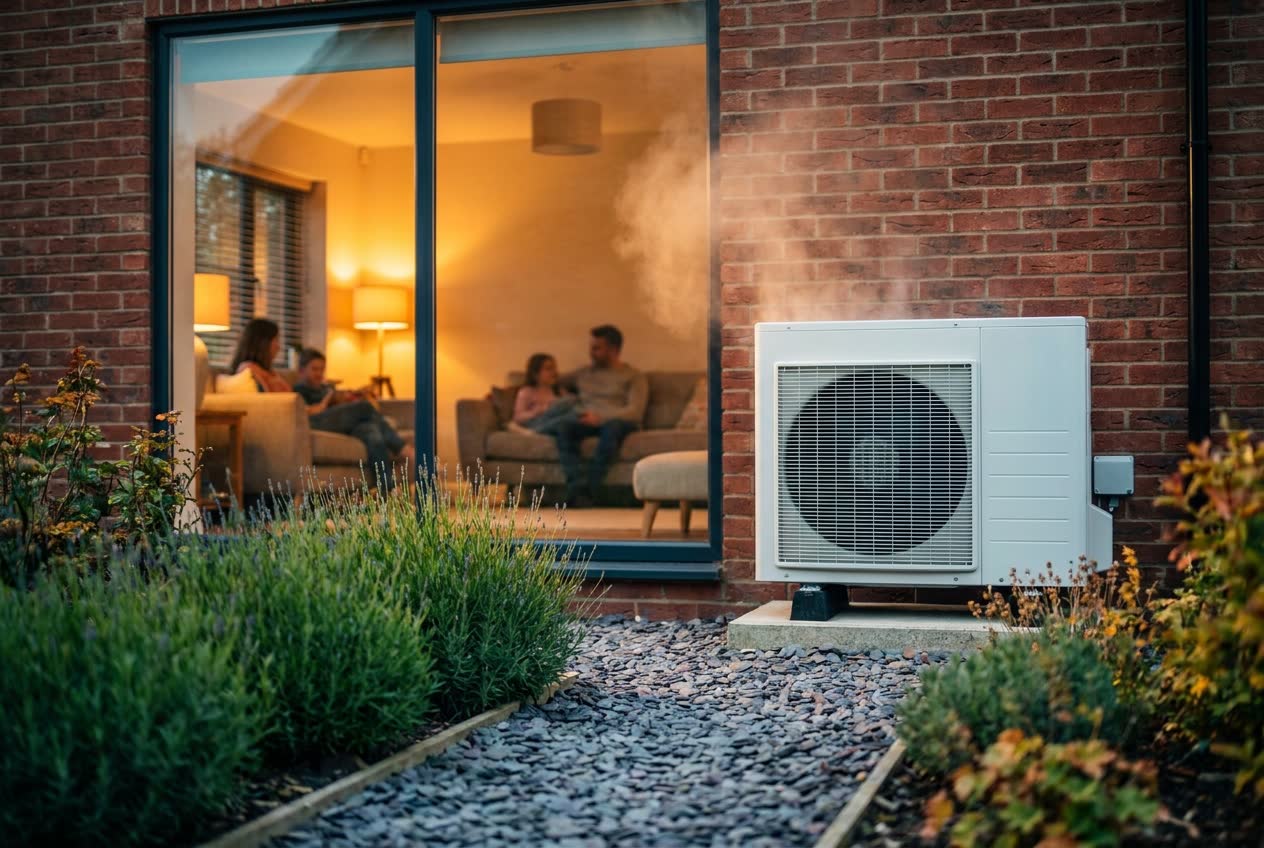
Semi-detached and terraced houses from the post-war estates usually have cavity walls, loft space and simpler layouts. End-of-terrace and semi-detached homes often have side access for the outdoor unit. These are frequently the most straightforward heat pump installs in the borough, subject to the same room-by-room design.
Former council homes and housing associations
Many houses on the post-war estates in Middleton and Heywood were bought by their tenants and are now privately owned. Those homes can use the Boiler Upgrade Scheme in the same way as any other owner-occupied house. Homes still rented from a council or housing association are different: social housing is not eligible for the scheme, so heating upgrades there are a matter for the landlord. If you own a former council home, the practical questions are the usual ones — cavity wall and loft insulation, radiator sizes, and whether there is side access or a rear garden for the outdoor unit.
Most air source heat pumps in England go in under permitted development rather than a full planning application. They are still conditional — there are limits on the size and siting of the unit, and an MCS 020 noise assessment is normally part of demonstrating compliance. Conservation areas, listed buildings and flats are treated differently, and the council's planning team is the authority on your specific address. Assume nothing; check first.
Rochdale Borough Council's planning team is the authority on your specific address.
Grants available in Rochdale
The Boiler Upgrade Scheme (BUS) covers England and Wales and is administered by Ofgem, so Rochdale homeowners are eligible on exactly the same terms as anywhere else in England. The amounts are fixed:
- £7,500 towards an air source, ground source or water source heat pump.
- £5,000 towards a biomass boiler — off gas grid, rural, emissions certificate required.
- £2,500 towards an air-to-air heat pump. Residential only.
For an air source, ground source or water source heat pump the grant is £7,500, on the same terms from Middleton to Littleborough.
Two details worth knowing. First, you no longer need an EPC — that requirement was removed on 28 April 2026, which means outstanding loft or cavity wall recommendations can no longer block an application. Second, the grant voucher for an air source heat pump is valid for three months from the date it is issued, so the installation has to be completed within that time — the grant is not something to sit on. The MCS-certified installer applies for you and takes the grant off your bill; you never handle the money yourself.
Separately, domestic heat pumps, solar and battery storage are currently at 0% VAT, which is due to end on 31 March 2027. Our full write-up is in the Boiler Upgrade Scheme explained.
Where ByEco stands right now. Boiler Upgrade Scheme applications can only be lodged by an MCS-certified installer. ByEco has MCS & TrustMark certification in progress and cannot submit a BUS application on your behalf yet. If you are planning work to a fixed date, tell us the date and we will say honestly whether we can meet it or whether you should go elsewhere.
Solar in Rochdale
Exposed hillside homes can have good unshaded roofs, but they also take the weather, so fixings and roof condition matter. In terraced streets, the direction the rows run decides whether roofs face south or east and west. East and west-facing roofs typically generate 15–20% less than south-facing ones. See are solar panels worth it, or try our solar size calculator.
Heat pump detail is on our heat pumps page. For prices, see what a heat pump costs in Greater Manchester; if you live in a terrace, can a terraced house have a heat pump? covers siting and planning. The other areas we cover are listed on our service areas.
Get a realistic figure for your house
Send us your postcode, roughly when the house was built and how it is heated now. We will come back with a straight answer about what would suit it — including if the answer is that the fabric work should come first.
Or email [email protected]. Our office is at 12–14 Midland Street, Manchester M12 6LB.