The short version
- Direct electric heating is about 100% efficient: one unit of electricity in, one unit of heat out. That covers storage heaters, panel and infrared heaters, electric radiators and electric boilers.
- A heat pump moves heat rather than making it. In the government-funded Electrification of Heat trial, air source heat pumps delivered a median 2.78 units of heat per unit of electricity over a year.
- At Ofgem’s October–December 2026 single-rate cap (26.32p per kWh), that is about 26.3p per kWh of heat from direct electric against about 9.5p from a heat pump at the trial median. Storage heaters on a cheaper night rate narrow that gap; how far depends on your night rate.
- The catch: homes with storage or panel heaters usually have no radiators or heating pipes, so switching usually means installing them.
- Replacing electric heating counts for the Boiler Upgrade Scheme: you may be eligible for £7,500 off an air source heat pump, claimed by an MCS-certified installer.
Electric heating is simple, cheap to put in and needs little maintenance. Its weakness is running cost.
Heat pump vs electric heating: which uses less electricity?
A heat pump, by a wide margin. SAP, the government’s method for rating the energy performance of homes, gives storage heaters, panel, convector and radiant heaters, oil-filled radiators and direct-acting electric boilers an efficiency of 100%. Nothing is lost, but nothing is gained either.
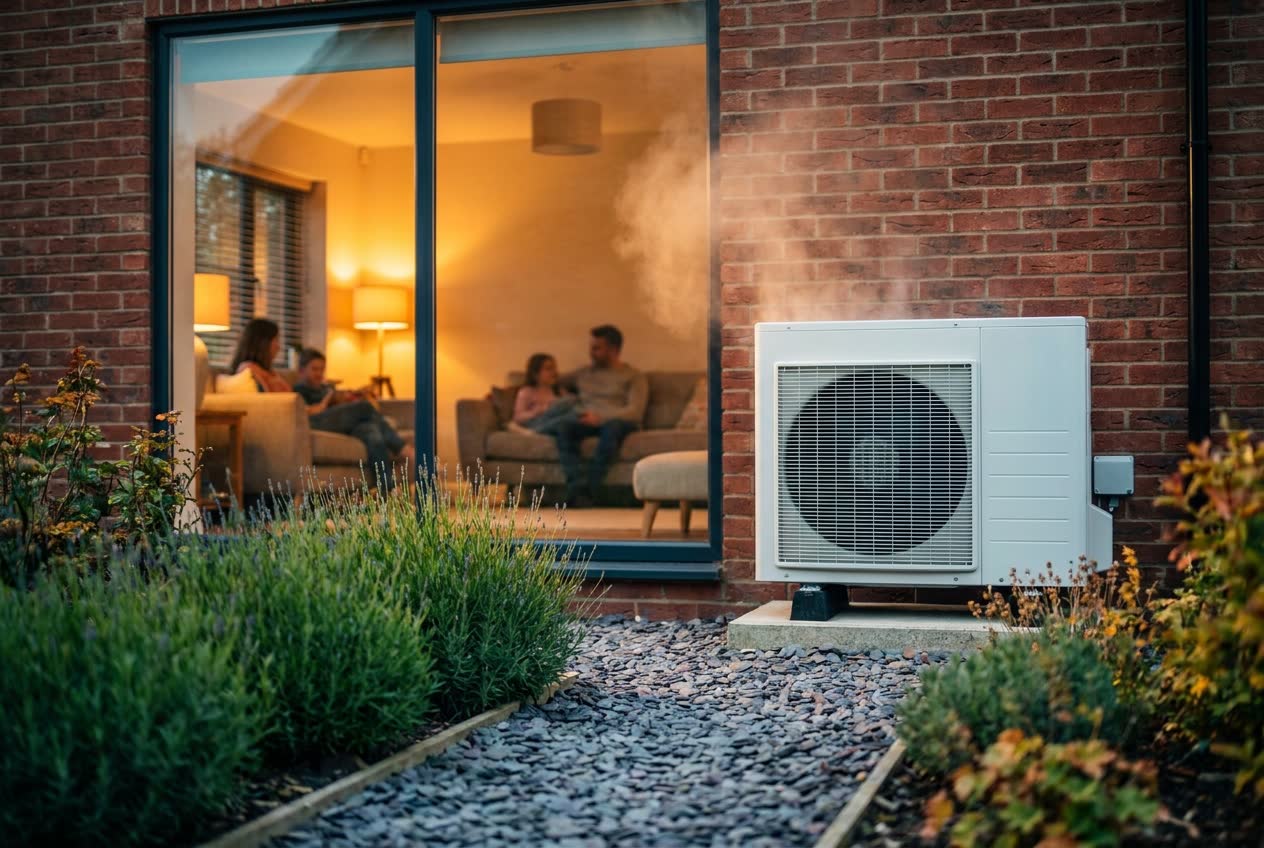
A heat pump uses electricity to move heat from the outside air into your home (see how an air source heat pump works), so it delivers more heat than the electricity it uses. The Electrification of Heat project, funded by the Department for Energy Security and Net Zero (DESNZ), installed and monitored 742 heat pump systems. Across 428 air source heat pumps with a full year of data, the median seasonal performance factor was 2.78, with the middle half of homes between 2.55 and 3.05. That figure covers the whole system, including back-up heaters and circulation pumps.
The Energy Saving Trust says heat pumps are “about three times more efficient than standard electric heaters”.
That is a much stronger case than against gas. At the October–December 2026 cap, electricity costs about 3.3 times as much per kWh as gas, so a heat pump must work hard just to match a gas boiler (see our heat pump vs gas boiler comparison). Against electric heating there is no fuel price gap to overcome: both run on electricity, though storage heaters use cheaper off-peak units (see below).
Running costs at the October–December 2026 price cap
The fairest comparison is the cost of each kWh of heat, which is the price of electricity divided by the efficiency. Here it is on a single-rate tariff:
| Heating | Efficiency | Electricity per 100 kWh of heat | Cost per kWh of heat |
|---|---|---|---|
| Storage, panel or infrared heaters, electric boiler | 100% | 100 kWh | 26.3p |
| Heat pump, trial lower quartile | 2.55 | 39.2 kWh | 10.3p |
| Heat pump, trial median | 2.78 | 36.0 kWh | 9.5p |
| Heat pump, trial upper quartile | 3.05 | 32.8 kWh | 8.6p |
An illustration, not a quote: our arithmetic using Ofgem’s price cap for 1 October to 31 December 2026 (26.32p per kWh, GB average, Direct Debit, single rate) and the Electrification of Heat seasonal performance factors. Standing charges are left out. Your heat pump’s performance depends on its design and installation. The next cap period starts on 1 January 2027.
At the trial median, a heat pump uses about 64% less electricity than direct electric heating for the same heat. That is not a promise: a badly designed system will do worse.
What about Economy 7 and storage heaters?
To be fair to storage heaters, they charge overnight on an off-peak rate such as Economy 7. Ofgem does not publish capped day and night rates: suppliers set them, and Ofgem says that “together, they cannot be more than the price cap”. So check your bill for your own night rate and apply a simple test. A storage heater’s heat costs whatever you pay for the electricity, so to match a heat pump at the trial median on the single rate, the electricity it uses would have to average about 9.5p per kWh or less, including any daytime “boost”.
Heat pumps can use cheaper rates too. On a time-of-use tariff, the Energy Saving Trust says you may be able to set hot water, and maybe space heating, to use the lower-priced hours. These tariffs charge more at other times, so you could still be better off on a standard tariff, and Economy 7 suits heat pumps poorly because they “often run throughout the day during the more expensive peak rate”. See running a heat pump efficiently.
Heat pump vs storage heaters
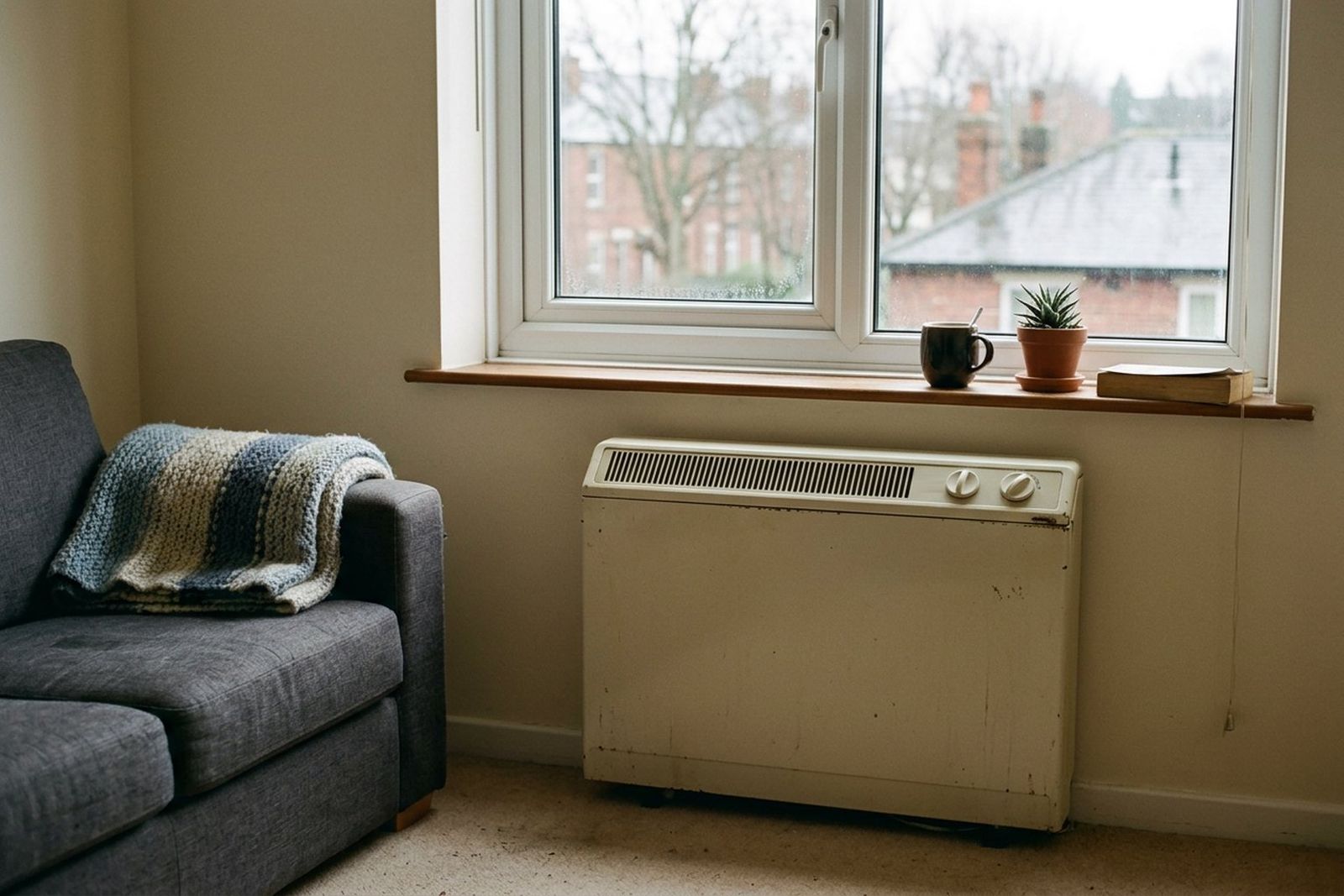
Storage heaters are the most common type of electric heating. Heavy bricks inside are warmed overnight on cheaper electricity and release the heat the next day. Older models have an input dial (how much heat is stored) and an output dial (how fast it comes out). The downsides:
- Running out by the evening. The Energy Saving Trust warns that if the output is set too high, “the heater may run out of heat before the end of the day”. Citizens Advice suggests keeping output low during the day so more is left for the evening.
- Planning a day ahead. You decide the night before how much heat you will need tomorrow. SAP rates old large-volume storage heaters at a responsiveness of 0.0, against 1.0 for panel heaters.
- Expensive top-ups. A “boost” heater uses peak-rate electricity. Citizens Advice says your bills might be high if you regularly use extra heat.
High heat retention storage heaters hold heat for longer and have automatic controls, but they still turn one unit of electricity into one unit of heat.
Still have a radio teleswitch (RTS) meter? Some homes with electric heating had one, switching between peak and off-peak rates by radio signal. Energy UK says the RTS phase-out was completed on 30 June 2026, and that without a replacement your heating or hot water may come on at the wrong times and your electricity costs could be much higher. If you still have one, contact your electricity supplier about a replacement meter, whatever heating you choose.
Heat pump vs electric boiler
An electric boiler heats water and sends it round radiators or wet underfloor heating, usually with a hot water cylinder. It is still 100% efficient, so the arithmetic above applies in full. The Energy Saving Trust says electric boilers are often paired with Economy 10, which gives three cheaper periods a day, and are more expensive to run outside those times.
An electric boiler home is usually the simplest switch, because the pipes and radiators already exist. Ofgem’s grant rules allow existing pipework, radiators and cylinders to be kept if they are in good condition and suitable. Some radiators may need to be larger, because a heat pump runs at lower water temperatures; see do I need new radiators for a heat pump?
Heat pump vs electric radiators, panel and infrared heaters
Panel heaters, wall-mounted electric radiators and infrared panels are “direct-acting”: they heat on demand, at whatever rate applies at the time. They are cheap to install and easy to control room by room. Infrared panels warm surfaces mainly by radiation, but the efficiency is the same 100%. The Energy Saving Trust says direct electric heating “typically has high running costs”, especially for a whole home or a poorly insulated one.
So what is the cheapest electric heating to run? The Energy Saving Trust ranks storage heaters as less expensive to run than direct electric heaters, and heat pumps as “often the most cost-effective electric option in the long run”.
Replacing storage heaters with a heat pump: what’s involved
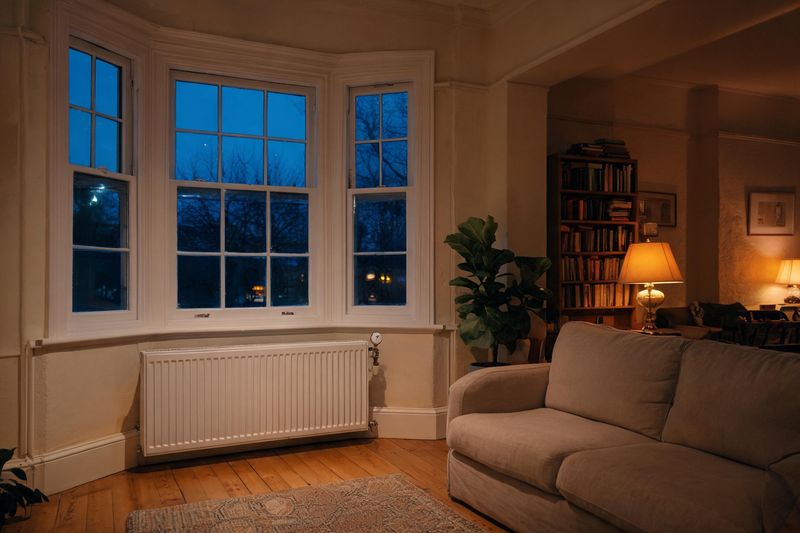
This is the part to take seriously. Storage, panel and infrared heaters do not need a “wet” central heating system, so homes heated only by them usually have no radiators or heating pipes. An air-to-water heat pump, the kind ByEco installs, heats water, so the job usually includes:
- New pipework and radiators (or wet underfloor heating), sized from a room-by-room heat loss calculation. This can mean lifting floorboards and some making good afterwards.
- Hot water. Citizens Advice says storage heater homes usually have a cylinder with immersion heaters. Whether that can be reused depends on the design, so your installer should spell out how hot water will be provided.
- An outdoor unit and the pipe run from it into the house.
- Any electrical work the installation needs.
You need not strip out every storage heater: since 28 April 2026, Ofgem allows grant-funded heat pumps alongside non-fossil supplementary heating, including storage heaters. But Ofgem still requires the heat pump to meet the home’s full space heating demand on its own, and the MCS design standard says it must cover the whole heat load “without input from any supplementary electric heater”.
Air-to-air heat pumps, which blow warm air into rooms, are another option; the Energy Saving Trust notes their suitability for homes without a radiator system. Our installation guide walks through each stage, and heat pumps in older houses covers insulation.
Electric heating to heat pump grant
The Boiler Upgrade Scheme covers replacing electric heating. GOV.UK says you must be replacing a heating system “such as oil, gas, electric or LPG”, and Ofgem’s guidance lists storage heaters, electric panel radiators and electric boilers as examples. In summary:
- You may be eligible for £7,500 towards an air source heat pump in England or Wales.
- You must own the property. Social housing and most new builds are excluded.
- You cannot get it to replace an existing heat pump, or for a hybrid with a gas boiler.
- Since 28 April 2026 you can apply without an EPC.
- An MCS-certified installer applies and takes the grant off your quote. An air source voucher lasts three months from the date it is issued.
For other routes, see heat pump grants and funding.
Who should switch, and who might wait
A heat pump is worth a serious look if you own a house heated mainly by electric heating and your bills are high, your storage heaters run out in the evening, or you have an RTS meter to replace anyway.
You might wait, or keep electric heating, if your home is small and well insulated. The Energy Saving Trust says that in a very well insulated or small property the higher running costs of direct electric heating “might not matter as much”, and that electric heating may suit a small flat. For flats, see can you get a heat pump in a flat? If you rent, only the owner can apply for the grant, so talk to your landlord.
What does switching cost?
There is no honest single figure; it depends on your home:
- The size of system your home needs, set by a room-by-room heat loss calculation.
- Radiators and pipework. A storage heater home usually needs a wet radiator system installing, while an electric boiler home may only need some radiators upsized.
- Where the outdoor unit goes, and how long the pipe run is into the house.
- Hot water and how it will be provided.
- Electrical work, including anything your supply or consumer unit needs.
The way to find your figure is a survey. Get in touch and we will arrange a free survey of your home and give you an itemised quote showing what your system needs; if you are happy with it, we can go ahead. See also our heat pump cost guide.
What to ask an installer, and where ByEco stands
- What heat loss did you calculate for each room, and what flow temperature is the design based on?
- Where will the new pipes and radiators go?
- How will hot water be provided, and can my existing cylinder be reused?
- What efficiency do you expect, and what does that mean for running costs on my tariff?
- What happens to my storage heaters, off-peak circuits and meter?
ByEco installs air source heat pumps in England and Wales. Our MCS and TrustMark certification is in progress, so we cannot yet apply for the Boiler Upgrade Scheme grant for you. If you are thinking of replacing electric heating, talk to us and we will tell you honestly what the switch would involve.
Sources
Every figure on this page was checked against primary sources on 12 October 2026. Grant rules, planning rules and prices change — if you are reading this much later, verify before acting.
- Energy Systems Catapult for DESNZ — Electrification of Heat Demonstration Project: Heat Pump Performance Data Analysis Report (December 2024)
- Ofgem — Energy price cap unit rates and standing charges: 1 October to 31 December 2026
- Ofgem — Energy price cap (default tariff) update from 1 October 2026 (26 August 2026)
- BRE for DESNZ — SAP version 10.3, Table 4a: Heating systems (12 June 2026)
- BEIS — Evidence gathering for electric heating options in off gas grid homes (Research Paper 2019/021)
- Energy Saving Trust — Electric heating (last updated 1 July 2026)
- Energy Saving Trust — Electric storage heaters (last updated 20 May 2026)
- Energy Saving Trust — Your heat pump questions answered (last updated 27 May 2026)
- Citizens Advice — Using storage heaters and immersion heaters
- Energy UK — The Radio Teleswitch Service switch-off: what you need to know
- GOV.UK — Apply for the Boiler Upgrade Scheme: check if you’re eligible
- Ofgem — Boiler Upgrade Scheme guidance for installers V5.1
- MCS — MIS 3005-D:2025 The Heat Pump Design Standard, Issue 2.0 (5 December 2025)
- legislation.gov.uk — Boiler Upgrade Scheme (England and Wales) Regulations 2022, regulation 15
Get a figure for your house
National averages only get you so far. Send us your postcode and a little about your home, and we will come back with a realistic price and an honest view on whether a heat pump suits it.