The short version
- Simple and steady suits a heat pump. Industry guidance describes weather compensation as the most critical control feature, alongside a timer or programmer and room temperature control.
- TRVs are a design decision, not a default. If they can shut off enough radiators to starve the heat pump of flow, the system needs a bypass or extra water volume. Your installer should say which applies.
- Zoning adds complexity. Separate time and temperature controls for each zone usually mean hydraulic separation, such as a buffer tank or low loss header, according to the same guide.
- One set of controls should lead. If a third-party smart thermostat is added, one system must be the primary control and you must be told which.
- Hot water has its own schedule. Where it is stored in a cylinder, the guidance says it needs a time control independent of the heating.
With a gas boiler you probably set a timer, a thermostat and a radiator valve in each room, and the boiler fired hard to catch up. A heat pump is different, and so are its controls. Our guide to running a heat pump efficiently covers the general habits and heat pump flow temperature explains weather compensation. This article is about the parts you can touch: thermostats, timers, radiator valves, zones and smart controls.
What controls does a heat pump need?
The most useful single source we found is a controls guide from the trade body BEAMA (October 2024), written for installers. It is industry guidance, not a regulation. It quotes Approved Document L of the Building Regulations, which applies in England (Wales has its own building regulations guidance, so ask your installer which applies to you). The paragraph it quotes says:
“The heat pump should have external controls that include both of the following. (a) Weather compensation or internal temperature control. (b) Timer or programmer for space heating.”
Paragraph 6.39 of Approved Document L (England), as quoted in the BEAMA controls guide (October 2024). We also checked this wording against the GOV.UK edition.
The same guide calls weather compensation “the most critical control feature” alongside time and temperature controls. The MCS installation standard (MIS 3005-I) says weather compensation should be enabled where it can optimise efficiency, and lets an installer leave it off where it would reduce efficiency or be of no practical value, for example with fan convectors, although the installer may be expected to explain why. The guide also admits that the requirements for heat pump controls “could be clearer”, particularly where TRVs are installed. In other words, this is an area where good installers make judgement calls, and where you should ask questions.
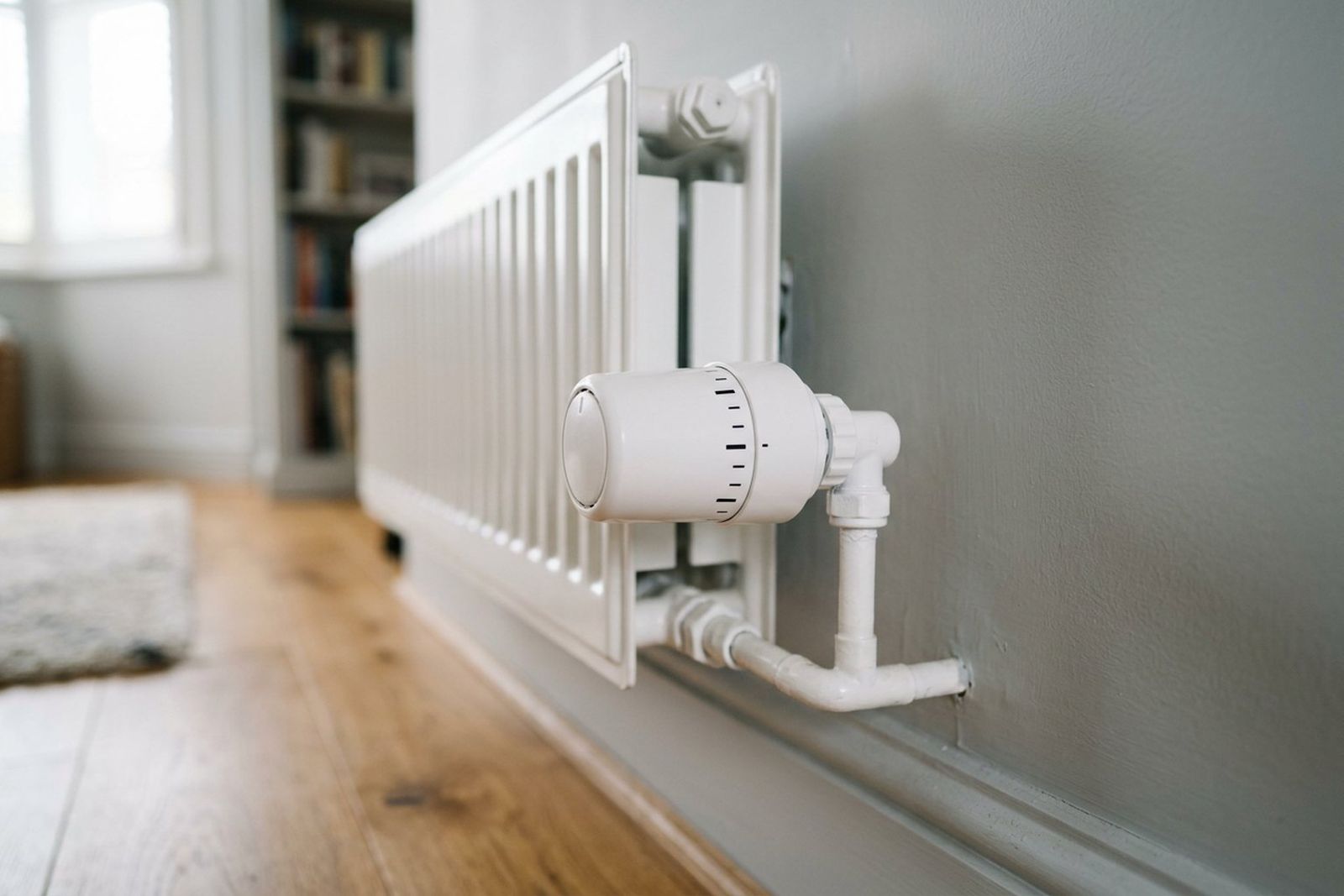
Heat pump thermostat: what it does
A room thermostat tells the system whether the house has reached the temperature you want. How it is used depends on the model and the design:
- As an on/off signal. One manufacturer’s installation manual describes heating being controlled “from a remote contact, e.g. an external programmer, motorised valves and/or a room thermostat”.
- As an input to the heat pump’s own controller. The Energy Saving Trust installer toolkit describes load compensation, where “the flow temperature is adjusted based on the internal temperature”, and says the combined approach is sometimes known as weather compensation with room influence.
The guide above adds that many heat pump controllers include both weather compensation and internal temperature control, so “care should be taken when commissioning and handing over the system to the homeowner”.
Where the thermostat sits matters because it speaks for the whole circuit. Approved Document L, as quoted in the guide, allows a thermostat in a room that the heating circuit serves, with valves on the other radiators, and says thermostatic radiator valves “should not be used in the same room as the thermostat”. A manufacturer’s manual for its remote controller says not to fit it in direct sunlight, damp or steam. We did not find a published rule about hallways or bedrooms, so we will not invent one: ask your installer which room is the reference room and why they chose it. University of Salford researchers fitted room thermostats alongside smart TRVs because it “reduced issues caused by the microclimates at the location of TRVs”.
Heat pump programmer and set-back
On timing, the BEAMA guide is direct: boilers are “designed for intermittent operation”, while “Heat pump systems are typically not operated on an intermittent basis and are usually designed to operate continuously for longer periods.” It adds that they typically offer a choice between a daytime and a set-back (lower) room or zone temperature.
That is the controls-specific point: a programmer for a heat pump is usually used to switch between two temperatures rather than between on and off. The Electrification of Heat householder leaflet makes the same point, and we cover the practical habits, including how big a set-back to use, in how to run a heat pump efficiently rather than repeat them.
One warning from the Salford test house. Researchers tried a whole-house set-back using smart TRVs on every radiator and found it “significantly increased heat pump cycling”; the report puts this down to the heat pump not being programmed to lower its flow temperature during the set-back periods. Their conclusion was that “whole house setback periods should be programmed using the heat pump controller, rather than smart TRVs on all radiators”. That was one test house and one heat pump, so treat it as a caution rather than a rule.
Do heat pumps need TRVs?
Not necessarily, and it is not an either-or. Approved Document L (England), as quoted in the guide, says that when a heat generator is replaced “each room should be provided with thermostatic room controls”, but it can be met in several ways, including one thermostat plus TRVs on the other radiators, or a thermostat for each room or zone. The Salford report notes that “TRVs are often omitted from ASHP installations based on concerns that they may reduce system efficiency and increase energy use”. The BEAMA guide describes an “open” single-zone circuit as one designed to operate effectively without radiator TRVs. It also says such a design may attract a homeowner request for extra zone controls, which then needs care to avoid short cycling.
The real issue: minimum flow and water volume
A heat pump needs water moving through it. If TRVs close, flow can fall too far. Three sources say the same thing in different words:
- Approved Document L, as quoted in the guide: “Wet heating systems should ensure a minimum flow of water to avoid short-cycling.”
- The guide: “Where TRVs (or eTRVS) are fitted, it is important to ensure that the minimum system volume is available at all times, especially where all TRVs and system valves are closed.”
- One manufacturer’s manual: “If thermostatic radiator valves are fitted to all radiators, a system by-pass must be fitted. The by-pass must be an automatic type and correctly set when the system is commissioned.”
Another manufacturer’s manual says that in installations “equipped primarily with thermostatic or electrically controlled valves, a constant and sufficient flow through the heat pump must be ensured”. In the Salford tests the circuit had an automatic bypass valve to keep flow when TRVs closed, plus a 25 litre volumiser (extra water volume). The report says “Using TRVs requires adequate volume within a system and flow rates to be maintained.”
The guide lists ways to deal with it: hydraulic separation providing enough volume, “an inline volumiser and by-pass valve arrangement”, or “a system bypass radiator in the reference room where the room thermostat is located which does not have a TRV fitted”. For more on volume, see do heat pumps need a buffer tank?
What commissioning looks like with TRVs
Grant’s Aerona³ manual shows how the bypass is set: fully open the TRVs and balance the radiators, then close every TRV, run the heat pump in space heating mode and open the bypass “until you detect that water is just starting to flow through it”. If the unit is modulating down, it is opened slightly more until the heat pump keeps running with all TRVs closed. Afterwards the TRVs are opened fully. That is one manufacturer’s procedure for one product; other heat pumps differ, so follow your own installer’s documents.
Using TRVs sensibly
The Salford report found that trimming the temperature of some rooms (about half the house’s internal volume, by 2–3 °C) with traditional or smart TRVs did not significantly affect the heat pump’s coefficient of performance in that test house. It advises that the first step is to lower the flow temperature until the worst-performing room is comfortable, with TRVs then “used to trim temperatures in other rooms”. It also cautions that the headline finding “may not be applicable to all occupancy behaviours, heating circuits and ASHPs” and that shutting off unused rooms was not tested. We therefore will not tell you how many valves are safe to close. Radiator sizing is a related question: see do I need new radiators for a heat pump?
Heat pump zoning: upstairs, downstairs and underfloor
Zoning means separate heating areas with their own time and temperature control. The guide says: “Consider that each zone will require its own time and temperature control so that they operate separately and independently.” It describes two cases: the same flow temperature but separate time or room temperature control, such as upstairs and downstairs, or two different flow temperatures, such as underfloor heating and radiators.
The catch with zoning is water volume. The guide says that, to keep minimum volume, “it is most likely a hydraulic separation (low loss header or buffer tank) will be required”, although it also says it may be possible to avoid a buffer tank “as long as the minimum volume requirements can be assured once all TRVs and system valves are closed”. It warns that homeowners “have two sets of time/temperature controls” and should be told so.
For a house that mixes radiators with underfloor heating, the guide says that where both share the same open loop meeting the minimum water volume, neither radiator TRVs nor underfloor manifold actuators must be fitted, and both are designed for the same flow temperature. If you want different temperatures for each, that is the zoned design above. Our underfloor heating guide goes further.
Room-by-room control is not always practical either. A note to the same paragraph of Approved Document L, as quoted in the guide, recognises that “installing thermostatic room controls may not be technically feasible in some cases”.
Smart thermostats and heat pumps
The Electrification of Heat trial gave participants a smart temperature controller with an app and/or wall display, and the householder leaflet says: “Avoid making changes to the installer settings, or to the heat pump itself, as this could make the heat pump system work less well.” We found no government test that ranks third-party smart thermostats on heat pumps, so we will not recommend a product or promise a result.
What the sources do support, in general terms:
- One boss. Where manufacturer and third-party controls both handle time and room temperature, “one of the systems needs to be the primary control. It must be made clear to the homeowner which one they are to interact with.”
- Check compatibility. “Installers must not assume that an existing control product within the building, such as a weather compensator, will be able to communicate with a new heat pump.”
- Look for features that lower the flow temperature. The toolkit describes active weather compensation as adjusting the curve automatically “by keeping the flow temperatures as low as possible”. A control that only switches heating on and off does not adjust the flow temperature in this way.
- Ask about smart TRVs on every radiator. In the Salford test they were linked to extra cycling when used for whole-house set-back, though that heat pump was not programmed to lower its flow temperature at the time.
Hot water controls
Hot water has its own schedule. The guide says that where hot water is stored in a cylinder, the Building Regulations require “a time control which is independent of the heating time control”, and that system controls must be able to raise the temperature for disinfection or pasteurisation. A hot water priority relay, as in Grant’s manual, “ensures that there can be no demand for space heating and hot water at the same time”. How your hot water is provided is a design choice for your installer to explain; see heat pump hot water.
Who sets the controls, and what to ask
The installer sets the controls and records them. MIS 3005-I requires that the system “shall be commissioned according to a documented procedure”, and its commissioning record asks whether the controls have been set up as per design, “demonstrated and explained to the customer”, and whether the customer has been given the documentation required. A manufacturer’s checklist has tick boxes for a room thermostat and programmer, and fitted or not required boxes for TRVs and an automatic bypass.
Questions to ask any installer:
- Which room has the thermostat, and are there any TRVs in that room?
- Are TRVs fitted elsewhere, and what keeps enough flow if they close (bypass, volumiser or buffer)?
- Are there separate zones, and how is minimum volume kept?
- Which controller do I use, and which is just for the installer?
- How is hot water scheduled separately from heating?
- Can I see the commissioning record showing controls set as designed?
ByEco is a Manchester installer working in England and Wales, and we explain the controls at handover. Our MCS and TrustMark certification is in progress; the £7,500 Boiler Upgrade Scheme grant can only be claimed through an MCS-certified installer, and you may be eligible — see our grant guide. What your system costs depends on your property: the size of heat pump it needs, any radiator or pipework changes, where the outdoor unit goes, hot water and electrical work (see heat pump cost in Manchester). Get in touch for a free survey and a clear, itemised quote, and decide only if you are happy. See also what to expect from an installation.
Sources
Every figure on this page was checked against primary sources on 27 October 2026. Grant rules, planning rules and prices change — if you are reading this much later, verify before acting.
- BEAMA — Controls Guide for Air-Water Heat Pump Systems (October 2024)
- University of Salford Energy House Labs for BEAMA — Air Source Heat Pump TRV Salford Energy House Test (January 2026)
- GOV.UK — Approved Document L, Conservation of fuel and power, Volume 1: Dwellings (2021 edition incorporating 2023 amendments)
- MCS — MIS 3005-I:2025 The Heat Pump Installation Standard, Issue 1.0
- Grant — Aerona³ air to water heat pump range: Installation and Servicing Instructions (DOC 0136 Rev 2.4, February 2024)
- Vaillant — aroTHERM plus VWL 35/6 to 75/6 A S2 installation and maintenance instructions
- Energy Saving Trust Green Heat toolkit — Weather compensation and other controls
- Energy Saving Trust Green Heat toolkit — System volume and frost protection
- Energy Systems Catapult — Electrification of Heat: Your new heat pump (householder guide)
- GOV.UK — Apply for the Boiler Upgrade Scheme: what you can get
Book your free home survey
Every home is different. The cost depends on the size of system, any radiators that need upgrading, the pipework and where the outdoor unit goes. Get in touch and we will arrange a free survey of your home and give you a clear quote. If you are happy with it, we can go ahead.