The short version
- Cooler radiators are normal. Judge the room, not the radiator.
- Long, steady running is normal. A cold house may take a few hours to warm up.
- Steam and light frost are normal. Never defrost the unit yourself, but keep it clear of snow and leaves.
- If gas used to heat your home, expect a higher electricity bill and a much lower gas bill if you still have one. Compare kWh, not just pounds.
- Leave installer settings alone and call about error codes, a unit iced solid, a breaker that trips or rooms that stay cold.
Most first-winter worries come from expecting a heat pump to behave like a boiler. This guide sorts what is normal from what is not. It is general advice: your own manuals and handover pack come first.
Why do my radiators feel cooler than with a boiler?
Because the water in them is cooler. Condensing combi boilers often have their flow temperature, the heat of the water sent to the radiators, set at 70–80°C by default. The low temperature heat pumps in the government-funded Electrification of Heat trial supplied heat at around 40°C. Your system’s design flow temperature may differ; it should be on your handover paperwork.
So the radiator will not feel hot in the way you are used to. The trial’s householder guide says this “doesn’t mean the system isn’t working” and suggests checking the app or wall display instead. For why some homes need larger radiators, see do I need new radiators for a heat pump?
They may not feel the same from day to day either. With weather compensation, the water gets hotter as it gets colder outside. The Grant Aerona³ user manual says radiators “will be warmer some days and cooler others” and that this is normal. See heat pump flow temperature explained.
Why does my heat pump run for so long?
Because it is designed to. The trial guide says a heat pump works best “on for long periods of time rather than short bursts”. It also compares the two: a gas boiler typically takes about half an hour to heat a house, whereas a heat pump may take a few hours if the house was cold.
That changes a few habits:
- Heating may come on earlier than you expect. The guide says this is normal, because the system needs time to reach the temperature you want by the time you want it.
- Turning the thermostat up will not make the room warm up faster. Check whether the set temperature has been reached. If it has and you are still cold, go up by a degree.
- Do not let the house get very cold. The guide warns it takes more time and energy to recover.
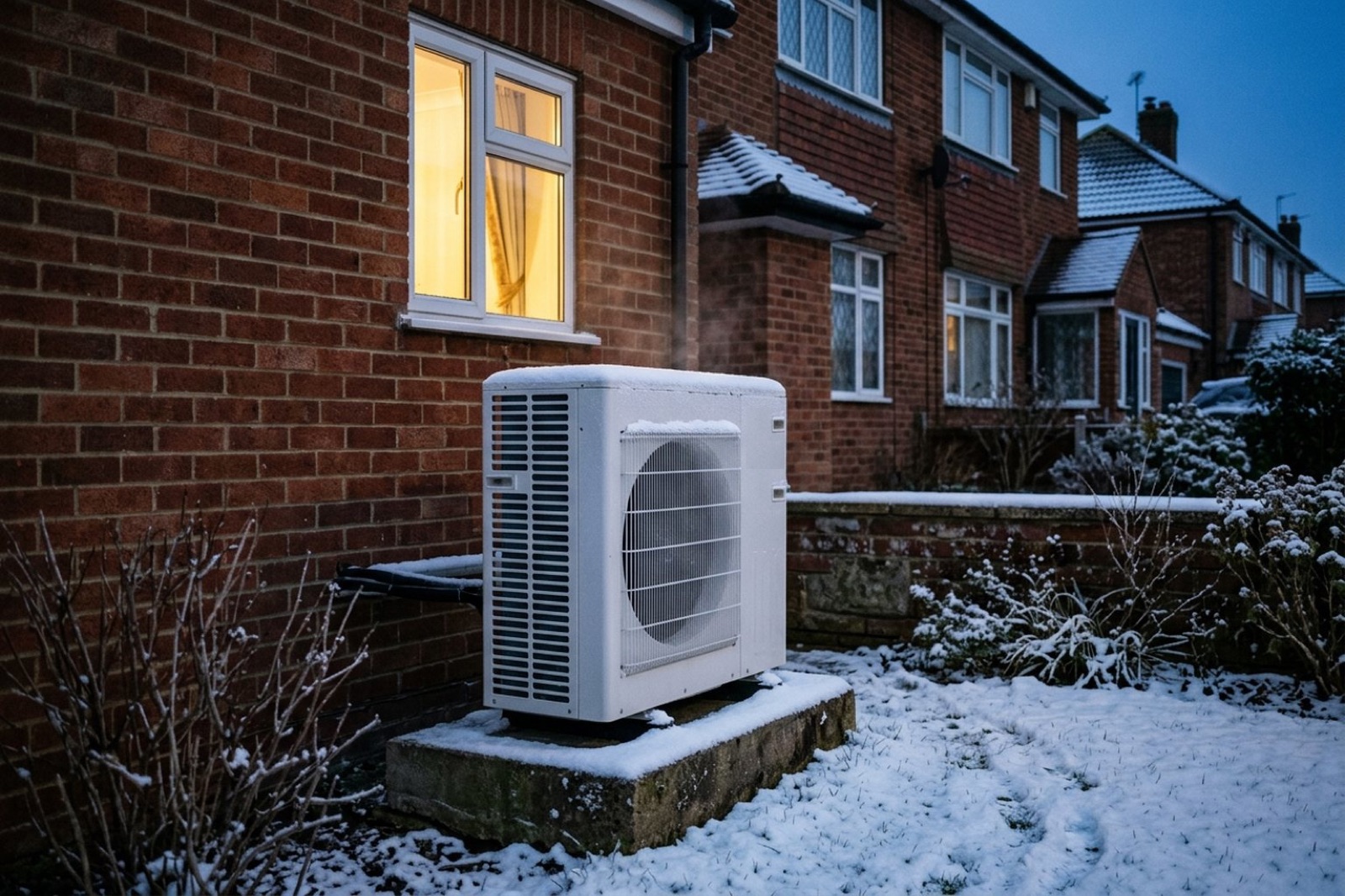
Steam, frost and ice on the outdoor unit
On a cold, damp day you may see a cloud of vapour rising from the unit. Vaillant’s manual for the aroTHERM plus says that if you do, “you do not have to do anything”, because it can happen during thawing.
Frost is expected too. The same manual says that below 5°C outdoors, condensation on the fins may freeze, and that the frost is detected and thawed automatically. It does not take a hard frost: the trial guide says a defrost can run “not only when it is freezing outside”, and a 2013 government-commissioned study said defrost was thought to be most frequent at outdoor temperatures of 5–7°C. During a defrost the unit may look as though it is working flat out, and your radiators can dip briefly. Our guide to the heat pump defrost cycle explains why.
Keeping the unit clear of snow and leaves
A heat pump needs air moving through it, so this is the one regular winter job that falls to you:
- Clear leaves, snow and other debris from the air inlet grille, and make sure the fan outlet is not blocked. The Grant and Vaillant manuals both ask for this. Stick to what comes away easily from the outside: do not use tools on the unit or push anything through the grilles.
- Clear snow that has gathered around the unit, not just on it. Vaillant says to do this regularly.
- Do not stack anything against it, such as garden furniture or bikes, and do not cover it. Grant’s manual warns against both.
- Look at where the water goes. A defrost produces meltwater, and Grant warns it must not run onto paths or driveways, where it can freeze into a hazard. If water is pooling or ice is forming on a path, tell your installer.
The trial guide also says heat pumps should be checked every year; see heat pump maintenance.
Your first winter bills: how to read them
If you used gas for heating before, expect your electricity bill to go up, because electricity now does the heating. The trial guide says your gas bill should then be a lot lower, if you still have one. Look at both together. For how the fuels compare, see heat pump vs gas boiler running costs. We make no promise about your own bills: they depend on your home, your tariff and the weather.
Before drawing conclusions, check:
- Is it based on real readings? An estimated bill or an old direct debit amount may still reflect how you used energy before the heat pump.
- Compare kWh, not just pounds. Prices change. There has also been no VAT on electricity since 1 October 2026, and Ofgem says costs cannot be compared directly with previous periods because of this. The Government said in the 2026 Budget that the cut will be extended until July 2027.
- Compare like with like. Heating demand is concentrated in the coldest months, so compare the same months from last year where you can, not December with October.
- Remember the gas standing charge. You keep paying it while the meter stays connected, although the Government has asked Ofgem to abolish it, aiming for the end of 2027 or as soon as possible after; see what happens to your gas supply.
- Check your tariff. The trial guide suggests asking your supplier or an independent adviser which electricity tariff suits a heat pump.
Worked example: what the charges on a bill mean
This uses the Ofgem price cap for 1 October to 31 December 2026 (Great Britain average, direct debit). The cap rates include 5% VAT on gas and no VAT on electricity. The next cap starts on 1 January 2027, and your rates will differ. The 100 kWh is a round number for the sums, not a forecast.
| Line on the bill | Cap rate | Example | Cost |
|---|---|---|---|
| Electricity used | 26.32p/kWh | 100 kWh | £26.32 |
| Electricity standing charge | 54.83p/day | 31 days | £17.00 |
| Gas standing charge, even at zero gas use | 29.68p/day | 31 days | £9.20 |
To judge a full year, find your annual heating and hot water demand and your SCOP (a seasonal efficiency figure; see our COP and SCOP guide). The MCS handover document has a place for all three, and your installer should have given you a performance estimate. Demand divided by SCOP gives a rough yearly electricity figure for the heat pump. It is a yardstick, not a promise, and one cold month will not match it. Your meter also counts everything else in your home, so use the heat pump’s own figure if your controls show one. If that looks far above the yardstick over a full year, ask your installer to check the system, including any backup electric heater. See also how much electricity does a heat pump use?
Which settings to leave alone
The everyday things are yours to change: the room temperature, the heating schedule, and a holiday setting if you have one. The trial guide says your installer will have set the controls to work efficiently, and to avoid changing installer settings or the heat pump itself, because that “could make the heat pump system work less well”.
- Weather compensation. This is the setting that matches water temperature to the weather. MCS’s installation standard says it should be enabled where it can optimise efficiency. Grant’s manual says operating parameters should be altered only by the installer or a Grant engineer. Ask your installer about any adjustment.
- Setbacks. Do not turn the heating off when you go out. The trial guide says to use the schedule to set it a few degrees cooler instead, including overnight. If the house struggles to recover, ask your installer.
- Hot water schedule. Some heat pumps pause space heating while they heat hot water, so ask how yours is set up before moving the times. Do not switch off any anti-legionella setting: on a Grant system with the optional immersion timer, the function will not operate if its isolation switch is off.
Once you know your system, how to run a heat pump efficiently covers fine-tuning. Do that only with the controls your installer has shown you how to use.
When something is actually wrong
The trial guide says to contact your installer rather than trying to fix a problem yourself. These checks can save a call, and none involve opening anything.
| What you see | What to check | When to call |
|---|---|---|
| Error code or warning light | Write down the code and take a photo of the screen. | Call, and quote the code. On a Grant Aerona³, a flashing red light on the controller signals a fault. |
| Rooms stay cold | Has the display reached the set temperature? Is the schedule on, and are radiator valves open? Is the heat pump running at all? | Call if the set temperature is not reached after a few hours, or one radiator stays stone cold. |
| Unit iced solid | Is snow or debris blocking the airflow? Clear that, but leave the ice alone. | Call if it stays iced up, or keeps defrosting without clearing. |
| Will not start, or breaker tripped | Is there power to the house? Is the outdoor isolator and any breaker for the heat pump on? | Call if it does not restart. If a breaker trips again, leave it off and tell your installer. |
If the unit has no power in freezing weather, say so when you call. If a problem is not resolved, MCS says to go to your MCS certified installer first, that 14 days is a reasonable maximum time to expect a response, and that you can then escalate it to MCS.
What happens to a heat pump in a power cut?
It stops, along with its controls, because it runs on electricity. In England and Wales, you can report a power cut online or by calling 105, at no charge. What matters next depends on how your system is protected from frost, and that varies:
- Grant says frost protection on its Aerona³ will not operate if the electrical supply to the heat pump is switched off.
- Vaillant says that on an aroTHERM plus with system separation and a water and frost protection mixture, the outdoor unit stays protected against freezing even in a power cut. Without that, it says to keep the product switched on.
- Vaillant also says that if you cannot keep the installation running during freezing conditions, a competent person should drain it.
So ask your installer now, not during a cold snap, which frost protection you have and what to do in a long power cut in freezing weather. If the product will not start once power returns, Vaillant says to check the power supply and disconnectors, then contact a competent person.
What to ask, and where ByEco stands
Before the first cold snap, ask whoever installed your system:
- What flow temperature was the system designed for?
- How do I set the schedule and setback, and what should I leave alone?
- How is my hot water provided, and when does it heat?
- Which frost protection do I have, and who do I call if a code appears?
Your handover pack should help. MCS says it includes a list of key parts, health and safety guidance, a maintenance schedule, the manufacturer’s manuals and your warranties.
We are MCS certified for air source heat pump installation (certificate IAA10330). If you are still deciding, read do heat pumps work in cold weather? and see our air source heat pump service. Cost depends on your property; see heat pump costs in Manchester, then get in touch for a free survey and an itemised quote. If you are happy with it, we go ahead.
Sources
Every figure on this page was checked against primary sources on 1 November 2026. Grant rules, planning rules and prices change — if you are reading this much later, verify before acting.
- Energy Systems Catapult — Electrification of Heat Demonstration Project: Your new heat pump (householder leaflet)
- Grant UK — Aerona³ User Instructions (DOC 0112 Rev 1.1, January 2023)
- Grant UK — Aerona³ R32 Installation and Servicing Instructions (DOC 0136 Rev 2.4, February 2024)
- Vaillant — aroTHERM plus VWL 35/6 to 75/6 A S2 operating and installation instructions (0020330791_03)
- Kiwa GASTEC at CRE for DECC — Investigation of the interaction between hot water cylinders, buffer tanks and heat pumps (2013), 5.3.2 Defrost
- Nesta — The impact of boiler optimisation on gas consumption and household comfort
- Ofgem — Energy price cap standing charges and unit rates
- MCS — Air source heat pumps: consumer guidance
- MCS — What to do if things go wrong
- MCS — Heat Pump Handover Document
- MCS — MIS 3005-I:2025 The Heat Pump Installation Standard, Issue 1.0
- MCS — MIS 3005-D The Heat Pump Design Standard, Issue 3.0
- MCS — Customer Commitment, MCS:2025 2.0, Issue 1.1 (redeveloped scheme)
- UK Government Be Ready campaign — Power cuts
- HM Treasury — Budget 2026
Book your free home survey
Every home is different. The cost depends on the size of system, any radiators that need upgrading, the pipework and where the outdoor unit goes. Get in touch and we will arrange a free survey of your home and give you a clear quote. If you are happy with it, we can go ahead.