The short version
- A heat pump is a strong replacement for an oil or LPG boiler, especially for homes off the mains gas grid, which have no gas-boiler option and run on relatively expensive, carbon-intensive fuel.
- The Boiler Upgrade Scheme covers replacing oil, gas, electric or LPG heating. You may be eligible for £7,500 towards an air source (air-to-water) heat pump in England and Wales, claimed for you by an MCS-certified installer.
- The heat pump must be sized to meet your home’s full space heating demand on its own. A heat pump that keeps the oil boiler as back-up is a hybrid, and hybrids are not eligible for the grant.
- Removing the oil tank frees up space and ends oil deliveries and the risk of running out. Existing radiators, pipework and the hot water cylinder may be reused or upgraded — that is decided at survey.
- Costs depend on your property, not a national average. Get in touch for a free survey and an itemised quote. ByEco’s MCS and TrustMark certification is in progress.
If your home is heated by an oil or LPG boiler, a heat pump is a credible, like-for-like replacement for your wet central heating: it warms the same radiators and hot water, from an outdoor unit rather than a tank of fuel. This guide covers why off-grid homes suit the switch, what it involves, and how the grant works.
Is a heat pump a good replacement for an oil or LPG boiler?
Yes, for most homes. An air source heat pump heats water and sends it round radiators or underfloor heating, exactly as an oil or LPG boiler does, and can provide your hot water too, so it replaces the whole system rather than sitting alongside it. The government’s Boiler Upgrade Scheme treats oil and LPG as fossil fuel heating you can replace: GOV.UK says you are eligible if you are “replacing fossil fuel heating systems – such as oil, gas, electric or LPG”, and Ofgem’s installer guidance lists a previous system fuelled by “gas, oil, LPG, coal” as qualifying.
The grant is specifically for an air source heat pump, sometimes called an air-to-water heat pump. One rule shapes everything else: the heat pump must be sized to meet your home’s full space heating demand on its own, which is why a proper survey and heat loss calculation come first (see what size heat pump you need).
Why off-grid homes are strong candidates
Homes off the mains gas grid are particularly good candidates for a heat pump, for a simple reason: a gas boiler is not an option, so the realistic alternatives are oil, LPG, electric heating or a heat pump. Oil (kerosene) and LPG are delivered and stored on site, their prices move with the global market, and both are fossil fuels burned in your home.
A heat pump changes the equation because it does not burn anything. It uses electricity to move heat from the outside air into your home, so it delivers more heat than the electricity it uses (see how an air source heat pump works and how much electricity a heat pump uses). In the government-funded Electrification of Heat project, which installed and monitored 742 heat pump systems, the air source heat pumps returned a median of 2.78 units of heat for each unit of electricity over a year, with the middle half of homes between 2.55 and 3.05.
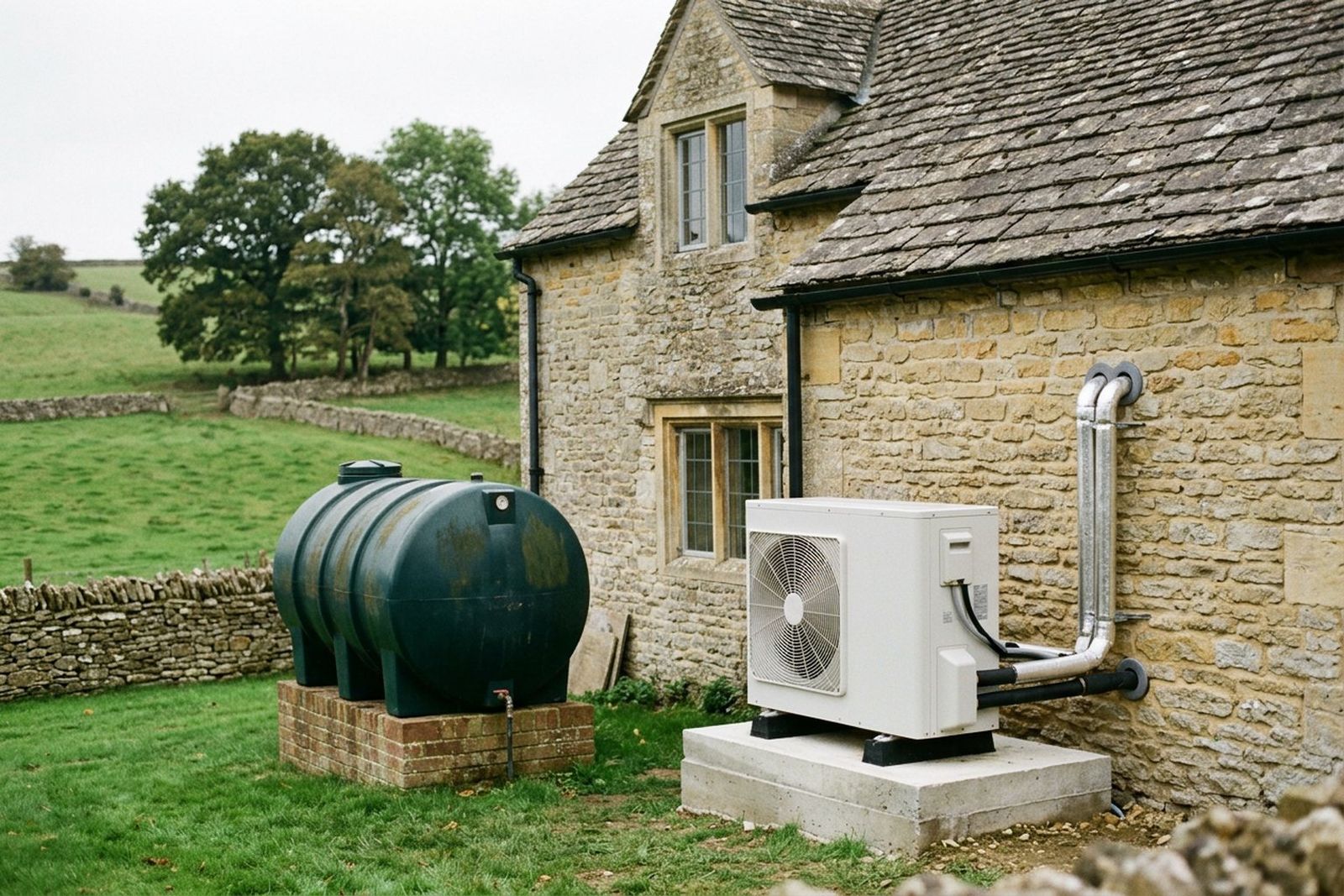
Running costs: oil, LPG and a heat pump
Be careful with running-cost promises: whether your bills fall depends on the current price of oil or LPG, which moves with the market, on your electricity tariff, and on how well the heat pump is designed. We will not promise a saving. What we can do is show what a heat pump costs to produce heat, and leave the oil or LPG comparison to a survey that uses your own figures.
At Ofgem’s price cap for 1 October to 31 December 2026, electricity is 26.32p per kWh (GB average, Direct Debit). Dividing that by the Electrification of Heat efficiencies gives the cost of each kWh of heat from a heat pump:
| Heat pump efficiency (trial) | Electricity per 100 kWh of heat | Cost per kWh of heat |
|---|---|---|
| Lower quartile, 2.55 | 39.2 kWh | 10.3p |
| Median, 2.78 | 36.0 kWh | 9.5p |
| Upper quartile, 3.05 | 32.8 kWh | 8.6p |
An illustration, not a quote: our arithmetic using Ofgem’s price cap for 1 October to 31 December 2026 (26.32p per kWh, GB average, Direct Debit) and the Electrification of Heat seasonal performance factors. Standing charges are left out, and a badly designed system will do worse. The next cap period starts on 1 January 2027.
Whether that beats your oil or LPG depends on what you pay for fuel at the time and your boiler’s condition. Oil and LPG prices rise and fall, and a tired boiler loses efficiency, so the only honest comparison is one built from your own recent fuel bills. A survey can do that. For how a heat pump compares with mains gas, which is a harder case, see heat pump vs gas boiler running costs; for electric heating, see heat pump vs electric heating.
Carbon: how oil and LPG compare
On carbon, the direction is clear. Heating oil (kerosene) and LPG are fossil fuels that release carbon dioxide when they are burned in your boiler. A heat pump burns nothing in the home; it runs on grid electricity, which is getting cleaner. In the 2025 edition of the UK government’s greenhouse gas conversion factors, the carbon intensity of UK electricity fell by about 15% on the previous year, “primarily due to less natural gas use in power stations and increase in net imports of electricity”.
Two things stack up in the heat pump’s favour here. The electricity itself carries less carbon each year as the grid decarbonises, and because a heat pump delivers roughly 2.78 units of heat per unit of electricity, the carbon attached to each unit of heat is lower again. Oil and LPG do not have that multiplier, and their carbon does not fall over time.
The practical switch: oil tank, pipework and radiators
Replacing an oil or LPG boiler brings some practical wins that a gas-to-heat-pump swap does not:
- The oil tank goes. Removing a bulky oil or LPG tank frees up space in the garden or driveway, and there are no more deliveries to book, no price to watch and no running out in a cold snap.
- Your wet system may be reused. Ofgem’s guidance says you do not have to remove every part of the existing system: pipework, radiators and the hot water cylinder “can be retained if they are in good condition and suitable” for the heat pump. Because a heat pump runs at a lower water temperature than a boiler, some radiators may need to be larger, which the survey works out room by room (see do I need new radiators for a heat pump?).
- Hot water is designed in. Oil and LPG homes usually have a hot water cylinder already. Whether it can be reused or should be replaced depends on the design, so ask your installer to set out exactly how hot water will be provided.
- An outdoor unit and pipe run. The heat pump sits outside, with insulated pipes running into the house; where it goes and how far it sits from the house both affect the job.
Our guide to what happens during an installation walks through each stage.
Rural, older and listed homes
Off-grid homes are often older, larger and more rural, so two things matter more than usual. First, fabric and sizing: a bigger or draughtier house loses more heat, so it needs a proper room-by-room heat loss survey to size the system and to check whether any insulation is worth doing first (see putting a heat pump in an old house). A heat pump works in an older home; it just has to be designed for it.
Second, planning. In England, permitted development rules changed on 29 May 2025: an outdoor unit can now be up to 1.5 cubic metres on a house, and a detached house may have up to two units. Listed buildings and conservation areas carry extra restrictions, and Wales has its own rules, so a rural or protected property is worth checking early. The old-house guide covers the planning points in more detail.
Keeping the oil boiler makes it a hybrid
A heat pump that keeps your oil or LPG boiler as back-up is a hybrid, and hybrids are not eligible for the Boiler Upgrade Scheme. GOV.UK is explicit that you cannot get a grant for “a hybrid heat pump system”.
The grant rules exist to replace the fossil fuel system, not to supplement it. Ofgem requires the funded heat pump to have enough capacity to meet the full space heating demand of the property on its own, and the MCS design standard says the heat pump must cover the whole heat load “without input from any supplementary electric heater”. In practice that means the oil or LPG boiler comes out as part of a grant-funded job. If a hybrid is genuinely the right answer for your home, it is a valid choice, but you would be paying for it without the grant; our guide to hybrid heat pumps explains the trade-offs.
The grant and how the switch works
The Boiler Upgrade Scheme is run by Ofgem and led by the installer, not by you. In short:
- You may be eligible for £7,500 towards an air source heat pump if you own the property and are replacing oil, gas, LPG or electric heating in England or Wales. Most new builds and social housing are excluded, as is replacing a system that is already low carbon.
- Since 28 April 2026 you can apply without an Energy Performance Certificate; if your home has a valid one, the installer still gives its number.
- An MCS-certified installer applies to Ofgem for you and takes the grant off your quote, so the discount shows on the quotation and the invoice.
- For an air source heat pump the voucher is valid for three months from the date it is issued, so the installation must be finished and claimed within that time.
- On top of the grant, installing a heat pump in a home is currently zero-rated for VAT until 31 March 2027.
What the switch costs is not a national average; it depends on your property: the size of system your home needs from its heat loss, whether any radiators or pipework need upgrading, where the outdoor unit goes and how long the pipe run is, how hot water will be provided, and any electrical work. The way to get a real figure is a survey. For other funding routes, see heat pump grants and funding and our grants page; for cost, our heat pump cost guide.
What to ask an installer, and where ByEco stands
- What heat loss did you calculate for each room, and what flow temperature is the design based on?
- Which radiators and pipes can be reused, and which need upgrading?
- How will hot water be provided, and can my existing cylinder be kept?
- Where will the outdoor unit go, and does my property need planning permission?
- Will the oil or LPG boiler and tank be removed, and is the design grant-eligible?
ByEco installs air source heat pumps for homeowners in England and Wales, including off-grid homes replacing oil and LPG. Our MCS and TrustMark certification is in progress, so we cannot yet apply for the Boiler Upgrade Scheme grant on your behalf, and only an MCS-certified installer can; we will tell you plainly where that stands before you commit to anything. If you are thinking of replacing an oil or LPG boiler, get in touch for a free survey and an itemised quote, and you can read more on our heat pumps page.
Sources
Every figure on this page was checked against primary sources on 23 October 2026. Grant rules, planning rules and prices change — if you are reading this much later, verify before acting.
- GOV.UK — Apply for the Boiler Upgrade Scheme: what you can get
- GOV.UK — Apply for the Boiler Upgrade Scheme: check if you’re eligible
- GOV.UK — Apply for the Boiler Upgrade Scheme: how to apply
- Ofgem — Boiler Upgrade Scheme: Guidance for Installers, Version 5.1
- MCS — MIS 3005-D:2025 The Heat Pump Design Standard, Issue 2.0 (5 December 2025)
- legislation.gov.uk — Boiler Upgrade Scheme (England and Wales) Regulations 2022, regulation 15
- legislation.gov.uk — The Town and Country Planning (General Permitted Development etc.) (England) (Amendment) Order 2025 (S.I. 2025/560)
- Ofgem — Energy price cap unit rates and standing charges: 1 October to 31 December 2026
- Energy Systems Catapult for DESNZ — Electrification of Heat Demonstration Project: Heat Pump Performance Data Analysis Report (December 2024)
- DESNZ/Defra — 2025 Greenhouse Gas Conversion Factors: major changes document
- HMRC — VAT on energy-saving materials and heating equipment (Notice 708/6)
Book your free home survey
Every home is different. The cost depends on the size of system, any radiators that need upgrading, the pipework and where the outdoor unit goes. Get in touch and we will arrange a free survey of your home and give you a clear quote. If you are happy with it, we can go ahead.