The short version
- A heat pump stops in a power cut. GOV.UK’s Be Ready campaign lists heat pumps and gas boilers together among the things that will not work without power.
- Citizens Advice says most gas boilers need electricity to start, so the gap between a heat pump and a gas boiler may be smaller than you think. Check your own boiler.
- How long your home stays warm depends on heat loss and thermal mass, not on the type of heating. We found no sourced single figure, so be wary of anyone who gives you one.
- The real heat pump question is frost protection. It varies by model: some manuals say it will not work without power unless the system has separate protection, such as a thermal fluid.
- To report a power cut, go online or call 105 (free in England, Scotland and Wales). HSE Northern Ireland warns that connecting a generator to your home could cause a dangerous surge, and that generators must not be used indoors.
Here is what happens in a power cut, what the official sources say, and what to ask your installer before winter.
What happens when the power goes off?
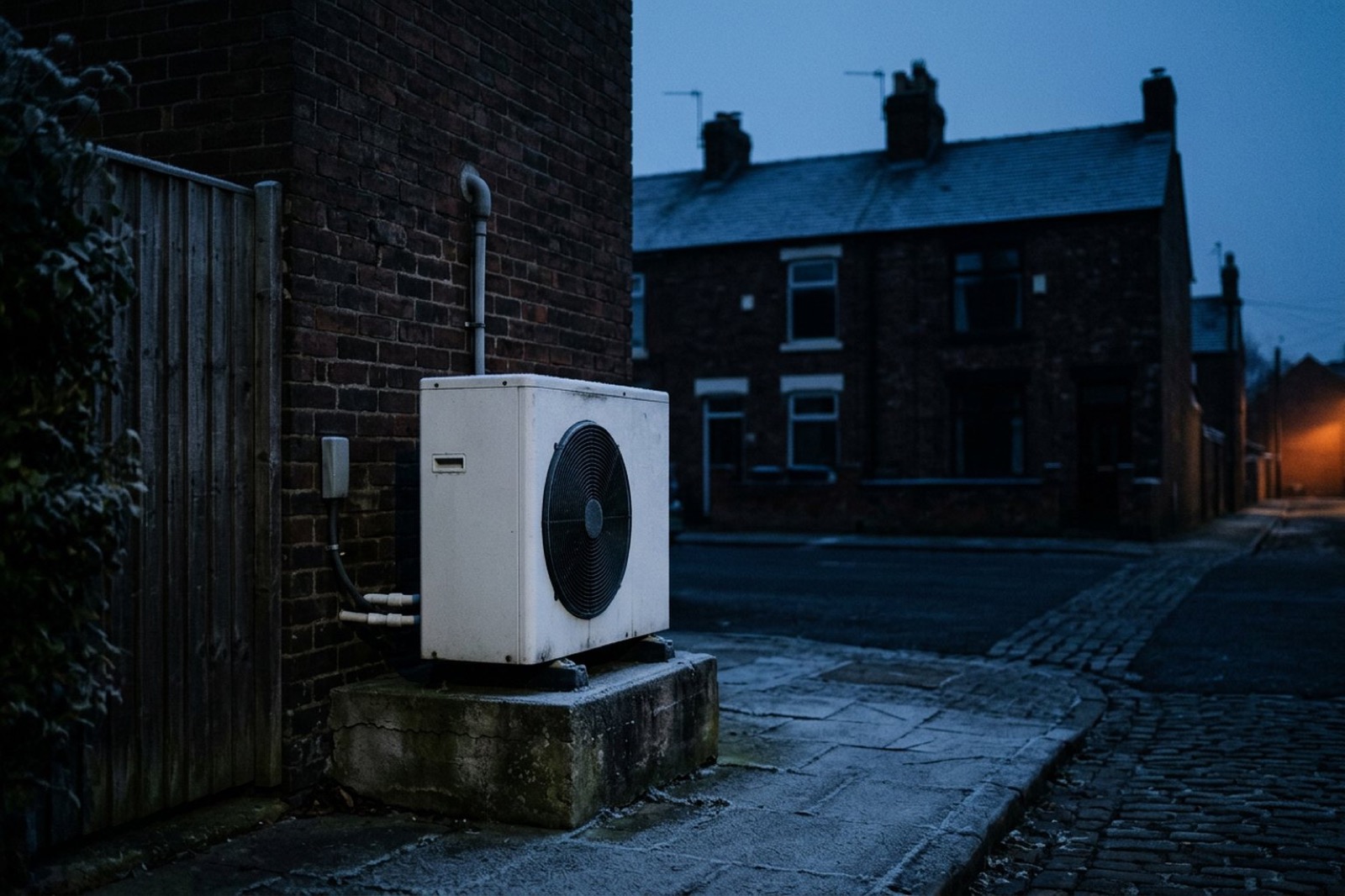
An air source heat pump runs on electricity. The outdoor unit has a compressor and a fan, the heating water is moved by a circulating pump, and the controls need power too. When the supply fails, all of that stops. The government’s Be Ready campaign says that gas ovens, boilers, heat pumps and your home internet will not work without power, and Citizens Advice says the same of heat pumps and electric storage heaters.
Be Ready says most power cuts are short-lived and local, although longer ones can happen and could potentially last several days. It is sensible to know what you would do in a long one.
Does a gas boiler keep working in a power cut?
Usually not, even though the gas keeps flowing. SGN, a gas network, says your gas supply and meters should continue as normal, but your boiler may not work as most boilers use electricity. Citizens Advice puts it more directly: most gas boilers need electricity to start, so you may not have any heating during a power cut. If you are unsure, it suggests contacting the manufacturer or a Gas Safe engineer. powercut105.com carries the same warning for gas boilers, hobs and heat pumps.
| In a power cut | Typical gas boiler | Heat pump |
|---|---|---|
| Does it heat your home? | Usually not: most boilers need electricity | No |
| Does the fuel supply carry on? | Yes, the gas supply should continue | Not applicable: the “fuel” is the electricity itself |
| Does it restart on its own? | SGN says it should begin to work when electricity is restored | Check your model’s manual (see below) |
So on the headline question a heat pump is no worse than most gas boilers, though “most” is not all, so check yours. The difference shows up in the details below: frost protection, and the electrical load a backup supply would carry.
How long will the house stay warm?
There is no honest single answer, and we found no sourced figure in hours that applies to every home. What we can say is what decides it.
- Heat loss. The MCS heat load calculator explains that a building loses heat through its fabric (walls, floors, ceilings, windows and doors) and through air leakage and ventilation. Each element’s loss depends on its U-value, its area and the temperature difference across it, and the lower the U-value, the slower heat passes through.
- Thermal mass. The Australian Government’s YourHome guide defines thermal mass as the ability of a material to absorb, store and release heat, and says heavyweight materials such as concrete, brick and stone have high thermal mass, while timber frames have low. It also says thermal mass needs to be combined with other design principles, such as insulation, to be effective.
- How warm it was when the power failed. General explanation, not a sourced figure: a house that was already up to temperature has more heat stored in its walls and floors to give back than one that was running at a setback temperature.
Our own reasoning from those two sources, not a measured result: a heavy, well-insulated house starting warm will generally hold its heat for longer than a light, draughty one starting cool, whatever heats it. Our guide to insulation and heat pumps covers what slows heat loss.
What about hot water?
If your hot water is stored in a cylinder, the water already in it does not vanish when the power goes. General explanation, not a sourced figure: an insulated cylinder loses heat at a finite rate, so stored water cools gradually, not all at once. The MCS design standard (MIS 3005-D) refers to a cylinder’s “standing heat loss” when it sets insulation requirements for reused cylinders. We are not giving a time, because it depends on the cylinder and how full of hot water it was.
Two cautions. First, once the stored hot water has been used, it will not be reheated until the power is back, whether by the heat pump or by any electric heater fitted. Second, Be Ready warns that your mains water supply could be disrupted during and after power cuts. Our guide to heat pumps and hot water explains how hot water is provided. Ask your installer exactly how yours is provided and what that means in a power cut.
Frost protection in a long winter power cut
This is the point where heat pumps differ from boilers, and it is worth understanding before winter. The manuals below describe a freezing risk to the outdoor part of the system if power fails in winter, and the heat pumps they cover have a frost protection function. What each manual says depends on the model:
- Grant (Aerona³). Its user instructions say that if the electrical supply to the heat pump is switched off, for example at the external isolator, the frost protection function will not operate. Its installer manual recommends a thermal fluid to protect the outdoor part of the system against freezing in the event of a power failure in the winter months.
- Vaillant (aroTHERM plus). Its manual says that if the primary heating circuit is filled with a water and frost protection mixture, the outdoor unit is protected against freezing even in a power cut. Without that separation, it says to keep the product switched on, and if you cannot ensure it keeps running, to have a competent person drain the installation.
- Warmflow (A-Series R290). Its installation guide says that in a power failure the freeze protection function is compromised, so alternative measures must be put in place at installation. It names a thermal fluid or antifreeze valves as examples.
These three are manuals we read, not the only options, and your unit may differ. The lesson is the same: ask your installer which frost protection your system has, whether it still works without power, and what you should do in a long freeze. Our guide to your first winter with a heat pump covers the other cold-weather questions, and the defrost cycle explains the vapour and ice you may see on the unit.
What happens when the power comes back?
We cannot say that every heat pump restarts the same way, and we found no neutral source that does. These are statements from specific manuals, not general rules, so go by yours:
- A delay. Grant’s installer manual says the heat pump may take up to seven minutes after a demand because it runs the circulating pump and checks the water temperature first, and that the compressor is not turned on during a 3 minute off-to-on waiting time.
- The controls may need resetting. On Grant’s remote controller, the day and time blink after a power cut, which means the time must be reset.
- If it will not start, Vaillant says to check whether the power supply is interrupted and to switch on the disconnectors to which the product is connected, then contact a competent person if that does not work.
Can a battery or generator run a heat pump?
Possibly, but it is a design question for an electrician and your installer, and we are not giving sizes here, because none can be stated safely for a home we have not surveyed.
Battery. Be Ready says that if you have solar panels and a battery storage system with power backup capability, some installations can continue to provide power during a power cut if they are designed and configured to operate independently of the electricity grid. That is conditional wording, so do not assume yours does. A heat pump is a much larger electrical load than a router or lights, so ask whether your backup circuit was designed to include it. See our guides to heat pumps and solar panels and home battery safety.
Starting current. The Warmflow A-Series R290 installation guide says its inverter-driven units ramp up slowly and so do not need the large starting current that fixed-speed appliances do, and that in the majority of situations the starting current will be less than 1 amp. The same guide rates its three models at 14, 25 and 35 amps. Our reasoning: that contrast is why the model matters for any backup supply, so ask the maker of your unit for its running and starting figures.
Generator. The Health and Safety Executive for Northern Ireland (a separate body from the Health and Safety Executive in Great Britain) gives this safety advice:
- Carbon monoxide from generators is colourless and odourless, so you will not know it is there. Do not use a generator indoors or in partially enclosed spaces, including homes and garages, even with partial ventilation.
- Connecting a generator to your home could cause a surge in electricity that might result in injury or death.
- Do not overload a generator: limit the wattage of connected equipment to the allowable loading in the instruction manual.
- Install battery-powered carbon monoxide alarms inside your home.
Our own advice, not HSE Northern Ireland’s: any backup supply to a heat pump is a job for a qualified electrician.
Who do you call, and how do you keep warm?
Report it. Be Ready says to visit your local network operator’s website to report a power cut and track updates, and if you cannot report it online, to call 105, which is free in England, Wales and Scotland. powercut105.com adds that the quickest way to report is online, and that your network operator is different from your energy supplier. Write the number down, because mobile and internet access may fail. Call your installer only if the unit shows a fault or will not restart once the power is back.
Keeping warm. Be Ready suggests blankets and layered clothing, closing the doors of unused rooms and closing the curtains. It says older adults, babies and young children and people with long-term health problems are most likely to become ill if they get too cold. Citizens Advice adds planning whether it would be warmer to stay with a friend or family member, and checking your council for “warm spaces” such as libraries. If you may need extra support during a power cut, the Priority Services Register is free, and Be Ready says lots of households are eligible.
If you smell gas or suspect carbon monoxide, SGN says to call the National Gas Emergency Service (0800 111 999) immediately.
What to ask an installer, and where ByEco stands
Whoever fits your heat pump, a good handover should cover this. Ask:
- How is my system protected from freezing, and does that protection still work if the power is off?
- Should I ever switch the heat pump off at the isolator in winter, and what do I do in a long freeze?
- What happens when the power returns: does the unit restart by itself, and which settings (such as the clock or schedule) might I need to check?
- How is my hot water provided, and what happens to it in a power cut?
- Could a battery or generator run the heat pump, what would that involve, and who would do the electrical work safely?
- What are the unit’s running and starting current figures?
We are MCS certified for air source heat pump installation (certificate IAA10330), and we apply for the £7,500 Boiler Upgrade Scheme grant on your behalf. We do not make promises about your system’s power cut behaviour before we have seen your home: the answers depend on the heat pump, the controls and how it is installed, and we would go through them with you. You can ask these questions at a free survey. Find out more about our air source heat pump service, see heat pump installation in Manchester, or book a free survey.
Sources
Every figure on this page was checked against primary sources on 4 November 2026. Grant rules, planning rules and prices change — if you are reading this much later, verify before acting.
- GOV.UK Be Ready campaign — Power cuts
- Power Cut 105 — Find your electricity network operator
- Citizens Advice — Prepare for a power cut (England; page last reviewed 14 November 2023)
- SGN — Power cuts
- Health and Safety Executive for Northern Ireland — Safety tips: using a portable generator in an emergency
- MCS — Heat Load Calculator: understanding heat loss
- Australian Government — YourHome: thermal mass
- MCS — MIS 3005-D The Heat Pump Design Standard, Issue 3.0
- Grant UK — Aerona³ air to water heat pump range: user instructions (DOC 0112 rev 11)
- Grant UK — Aerona³ R32 heat pump installation and servicing instructions (DOC 0136 rev 2.4)
- Vaillant — aroTHERM plus VWL 35/6 to 75/6 A S2 operating and installation instructions
- Warmflow — A-Series AS01/AS02/AS03-R290 air source heat pump installation guide
Book your free home survey
Every home is different. The cost depends on the size of system, any radiators that need upgrading, the pipework and where the outdoor unit goes. Get in touch and we will arrange a free survey of your home and give you a clear quote. If you are happy with it, we can go ahead.